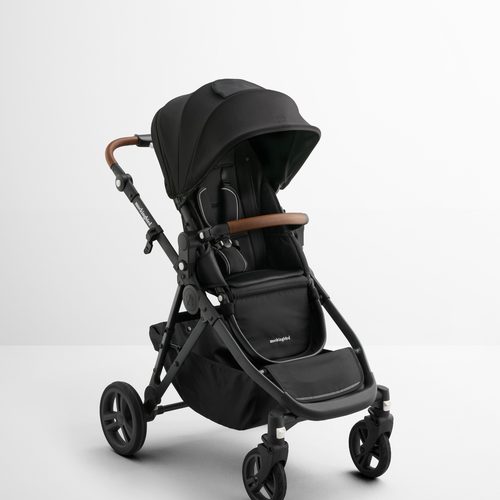
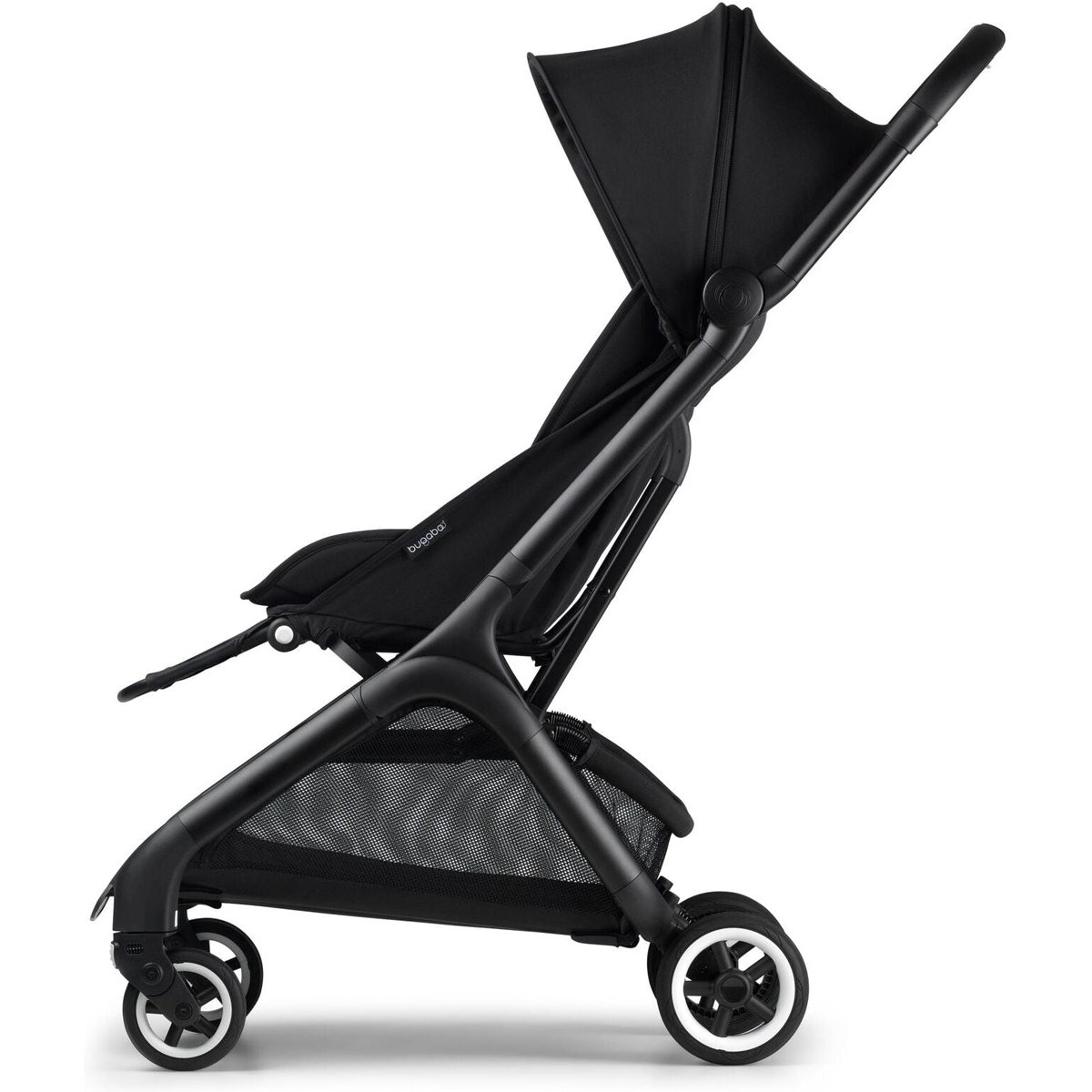
 The Butterfly in Midnight Black (brand photo)
Travel & On the Go · Check #281
Is the Bugaboo Butterfly worth it?
Bugaboo Butterfly
The one-second, one-hand fold is real — BabyGearLab measured the fold at 17.5 × 9 × 21.3 in, inside IATA’s cabin guideline — but it still fails the US 22 × 14 × 9 in sizer on width, the seat is 6 months+ with no bassinet (newborn use costs $69.95 in adapters), and at $549 list the lay-flat, from-birth Butterfly 2 sits just $50 away while this model clears at $384.30.
See current price ↗The pitch
A one-second, one-hand fold into an IATA-guideline-size package (17.72 × 9.06 × 21.26 in) at 16.09 lbs, with a tall ergonomic seat, a 17.64 lb-rated basket, a UPF 50+ four-panel canopy, and the rain cover, carry strap and seat inlay included in the box
The catch
The fold fails the US 22 × 14 × 9 in carry-on sizer on width (17.72 in vs 14 in), so overhead stowage is likely but never guaranteed; the seat is 6 months+ only — 143° near-flat, not lay-flat, no bassinet — and the fully kitted cost at list reaches $743.85
FSA/HSA
not eligible — a general-purpose stroller is a personal item, not a qualified medical expense
What it is
Bugaboo’s premium ultra-compact travel stroller — a forward-facing, one-hand-fold stroller built around a genuinely tiny fold, sold as a complete package: chassis with wheels, seat fabrics and four-panel canopy, padded seat inlay, integrated leg rest, carry strap and a rain cover are all in the box. The hard specs: 16.09 lbs (7.3 kg), seat rated 6 months to approx. 4 years (max 48.5 lbs on Bugaboo’s spec sheet; some retailer copy rounds this to 50 lbs), underseat basket rated to 17.64 lbs (8 kg), small wheels (4.7 in front, 6 in rear), a fixed-height 40.31 in handlebar, and a one-hand seat recline Bugaboo specifies at 30°–143°. It is a city-and-airport stroller, not an all-terrain one, and in the US it has now been superseded by the Butterfly 2 — which matters to the price story, because original-model stock is being cleared. This check covers the original Butterfly, not the $599 Butterfly 2.
Claims vs. reality
“One-second, one-hand fold”: holds up. BabyGearLab calls it “a true one-handed fold-and-unfold process” that automatically locks and self-stands, folds in thirds and deploys with a quick arm flick, with one of the highest ease-of-use results in its travel group; owners name the fold the single most praised feature. The asterisks: no independent stopwatch test of the literal second was found, and a minority of new owners report stiff unlock buttons and a short learning curve. “IATA-compatible / fits overhead”: true against IATA’s guideline, false against the US sizer. Bugaboo’s folded spec is 17.72 × 9.06 × 21.26 in, and BabyGearLab measured 17.5 × 9 × 21.3 in (3,355 in³) — essentially identical. Against IATA’s cabin-bag guideline (56 × 45 × 25 cm) the fold passes on every axis, the 45 cm width exactly at the limit. Against the standard 22 × 14 × 9 in US carry-on sizer it fails on two axes: the 17.72 in width is 3.72 in too wide for the 14 in axis, and the 9.06 in depth is 0.06 in over. Owners still stow it overhead routinely, because a bin is not a sizer box — but as check #271 established, IATA does not certify strollers and no airline approves a model, so fly it with a gate-check plan. “Lightweight”: the 16 lbs BabyGearLab weighed is honest, but above its travel-group average of 15 lbs; the weight buys top-of-group build quality. Recline and newborn readiness: the 143° recline is “near-flat,” not lay-flat — Bugaboo’s own Butterfly 2 comparison lists the original seat as having “no fully upright or lay-flat recline.” The seat starts at 6 months, no bassinet is offered for this model, and the only newborn route is an infant car seat on adapters sold separately at $69.95. Basket and canopy: the 17.64 lb basket rating is best-in-class on paper, but BabyGearLab fit its large diaper bag only as “a squeeze”; the UPF 50+ canopy’s zip-out panel is a large mesh panel rather than a true peekaboo window — the original’s most-criticized design point, redesigned on the Butterfly 2.
Safety & recalls
No CPSC recall names the Bugaboo Butterfly (checked Nov 1, 2026). Bugaboo the brand has recall history on other models — Bee brakes (2009) and swivel wheels (2011), Cameleon/Donkey carry handles (2013), and a Dragonfly seat recall alert (2024) — none of which involves the Butterfly or transfers to it. US-sold strollers are subject to the mandatory ASTM F833 standard (16 CFR 1227). The safety pattern owners actually report is stability, not defects: the rear wheelbase is narrow by design (it is how the fold gets so small), and a minority of owners report the stroller tipping onto two wheels during sharp course corrections or feeling tippy with weight hung off it — one collected parent review reports repeated tipping, most owners report none. Treat it like the compact it is: both hands for sharp turns on slopes, and nothing heavy hung from the handlebar.
Real reviews — what owners say
Nordstrom’s owner pool rates the original Butterfly 4.6/5 across 211 reviews. BabyGearLab — the independent lab test in this category — made it a tester favorite, top-tier on quality and ease of use, while scoring maneuverability only above-average: the small wheels struggle with tall curbs and path lips and are weak on grass and gravel, a pattern collected parent reviews echo (excellent on flat ground, rough feedback on loose surfaces). The long-term record is unusually good for a travel stroller: owner threads include running it as a daily stroller for almost four years across two kids, and resale is strong (one owner reports selling at $200 after 2.5 years of heavy travel). The recurring complaints are consistent and specific: the fixed, non-adjustable handlebar; frame finishes that scratch easily; the canopy bulging when folded; a slight rattle on some units; stiff fold buttons on a minority; and the thin, minimally padded leg rest. New York Post coverage of the line is affiliate commerce writing — flagged as sponsored-style content and not relied on.
Price & FSA/HSA
$549.00 list is the original Butterfly’s US price at Amazon (tracker record: current $549.00, average $448.50, lowest $384.30) and at full-price retailers — several of which now show it sold out, because the Butterfly 2 ($599 at bugaboo.com) has replaced it. New original-model stock was already clearing at $384.30 at Albee Baby at check time, and at clearance money the math changes. The box genuinely includes the rain cover, carry strap, seat inlay and leg rest — more than most rivals include — but the add-ons are all separate: car seat adapters $69.95 (required for any newborn use), bumper bar $54.95, transport bag $69.95. Newborn-ready at list is $618.95 before the car seat itself; fully kitted, $743.85. Strollers are not FSA/HSA eligible — a general-purpose stroller is a personal item, not a qualified medical expense under IRS rules, and FSA/HSA baby-item guidance lists strollers among the items that do not qualify.
The one-second, one-hand fold is real — BabyGearLab measured the fold at 17.5 × 9 × 21.3 in, inside IATA’s cabin guideline — but it still fails the US 22 × 14 × 9 in sizer on width, the seat is 6 months+ with no bassinet (newborn use costs $69.95 in adapters), and at $549 list the lay-flat, from-birth Butterfly 2 sits just $50 away while this model clears at $384.30. Worth It If…