
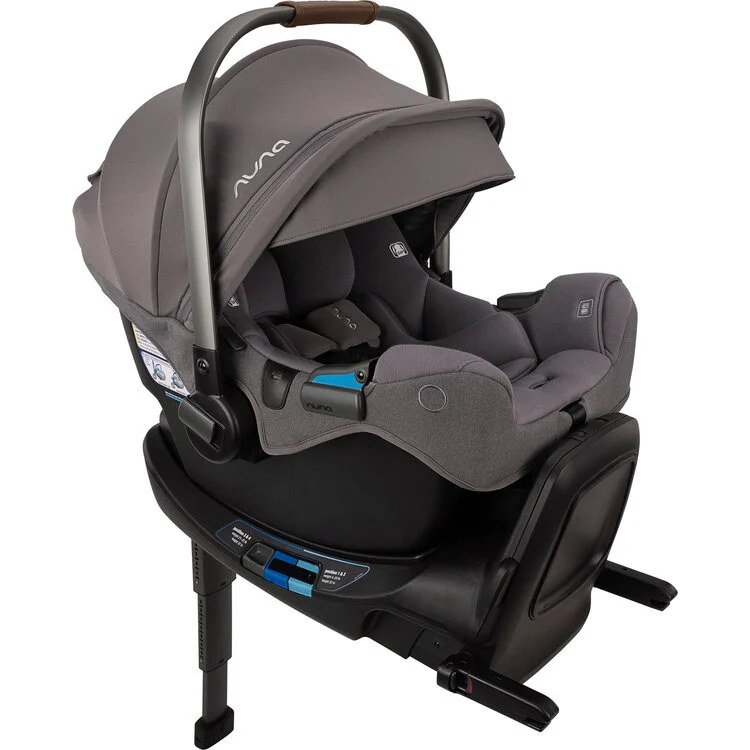
 The PIPA rx carrier on its RELX base — rigid LATCH, a steel stability leg and an anti-rebound panel under the canopy Nuna is known for
Infant car seat · Check #28 — from the overnight review list
Nuna PIPA rx Infant Car Seat + RELX Base
Worth It If… maximizing measured crash margin and minimizing install error is the priority and the budget absorbs $550 — the best crash-test margin in its class, with top install scores by every method.
See current price ↗The pitch
the best measured crash margin in its class — BabyGearLab’s Best Overall, 86/100, Crash 9.0/10 — over a “5-second” True lock install
The catch
the most expensive infant seat at $550, a rethread harness at that price, $250 for a second base — and the current label reads 4–30 lbs / 30″, not the 4–32 / 32″ in the manuals
FSA/HSA
not eligible — car seats don’t qualify as medical care under IRS rules
What it is — a rear-facing-only carrier plus the RELX base
A rear-facing-only infant car seat — carrier plus stay-in-car RELX base. Nuna’s current page lists the PIPA series at 4–30 lbs, 16–30″ — older manuals and test labs list 4–32 lbs / up to 32″ (see the limits check below). Carrier 7.6 lbs by brand spec, without canopy or insert; about 8–8.5 lbs as actually carried (BabyGearLab measured 8.5) — still among the lightest full-featured carriers. In the box: carrier, RELX base, latch guides, and a two-piece infant insert + head support (insert out at ~11 lbs). The RELX base: steel-reinforced True lock rigid LATCH with green indicators, a locking 3-piece steel stability (load) leg with a crumple zone, an anti-rebound panel, a built-in belt lock-off, and a 4-position on-the-go recline. The carrier installs baseless with European belt routing, has Side Impact Protection, and the canopy system Nuna is known for: UPF 50+ with flip-out eyeshade, mesh peek-a-boo window and the magnetic Sky drape. Clicks onto all Nuna strollers and many other brands’ with adapters. FAA-certified with or without the base, GREENGUARD Gold, flame-retardant-free fabrics, 7-year expiration.
Claim vs. reality — “5-second install”
“5-second True lock install”
The 5 seconds is marketing rounding — the substance underneath is confirmed, and it is this seat’s second headline strength. BabyGearLab scored LATCH install 8.5/10, belt install 8.5/10, install without base 9.0/10 — top marks by every method, where check #27’s Mesa V3 is a LATCH-only story. Babylist’s CPST editor got the base in by LATCH in about 30 seconds, by belt or baseless in under a minute. CSFTL’s CPST review confirms the RELX redesign fixed the original PIPA base’s real problems: the confusing bubble recline indicator is gone, the lock-off no longer bunches the belt, and the stability leg now has a position that fits middle seats. Correct installation is the common real-world failure mode for infant seats — a base a tired parent can verifiably install tight, by whichever method the seating position forces, is a safety feature, not a convenience extra.
Claim vs. reality — the crash-test margin behind the price
The safest seat in its class
On the instrumented evidence, this is the rare premium claim that survives testing. In BabyGearLab’s faster, instrumented sled-test analysis (MGA Research data), the PIPA RX scored 86/100 overall — Best Overall Infant Car Seat — with Crash Test 9.0/10, its head (HIC) and chest sensor results “much lower (lower is better)… than in any seat we’ve ever tested.” And unlike the Mesa V3 in check #27, the full premium hardware set is here: rigid LATCH, a load leg and an anti-rebound panel in one base. Price context inside the same program: Romer Juni Crash 8.8 at $400, Britax Willow S 7.8 at $280, Graco SnugRide Lite LX 7.4 at $140, Joie Rue 7.2 at $170 — and the Mesa V3 5.1 at $349.99. The honest limit is the same as everywhere in this library: one lab’s commissioned analysis; every seat here passes the federal FMVSS 213 bar and is presumed safe when correctly installed — no seat makes a correctly installed cheaper seat unsafe.
Claim vs. reality — the limits on the label
Rated to 4–32 lbs and 32 inches
Check the label on the seat you actually buy — Nuna’s own numbers no longer agree, and the direction is down. Nuna’s current product page and current retailer spec tables list 4–30 lbs / up to 30″ for the rx, while the manual generation, CSFTL and BabyGearLab list 4–32 lbs / 32″ — and Babylist’s main review says 4–32 / 32″ while its own three-across guide lists both numbers for the same seat. It mirrors check #27, where the Mesa V3 quietly dropped from 35 lbs to 30 lbs. The practical effect either way is small — most babies outgrow an infant carrier by height or by the 1″-from-the-shell-top rule first, roughly the first 9–12 months — but the label and manual that ship with the individual seat control. Don’t buy older stock expecting either set of numbers.
Claim vs. reality — the harness, at $550
A flagship in every detail
One spec does not belong at this price: the harness rethreads. To move the harness height you take the baby out, pull the straps off the splitter plate at the back, and rethread them through the next of 3 slots. BabyGearLab lists it first among its cons — “a disappointment, given the price” — and Babylist, MommyHood101 and Safe in the Seat all flag the same point. Check #27’s $349.99 Mesa V3 has a 25-position no-rethread headrest. Babylist’s CPST offers the fair counterpoint: rethread systems can give a finer fit, and the adjustment happens only a few times in the seat’s life. Both are true — the finding is narrower: at $550, buyers are entitled to expect the no-rethread convenience cheaper seats already include. Same fine-print pattern on weight: the “7.6-lb lightweight carrier” excludes canopy and insert — as carried it is ~8–8.5 lbs, still genuinely light, but comparison-shop on as-used weights.
Safety & recalls — no PIPA rx recall found
No US recall of the PIPA rx found (checked Oct 17, 2026) — no CPSC or NHTSA recall naming the PIPA rx or the RELX base. Keep the brand’s real actions separate from this seat: NHTSA recall 24C-002 covers about 608,786 RAVA convertible seats (manufactured Jul 2016–Oct 2023) whose plastic harness adjuster can let in debris so the harness may not stay tight — the RAVA is a convertible, not a PIPA; and a 2024 NHTSA compliance investigation (AQ24-002) looked at the discontinued PIPA lite / lite r, not the rx. A search-surfaced claim of a late-2024 “RELX base recall” has no NHTSA, CPSC or Nuna source behind it. Register the seat, check the white manufacture/expiration label (7 years), and run model + date through NHTSA before first use. Fit rules: some vehicles forbid load legs (stow-and-go floors, underfloor storage) — check the vehicle manual; don’t use the Sky drape in full sun, it raises the temperature around the baby; keep baby rear-facing to the limits, harness at or below the shoulders, chest clip at armpit level. A car seat is never a sleep space — move a sleeping baby to a flat, firm crib on arrival.
What owners say — the consensus top seat
Editorially this is the consensus top infant seat of its generation, and the owner signal matches. Babylist: Best Infant Car Seat Overall in its 2026 Most Loved survey — Nuna was the favorite infant-seat brand for 25% of surveyed families, nearly half of Nuna choosers named the Pipa Rx specifically, and it was the third most registered infant seat on Babylist in 2024. MommyHood101 praises the rigid-LATCH install and the fit-and-finish (its price line still reads “about $300” — a stale figure from an earlier price generation). Retail pools are boutique-sized because Nuna doesn’t sell this seat through a canonical Amazon listing: Albee Baby runs 151 reviews at $550; Baby Cubby 4.9/5 across 12. Praise is consistent: installs tight the first time by any method; genuinely light to carry; excellent fit for preemies and small newborns; the silent magnetic Sky drape; cross-brand stroller freedom. Complaints: (1) price — the most expensive mainstream infant seat in BabyGearLab’s group, and some Nordstrom owners call the canopy material “stretchy and thin”; (2) the rethread harness; (3) front-to-back length — a longer seat, not the pick for three-across in a compact car; (4) an “annoying” handle/stroller release (BabyGearLab); (5) tricky to clean (Babylist). No pattern of structural, harness or base failures surfaced.
The money math & FSA/HSA
$550.00 is the current US price, unanimous across Albee Baby, Nordstrom, Babylist Shop, Baby Cubby and BabyGearLab’s list. One flag: nunababy.com’s own structured data showed $409.99 and OutOfStock at check time — a figure no retailer corroborates; treat $550 as the price. The price history is part of the story: the rx launched around $379.95 in 2020 and has climbed to $550, so older “about $300–$400” reviews describe a cheaper seat’s price. A second RELX base is $250.00 (up from its $199.95 launch price) — a two-car PIPA rx setup is $800 before a stroller adapter or the convertible seat still to buy within the year. Over a typical ~9–12-month carrier window that is roughly $46–$61 a month. Nuna rarely discounts outside major holiday events; registry completion discounts are the realistic way to pay less. The 7-year expiration can cover siblings — the strongest version of the value case.
FSA/HSA: not eligible — car seats are required safety equipment but do not qualify as medical care under IRS rules.
Sources: nunababy.com PIPA rx product page (PIPA series recommended use 4–30 lbs / 16–30″; True lock rigid LATCH, stability leg with crumple zone, anti-rebound panel, 4-position on-the-go recline; UPF 50+ canopy with Sky drape; FAA-certified with or without base; structured-data price $409.99 / OutOfStock at check time — uncorroborated) and RELX base page ($250.00 standalone) · babygearlab.com infant car seat program and PIPA RX review (Best Overall, 86/100; Crash 9.0/10 with the lowest head and chest sensor readings it has recorded; LATCH 8.5, belt 8.5, baseless 9.0; $550 list; 4–32 lbs / 32″ spec table; carrier measured 8.5 lbs; rethread harness and handle release as cons; Romer Juni 8.8 at $400, Britax Willow S 7.8 at $280, Joie Rue 7.2 at $170, Graco SnugRide Lite LX 7.4 at $140 in the same program) · babylist.com PIPA rx review and Most Loved survey (Best Infant Car Seat Overall; CPST editor’s ~30-second LATCH install; Nuna the favorite brand for 25% of families; longer front-to-back and tricky-to-clean cons) · csftl.org PIPA rx + RELX review (CPST; 4–32 lbs / under 32″; carrier 8 lbs as-weighed; insert out at 11 lbs; RELX fixes over the original base) · mommyhood101.com infant car seat rankings (rigid-LATCH ease and fit-and-finish praised; rethread harness the named downfall; stale “about $300” price line) · albeebaby.com PIPA rx listings ($550.00; current tech specs 4–30 lbs / up to 30″ alongside a 4–32 lbs specifications block — the variance flagged) · NHTSA recall records (24C-002 covers ~608,786 RAVA convertibles, 2016–2023 — not the PIPA rx; AQ24-002 investigation covered the PIPA lite / lite r; no PIPA rx recall found — checked Oct 17, 2026). Check #28 — from the overnight review list, checked October 17, 2026. Some links on this page may earn WorthItMama an affiliate commission — it never changes the answer.
Worth It If… maximizing measured crash margin and minimizing install error is the priority and the budget absorbs $550 — otherwise cheaper seats in the same test program (Britax Willow S $280, Joie Rue $170, Graco SnugRide Lite LX $140) buy a solid margin for far less.