
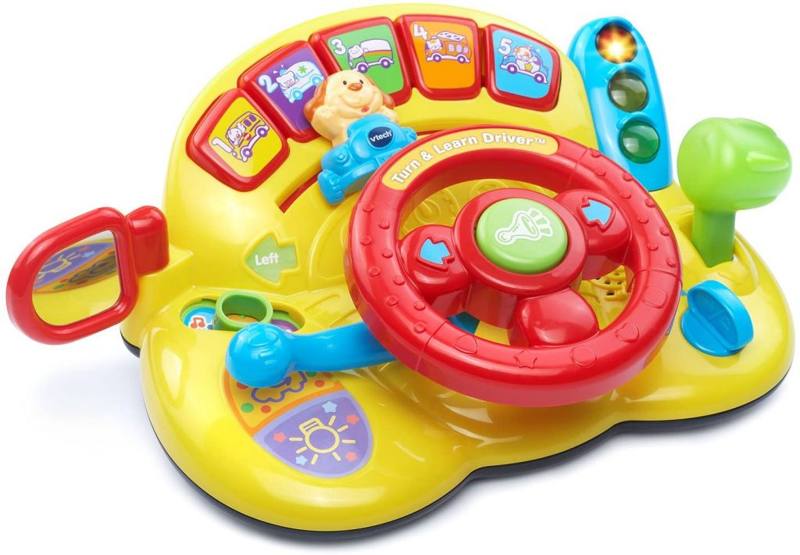
 The Turn and Learn Driver — a lap-sized pretend dashboard: wheel, horn, five numbered buttons, traffic light, gear shifter and signal lever
Play & Soothe · Check #191 — Batches 11–15
VTech Turn and Learn Driver
A durable pretend-driving dashboard — turning wheel with a shuttling dog, five numbered buttons, horn with traffic lights, gear shifter and signal lever across Animal/Driving/Music modes — with a strong owner file (Target 4.6/5, 798 reviews, 90% recommend), sold on a 'learning' claim that is really vocabulary exposure: the JAMA Pediatrics evidence says electronic toys earn language value only when an adult talks…
See current price ↗The pitch
“Drive into learning fun” — 60+ songs, melodies, sounds and phrases; three modes (Animal, Driving, Music); animals, vehicles, numbers and opposites through pretend driving, for ages 6–36 months
The catch
the 60+ count is songs + melodies + sounds + phrases combined, the wheel does not spin full-circle, both volume levels strike some parents as too loud for a baby, and no study shows this toy — or any electronic toy — teaching words on its own
FSA/HSA
not eligible — a toy, not a medical expense
What it is
A battery-powered pretend-driving dashboard from VTech, model 80-166600, pinned in its yellow version (Amazon ASIN B00Y53V80E, on the market since 2015) — not VTech’s newer screen-based Race & Learn / Race and Discover Driver, a different and pricier toy. The unit is lap-sized — 8.86 × 10.79 × 4.33 inches, about 1.4 lb — and everything is worked from the front: a red steering wheel whose turning shuttles a small dog character back and forth, a green horn button in the wheel’s centre linked to a red/yellow/green traffic light, five colourful numbered buttons across the top that introduce animals and vehicles, a gear shifter that pushes forward and pulls back, a signal lever for left and right, and a small side mirror. A mode slider selects three play modes — Animal, Driving and Music — and the on/off switch doubles as the volume control, with low and high settings only. Power is 2 AA batteries (a demo set is included; VTech says fit fresh batteries for regular use), the battery compartment opens with a screwdriver, and the manual’s automatic shut-off powers the unit down after roughly 50 seconds without input — press any button to wake it. Rated 6–36 months.
Claims vs. reality
“60+ songs” — READ THE FULL PHRASE. VTech’s own wording is “60+ songs, melodies, sounds and phrases” — one combined count of everything the toy can emit, not 60 songs. Retailer copy that shortens it to “60+ songs and phrases” inflates it further. The library of sounds is still genuinely varied for the price — animal and vehicle sounds, driving phrases and melodies including “Row, Row, Row Your Boat” — but a parent picturing an hour of distinct music is picturing a different product.
“Drives learning” (animals, vehicles, numbers, opposites, directions) — THE EXPOSURE IS REAL; THE LEARNING OUTCOME IS NOT THE TOY’S TO CLAIM. The content is all physically there: the five buttons are numbered and picture animals/vehicles, the gear shifter’s push/pull is paired with opposites, the signal lever names left and right, and the horn cycles the traffic-light colours. That is vocabulary exposure and cause-and-effect practice, and it verifies as far as it goes. What no source supports is that the toy teaches these things by itself: in the controlled JAMA Pediatrics study of toy type and parent–infant communication (Sosa, 2015; 26 parent–infant pairs, babies 10–16 months), play with electronic toys that produce lights, words and songs was associated with fewer adult words, fewer conversational turns, fewer parental responses and fewer content-specific words than play with books or traditional toys, and babies vocalised less than with books. The study did not test this VTech model specifically — it tests the category claim. Practical ruling: the Driver earns its “learning” label when an adult narrates along (“red light — stop!”); used as a solo entertainer, it is a sound machine with a steering wheel, priced accordingly.
The wheel — IT TURNS, IT DOES NOT SPIN. The steering wheel rotates through a limited left–right arc and moves the dog character as it goes; it does not rotate 360°. Most toddlers never mind — the arc is where the sounds and the dog’s movement live — but the expectation gap is a named complaint (“Wheel doesn’t turn 360 degrees; this can be frustrating to the kiddo… find something simpler,” Target, June 2026; steering-wheel roundups list the same limit as the toy’s standing con). Know it before you buy, especially for a car-obsessed two-year-old who will test exactly that.
Volume — TWO SETTINGS, AND “LOW” IS NOT QUIET. The only control is the low/high on-off/volume switch, and volume is the toy’s most consistent complaint: Target reviewers call both settings too loud, one reporting the low setting scared their 6-month-old (June 2026), and one owner measured ~75 dB(A) on the lowest setting with a handheld meter and noted the control is easy for the baby to reach (Dec 2024). Context, stated precisely: that owner figure is not a lab measurement (distance and method unstated) and does not show a standards breach — the mandatory ASTM F963 acoustic cap for a toy of this type is 85 dB measured at 50 cm — but at lap distance, which is how this toy is actually used, “compliant” and “comfortable” are different things. Households that hate loud toys should hear this one before committing, or plan on the low setting plus distance.
“Ages 6–36 months” and engagement past week one — THE WINDOW IS REAL BUT NARROWER THAN THE BOX. The candidate question was whether toddlers stay engaged past the first week; the owner file says most do, inside a tighter window than 6–36. Target’s sub-scores put length of play at 4.45/5 and broad age appeal at 4.49/5; owners report babies playing from when they can sit up, toddlers playing until about age 3, siblings sharing it, and at least one grandparent buying it a generation later because the first one was a hit. The realistic arc: at 6–9 months it is mostly pressing, honking and lights (with the volume caveat at its sharpest); pretend driving peaks in the second year; by 3 most children have outgrown five buttons and three modes. A minority file calls it repetitive and smaller than expected and says interest faded fast — that minority is why this is a $20 toy to buy at $20, not a keepsake purchase.
Safety & recalls
No CPSC recall for the Turn and Learn Driver (model 80-166600) was found Oct 23, 2026. VTech has recalled other infant toys — in 2018, its Lights & Lullabies Travel Mobile (crib clamp could break) and Shake and Sing Elephant Rattle (ears could break off) — both different products with different model numbers; neither finding touches this model, and they are named here only so a “VTech recall” headline is not mistaken for one. The standing safety items are ordinary and in the manual: the battery compartment is secured with a screw (fit batteries with a screwdriver, tighten the cover, use only the recommended AA type, do not mix old and new or different types, remove exhausted batteries and remove batteries for long storage, never charge non-rechargeable cells). Sound: keep the toy at lap distance rather than against an ear and use the low setting for young babies (see the volume finding above). And a use note from the design itself: the Driver has no strap or mount — it is a floor/lap toy that slides off trays and laps, and in a car it is a loose object that will end up on the floorboards; it is not a car-seat attachment. Information only, not medical advice.
Real reviews — what owners say
The headline file is Target: 4.6/5 across 798 reviews, 90% would recommend, with sub-scores of ease of use 4.74/5, quality 4.62/5, value 4.52/5, broad age appeal 4.49/5 and length of play 4.45/5 (read Oct 23, 2026). Owner praise, in order: toddlers stay engaged for long stretches; the wheel, horn and gear shifter are satisfying to work; it holds up to everyday toddler handling; babies as young as 6 months can operate the buttons — recent verified reviews run from “my son can not stop playing with it” to a grandparent rebuying the toy they remembered from an older grandchild. Owner complaints, in order: (1) volume — both settings too loud for some babies, one 6-month-old reportedly scared by it; (2) the wheel’s limited arc (no 360° spin); (3) a minority finding it repetitive, small, or cheap-feeling, with interest fading quickly; (4) the usual electronic-toy tax — it eats attention in short, noisy bursts rather than quiet play. No Amazon aggregate is quoted: Amazon’s page refuses agent reads, so this check cites the Target file and the price records below rather than inventing a star count.
Price & FSA/HSA
Price note: Amazon’s page refused a live read, so the price is pinned from independent records, the standing method for this library: CamelCamelCamel’s record for ASIN B00Y53V80E shows Amazon at $22.99 (Apr 5, 2026), list $24.99, long-run average $22.96 — $22.99 is simply this toy’s normal Amazon price, not a deal. Target sells the identical driver for $19.99 (InStock), which is the buy price this check recommends; at either price the running cost is just AA batteries, softened by the ~50-second auto shut-off. The ladder: below, simple non-electronic steering-wheel toys (the B. toys driving wheel sits at ~$18–$20) trade the sounds for quiet; above, VTech’s own Race & Learn Driver is $29.99 at Target and adds a screen and racing games for older toddlers — a different toy for a different age, not an upgrade a 1-year-old needs. FSA/HSA: not eligible — a children’s toy is a personal expense, not a qualified medical expense.
A durable, genuinely replayable pretend-driving toy — a turning wheel that shuttles a little dog back and forth, five numbered buttons, a horn with traffic lights, a gear shifter and a signal lever, across Animal, Driving and Music modes — whose owner file is strong (Target 4.6/5 across 798 reviews, 90% would recommend, and a decade on the market since 2015). The conditions are the headline words: “learn” here means exposure to animal, vehicle, number and opposite words, not measured learning — the research on electronic toys says the language value arrives when an adult plays and talks along, not from the toy solo — the wheel turns through a limited arc rather than spinning 360°, and the two volume settings both read loud to a vocal minority of parents, one of whom measured ~75 dB(A) on the lowest setting. Worth it if you buy it at $20, for the roughly 9–30-month pretend-driving window, in a household that can live with a loud electronic toy.