
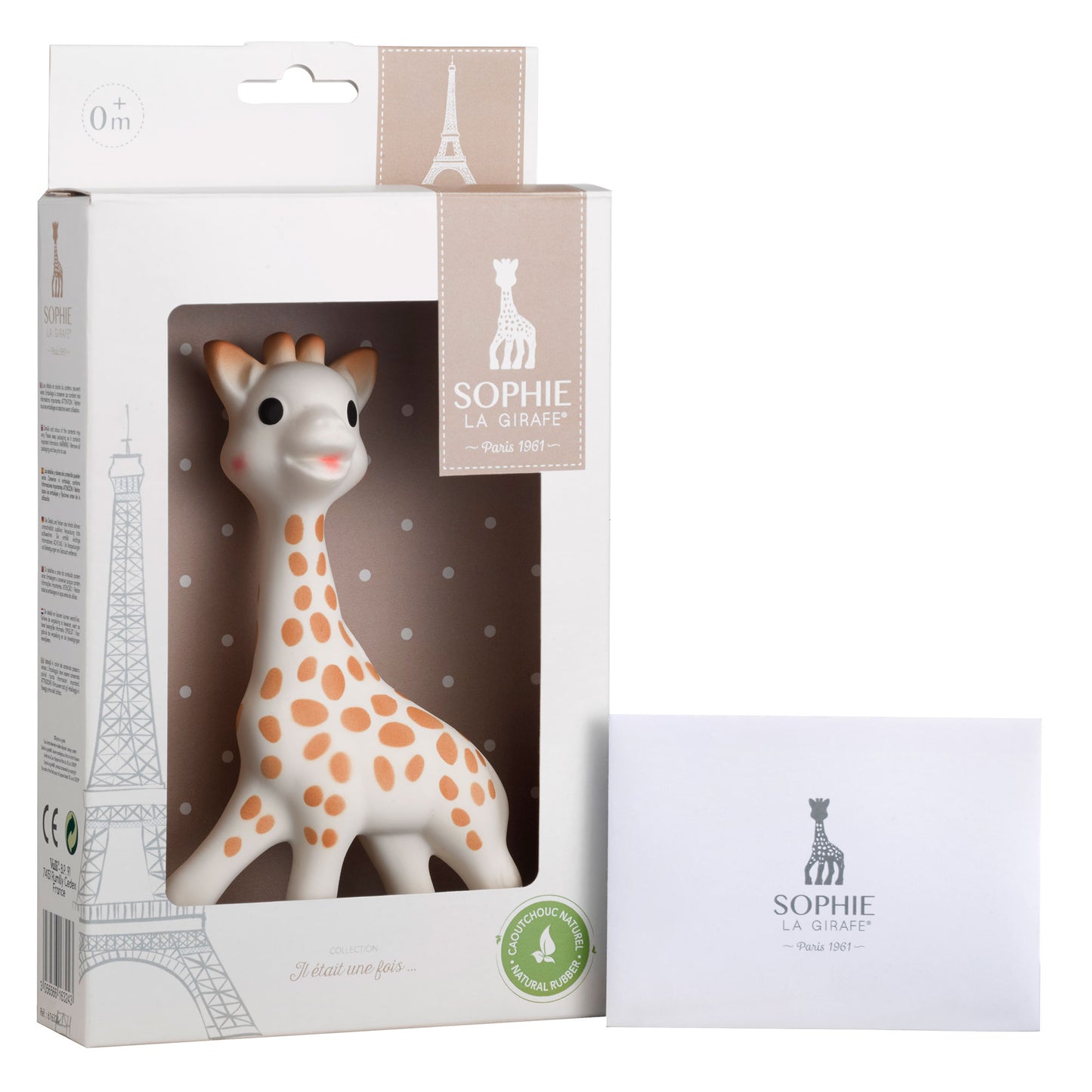
 Sophie in her gift box — the hollow 7-inch natural-rubber giraffe with the squeaker inside, unchanged in outline since 1961
Baby teether · Check #42 — from the overnight review list
Sophie la girafe Original Teether
The beloved natural-rubber teether babies grip and chew for real — worth it if you’ll wipe-clean only, inspect-and-discard once teeth arrive, and don’t need ‘Made in France’ to be literally true anymore.
See current price ↗The pitch
100% natural Hevea rubber and food-grade paint, a built-in squeaker and “all five senses” copy — sold since 1961 with 50–70+ million sold, and The Bump’s Overall Best Teething Toy
The catch
wipe-clean only — never boil, sterilise or submerge, because water trapped in the hollow body grows mould (the viral 2017 finding); inspect-and-discard once teeth arrive; and $31.99 is 3–6× a good silicone teether
FSA/HSA
not eligible — a baby teether/toy is standard consumer baby gear, not a medical expense
What it is — the 1961 original, hollow by design
A single hollow teether/toy in the shape of a giraffe: 7 inches / 18 cm tall, 2.4 oz (model 616400; Amazon ASIN B06XHNCJHV), made from 100% natural rubber derived from the latex of the Hevea tree and decorated with food-grade paint. Sold since 25 May 1961 — first in Paris, and from 1991 by Vulli of Rumilly, France — with 50–70+ million sold across six decades (older brand coverage cites over 50 million; current retailer copy cites over 70 million). The design is unchanged in outline: a long neck and four long legs sized for a small hand to grasp, ears, horns and legs as chew points that can reach toward the back gums, dark contrasting spots, a soft flexible body, the natural Hevea scent, and a built-in squeaker in the body that sounds when squeezed, with a small hole on the underside. Marketed from 0 months+. The brand’s own rules frame everything below: single-child use only — Sophie “is intended for use by only 1 child,” must not be shared, handed to a second baby or resold, like a toothbrush or pacifier nipple — and every Sophie produced since July 2011 carries a batch/traceability number on a leg, tested batch by batch by a certified laboratory. Not the smaller Sophie Teething Ring ($19.99 at Target), the So’Pure ring variants, the Sophie pacifier line, or the Janod Sophie Bead Maze — different products, flagged separately below where their records could be confused with this one.
Claims vs reality
“100% natural rubber and food-grade paint, BPA/phthalate-free, safe to chew”
The material claim is the product’s real foundation and is consistently supported: Vulli’s FAQ describes the rubber as Hevea latex processed by vulcanisation and the paint as natural rubber mixed with natural pigments, and independent roundups repeat the same specification without contradiction (The Bump’s Overall Best; MadeForMums’ Best for Timeless Design; LeafScore’s tested pick). Two cautions belong on the record. First, listing copy that calls Sophie “latex-free” is wrong on its face: the Amazon technical-details block for this ASIN lists “Material Free: BPA Free, Phthalate Free, Latex Free, Lead Free” and retailer copy repeats it, while the brand itself defines the material AS latex from the Hevea tree. Natural rubber IS a latex product — a family managing a latex allergy should treat those “latex-free” lines as a listing error and check with their own clinician rather than trusting the spec block (information only, not medical advice). Second, the historical chemistry file: in 2011–2012 a US retailer, Sprout San Francisco, pulled Sophie after lab data it obtained showed N-nitrosatable substances at 0.5 mg/kg, above the EU soother limit of 0.1 mg/kg (nitrosamine itself was below detection); Vulli supplied April 2012 data showing a reformulated level of 0.05 mg/kg that would satisfy the limit, but never confirmed which US stock was old vs. new formulation, so Sprout never restocked. That is a 14-year-old formulation dispute about stock long since sold through, not a finding about a Sophie bought today — it is the origin of much of the “is Sophie really non-toxic?” search traffic, and the current product’s batch-traceability system exists in part because of that era.
“Stimulates all five senses”: every element named in the pitch exists, and the framing still oversells. Sight: the dark spots are genuinely high-contrast for young vision. Hearing: the squeaker is real and teaches cause-and-effect squeezing — and is also the product’s most complained-about feature (see Reviews). Taste/chew: multiple chew points at different firmnesses, with legs that reach back gums in a way rings cannot. Touch: soft, light, easy to grip from a few weeks old. Smell: the distinct sweet Hevea scent makes Sophie recognisable among toys. What no source supplies is a measured developmental outcome — “stimulates” describes exposure, not a proven gain, and the same exposure is available from far cheaper teethers. Hands-on nuance: in one twin test Sophie was “something they grew into rather than an immediate favorite,” taken up at seven months, and its 18 cm size “may feel bulky for babies who prefer slimmer toys.” Treat the five-senses copy as an accurate parts list, not evidence this teether develops a baby faster than another.
More claim checks — “Made in France,” the mould story, and the “heirloom”
“Made in France,” the premium’s founding story, is now contested at the source: in May 2026 the French investigative outlet Mediapart revealed that Vulli had been manufacturing Sophie in China since approximately 2013, with French production having effectively ceased by 2019 and the Rumilly factory maintained largely for packaging and for client/press visits, while toys continued to be sold bearing a “made in France” label until at least a 2025 inspection — after which French authorities opened an investigation into suspected deceptive commercial practices. Vulli chief executive Alain Thirion dismissed the revelations as “fake news” while acknowledging that the “basic” giraffes were made in China, finished and inspected one by one in France, and that production had been “partly” in China for three decades. French packaging was subsequently changed from “made in France” to “born in Paris” — accurate about invention, silent about manufacture. For a US buyer the practical consequence is narrower than the French scandal: US listings and gift copy still trade on French craftsmanship, and at $31.99 that craftsmanship is a large part of what the premium claims to buy. On the May 2026 reporting, a buyer today cannot assume a new Sophie was made in France; what is verified is design in France (1961), Hevea rubber, food-grade paint and batch traceability, wherever the moulding happened. This check takes no position beyond the reporting and Vulli’s own partial acknowledgment: the investigation is open, Vulli disputes the characterisation, and no US regulator has acted on origin.
Cleaning, and the mould story that follows this toy everywhere: Sophie cannot be cleaned the way parents clean every other teether, and the brand says so in capital letters — surface-wipe only with a damp cloth and soapy water; DO NOT boil, DO NOT sterilise, NO dishwasher, do not rinse or submerge, and keep water out of the squeaker hole (one retailer’s care copy: “If you’ve already sterilized Sophie, we recommend discontinuing use, for safety reasons” — heat alters natural rubber’s integrity). The reason is structural: the squeaker requires a hollow body and a hole, and any water that enters cannot be dried out. That is exactly how the January 2017 viral episode happened — a New Jersey paediatric dentist cut open a Sophie that smelled bad and found mould inside, other parents cut theirs open and found the same, and the images travelled worldwide. Vulli’s response then and now is that mould follows failure to follow the cleaning instructions; no illness was reported in that episode and Sophie was not recalled over mould. Independent context agrees on the mechanism while softening the alarm: mould inside is “a common feature of any baby toy that comes in contact with moisture” in hollow squeak toys, posing minimal risk for most children if the toy is kept clean and dry. The honest synthesis: the mould risk is real, design-inherent and entirely managed by one discipline — wipe only, never use Sophie as a bath toy, never submerge her to “clean her properly,” and replace her if she develops an odour, because the inside cannot be inspected without destroying the toy. A parent who knows they will want to boil or sterilise a teether should not buy this one (see the solid-ring alternative in Price).
Durability and the “heirloom” pitch contradict the brand’s own instructions: retailer copy sells Sophie as an heirloom to “use across multiple children without degradation” and for “your grandchildren.” The manufacturer says the opposite: natural rubber is a “live” material that changes over time and with storage — “Examine the product carefully before each use, especially when the child has teeth. Pull the product in all directions and discard it if [it] shows the slightest sign of deterioration or fragility. Do not expose to direct sunlight and keep away from sources of heat”; single child only, never resold or handed down. That warning is not boilerplate colour: a verified Target owner in November 2025 reports the exact failure it describes — with two sharp bottom teeth at 4 months “little bits of the toy are falling off and being ingested,” and the toy was thrown out (single-owner report, flagged as such, consistent with the brand’s inspect-and-discard rule rather than a proven defect pattern). Buy Sophie as a consumable with an inspection habit and a likely single-baby life, not as the multi-generational object the gift copy describes; secondhand Sophies are a no in this library’s judgement, on the brand’s own hygiene rule alone.
Safety & recalls
No CPSC recall found for the original Sophie la girafe teether itself (checked Oct 17, 2026). Three look-alike records must not be conflated with it. (1) The Sophie la Girafe Bead Maze — a wooden Eiffel Tower shape-sorter by Janod/Juratoys sold Feb–Nov 2019 for about $25 — WAS recalled because the wooden triangle piece failed the federal small-parts standard and posed a choking hazard (remedy: destroy the triangle and contact Juratoys for a free replacement). Different product, different maker, different hazard. (2) CPSC Recall 26-226 (Jan 29, 2026) covers Hobby Lobby Giraffe and Llama Plush Toys with Clips (about 21,230 units, $6–$8, legs detach releasing beads) — a plush clip toy with no connection to Vulli. (3) A Czech consumer watchdog (dTest) test of 21 pacifiers reported in 2025 found BPA at 3 µg/kg in Sophie la Girafe’s “natural rubber” PACIFIER — the second-highest in that test but below the EU 10 µg/kg limit it cites for the category; a soother, not this teether, recorded here only so it is not mistaken for a teether result. The teether’s own safety file is therefore: no recall, plus three use rules from the brand and the category — supervise (all baby toys, per the packaging warning), inspect-and-pull-test before use once teeth arrive and discard at any deterioration, and keep the interior dry (wipe only, no bath use) to prevent the mould growth documented in 2017. Latex note as in the claim check: the material is Hevea latex/rubber despite “latex-free” listing errors.
Real reviews — a beloved classic whose recent buyers argue about price, not babies
Two very different aggregates tell the product’s true shape. Amazon: 4.7/5 across 20,286 ratings in the listing mirror for ASIN B06XHNCJHV (20,707 customer reviews in the Woot mirror of the same ASIN) — one of the largest teether review pools in this library, with the top-positive pattern being gift-recipient babies who “always end up loving it,” easy grip, multiple chew points and immediate replacement purchases when lost. Target tells the cooler recent story: 4.3/5 across 930 ratings for the full-size teether at $31.99, against 4.5/5 across 371 for the brand’s own $19.99 Teething Ring. The editorial file is top-tier and consistent: The Bump’s Overall Best Teething Toy (“a legend … most parents who invest say it’s worth every penny,” while flagging wipe-clean-only and mould susceptibility); MadeForMums’ Best for Timeless Design at £15 UK (“It may seem expensive, but … it really is worth it”); LeafScore’s tested hit with the mould caveat handled by keeping her dry. Praise, consistently: babies who take to Sophie chew her for long stretches, the neck and legs are graspable weeks before a ring is, the legs reach back gums, the squeak delights, and the natural-rubber feel and smell are unlike silicone. Complaints, in order: (1) price, now explicit and resentful at the new level — “How is this toy $31.99 now that’s ridiculous! The quality is not even the same as six years ago” (Target, Jan 30, 2026, 1/5), with “Cute but pricey” as the representative 4-star shrug; (2) cleaning fragility and mould anxiety — owners awarding 4 stars solely because “you have to be very careful not to get water inside the hole, or mold might grow,” and a 1-star Target review whose whole case is the squeaker hole making sterilisation impossible and the toy a dog magnet (May 20, 2025, 39 guests found helpful); (3) the squeak itself — “squeaks like a dog toy” recurs across years and channels, attracting household dogs and wearing on adults; (4) baby-dependence — a real minority simply never take to her (“It wasn’t all the rage at our house … we didn’t get $20+ out of it”; twins ignoring her until 7 months), which at $32 is an expensive indifference, unlike at $7; (5) gift-box condition on shipped orders (multiple 2025–26 Target reviews are about crushed or flattened boxes making a shower gift unpresentable, not about the toy) and paint-wear / quality-not-what-it-was assertions — including one owner insisting a decades-past Sophie was “solid rubber”; she never was, the hollow squeaker body is the original design, and the perception gap itself shows how mythic the remembered product has become. No BabyGearLab dedicated tested teether score for Sophie was reachable in this check and none is claimed.
Price & FSA/HSA
$31.99 at Target, in stock (checked Oct 17, 2026) — the current US street anchor; $29.60 at ANB Baby, out of stock at check time; £15 in the UK. The trajectory is the story: about $15–$19 on Amazon in Bump-forum years, around $20 in 2021 gift coverage, a long-time ~$25 anchor in the 2017 mould coverage, and $31.99 today — roughly a 28% rise over the $25 anchor, landing after the production-origin reporting above. The comparison set: competent silicone teethers at Target run $5–$10 (Nuby Stage 1 $4.99, Baby Banana $6.69, Itzy Ritzy teethers $7.49–$9.99), so Sophie costs roughly 3–6× a good-enough teether; and the brand’s own Sophie Teething Ring is $19.99 at Target (4.5/5, 371 ratings) — $12 less, solid-ring construction with no hollow body and no squeaker hole, and therefore no interior-mould failure mode, at the cost of the giraffe shape, the squeak and the back-gum leg reach. Counterfeit caution is part of the price advice: the US distributor warns that deeply discounted “wholesale/clearance” Sophies are the counterfeit tell and offers authenticity verification through customer care — buy from Target, the brand’s US store or another authorised retailer, check the leg batch number on arrival, and treat a $12 marketplace Sophie as a materials unknown going into a baby’s mouth. Secondhand: do not — brand hygiene rule, single child only.
FSA/HSA: not eligible — a baby teether/toy is standard consumer baby gear, not a medical expense, and no FSA/HSA eligibility listing was found for it (checked Oct 17, 2026). Budget it as a regular registry/gift purchase.
The verdict
WORTH IT IF Sophie is bought for what she verifiably is in October 2026 rather than for the legend. What is verified: a genuinely well-shaped natural-rubber teether (long graspable neck and legs, back-gum reach, varied chew points, contrast spots, a squeak babies work to reproduce) with the largest satisfied owner pool of any teether in this library (Amazon 4.7/5 across ~20,500 ratings), top editorial placement (The Bump’s Overall Best), food-grade paint, batch traceability on every unit since 2011, and no CPSC recall of the teether itself. The conditions that are the verdict: (1) the price is $31.99, 3–6× a competent silicone teether, and a real minority of babies are indifferent to her — so she makes most sense as the shower gift she overwhelmingly is, or bought from a retailer with painless returns inside the window when a baby’s preference declares itself; (2) you accept wipe-only care as a permanent discipline — never submerge, never boil/sterilise/dishwash, never a bath toy, keep the squeaker hole dry — because the 2017 mould findings are what happens when that discipline lapses, and the inside can never be cleaned once wet; (3) you run the brand’s inspect-and-discard rule once teeth arrive (pull-test, discard at any deterioration) and treat her as a single-baby consumable, not the heirloom of retailer copy; (4) you do not need “Made in France” to be literally true of the unit in the box — on May 2026 Mediapart reporting, production moved to China from about 2013 and French manufacture had ceased by 2019 while “made in France” labelling continued into 2025, a characterisation Vulli’s CEO partly acknowledges (finishing/inspection in France) while disputing the rest, with a French deceptive-practices investigation open; if verified French manufacture is the reason you would pay the premium, that reason is currently unprovable at purchase; (5) you buy authorised-channel only, because counterfeits are the distributor’s stated concern and a fake’s materials are unknowable, and you disregard any “latex-free” listing line — the material is Hevea latex/rubber. NOT worth it if: you want a teether you can sterilise or throw in the dishwasher (buy silicone, or the brand’s own solid $19.99 ring if the giraffe matters and the squeak does not — it removes the hollow-body mould mode for $12 less); your household has a dog that fixates on squeakers; a latex allergy is in the family picture without a clinician’s clearance; or $32 for a single, possibly-ignored chew toy strains the budget — a $5–$10 silicone teether delivers the core gum-relief job, and no source shows a developmental gain that closes that gap.
Sources: calisson.toys / sophiethegiraffe-usa.com FAQ (100% natural rubber as Hevea latex, vulcanisation, cleaning — damp cloth only, DO NOT boil/sterilise/dishwasher, single-child-only rule, inspect/pull/discard warning, sunlight/heat warning, batch traceability since July 2011, counterfeit warning and verification, 30-day returns / 1-year defect warranty for brand-store purchases) · sophielagirafe.in FAQ (paint as 100% natural rubber + natural pigments, whistle hole and no-rinse/no-submerge rule) · target.com listing A-15286048 ($31.99 offer, in stock, checked Oct 17, 2026; full-size teether 4.3/5 across 930 ratings; the owner pool quoted — May 20, 2025 1/5 squeaker-hole/dog/sterilise case with 39 helpful votes, Nov 23, 2025 1/5 bits-falling-off report, Dec 20, 2025 4/5 cute-but-pricey, Jan 30, 2026 1/5 $31.99-quality complaint, plus repeated crushed-gift-box reviews) and Target search listings (Sophie Teething Ring $19.99, 4.5/5 across 371; silicone comparison prices — Nuby $4.99, Baby Banana $6.69, Itzy Ritzy $7.49–$9.99) · Amazon ASIN B06XHNCJHV technical block via a listing mirror (model 616400, 7.09 × 1.97 × 3.54 in, 2.4 oz, material natural rubber, the erroneous “Latex Free” Material Free line, full safety warning text, 4.7/5 across 20,286 ratings) and home.woot.com Amazon-review mirror of the same ASIN (4.7/5, 20,707 customer reviews; gift and lost-and-replaced patterns, 4-star cleaning/mould caution, dog-attraction note) · thebump.com Best Teething Toys (Sophie as Overall Best — natural rubber, food-grade paint, long limbs, BPA/PVC/phthalate-free, wipe-clean-only and mould-susceptible flags) and thebump.com forums (back-gum leg reach, baby-indifference reports, historical $15–$18.95 Amazon prices) · madeformums.com best teethers tested by families (Sophie Original, Best for Timeless Design, £15) · leafscore.com non-toxic teethers (tested hit, mould as a hollow-toy moisture issue with minimal risk if kept dry) · greenchoicelifestyle.com tested roundup (twins took Sophie up at 7 months, 18 cm bulk caveat) · chaoswithtwo.com hands-on review (five-senses breakdown, cleaning care) · momtastic.com cult-item review (50M+ sold at its writing, ~$20 era price, Hevea scent, no-submerge warning) · anbbaby.com listing ($29.60, out of stock; 70M+ sold claim; heirloom/multi-child, “latex-free” and “French-manufactured” retailer assertions, flagged) · en.wikipedia.org/wiki/Sophie_the_Giraffe (7-inch Hevea giraffe, 1961 launch, Vulli Rumilly from 1991, and the May 2026 Mediapart investigation summary — China production from ~2013, French production ceased by 2019, “made in France” labels until a 2025 inspection, deceptive-practices investigation, “born in Paris” rebrand) · europesays.com (The Times) reporting (Mediapart detail; Vulli CEO Alain Thirion’s “fake news” dismissal with acknowledgment that basic giraffes are made in China and finished/inspected in France) · larryhparker.com and thetoxicfreefoundation.com on the Jan 2017 mould episode (paediatric dentist cutting Sophie open, mould found, Vulli statement, no recall, no reported illness) · tinybeans.com on the CPSC Sophie la Girafe Bead Maze recall (Janod/Juratoys, different product) · cpsc.gov on Recall 26-226 Hobby Lobby giraffe plush (different product) · parliamentnews.co.uk reporting dTest pacifier testing (Sophie PACIFIER at 3 µg/kg BPA, below the cited EU limit — different product) · sproutsanfrancisco.com (2012 pull and Aug 2015 update — 2011 nitrosatable data at 0.5 mg/kg vs EU soother limit 0.1, Vulli Apr 2012 reformulated 0.05 mg/kg data — historical file) · pupsik.sg Sophie care copy (never sterilise, discontinue use if sterilised) · firstcry.com brand page (legacy French-craftsmanship framing still in retail). Not verified: a live sophiethegiraffe-usa.com product-page price read directly (the US brand store did not surface a readable product page — US price rests on Target’s offer and ANB Baby, per the source-fallback rule; the brand FAQ was read in full via its calisson.toys host); a live Amazon buy-box price read directly from amazon.com (Amazon blocks automated reads — rating/count and specs rest on ASIN-matched mirrors, and the card’s click-through uses the verified ASIN dp link); the current country-of-origin printed on US retail packaging in October 2026 (the check therefore says a buyer “cannot assume” French manufacture rather than asserting what a US box states); any independent laboratory test of a 2026-production Sophie (the chemistry sources are the 2011–12 Sprout file and the 2025 dTest pacifier test of a different product, both flagged by date and product); a BabyGearLab or Wirecutter dedicated tested score for Sophie (none was reachable and none is claimed). Check #42 — from the overnight review list, checked October 17, 2026. Some links on this page may earn WorthItMama an affiliate commission — it never changes the answer.
The beloved natural-rubber teether babies grip and chew for real — worth it if you’ll wipe-clean only, inspect-and-discard once teeth arrive, and don’t need “Made in France” to be literally true anymore.