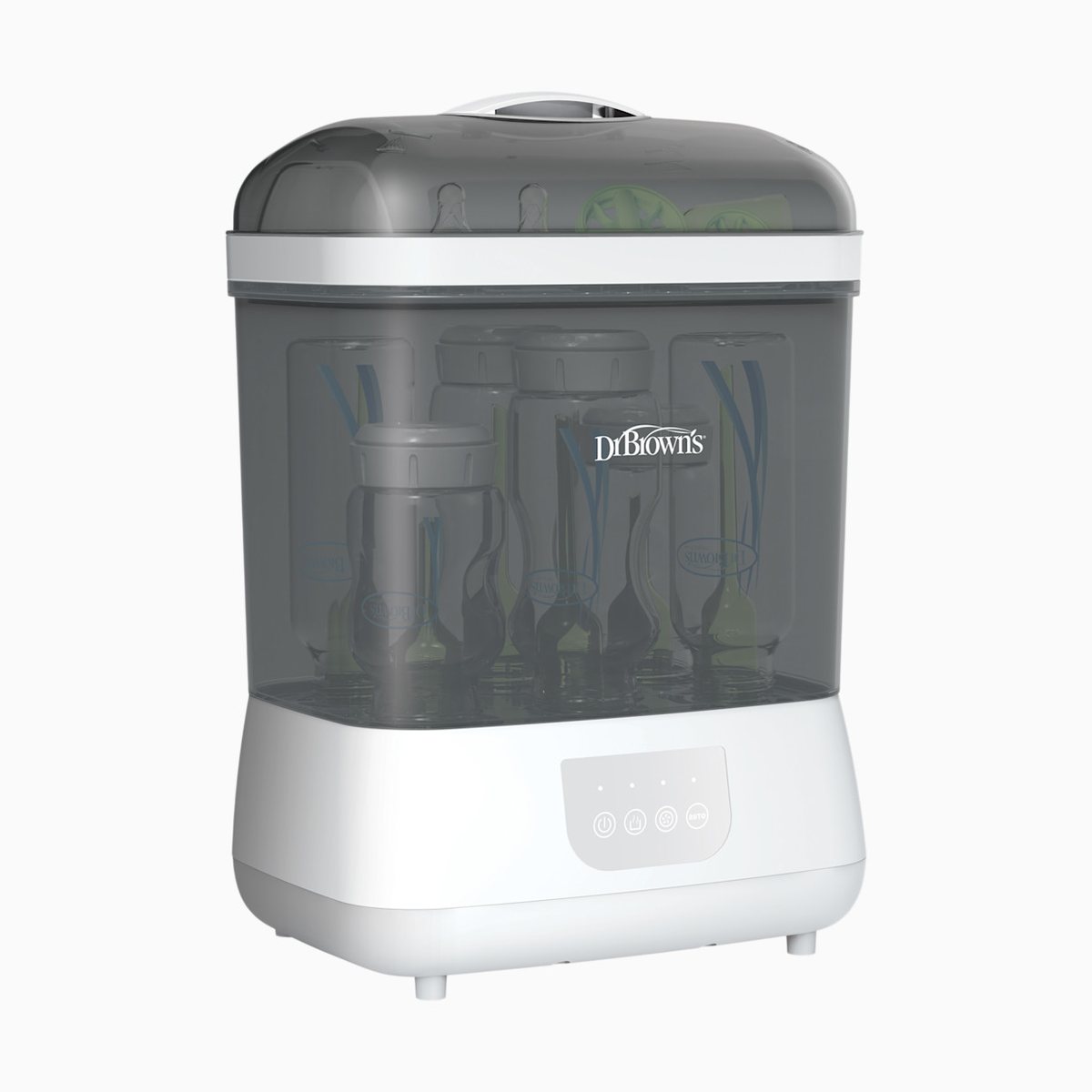
 The AC177 sterilizer and dryer (retailer photo)
Feeding & Pumping · Check #295
Is the Dr. Brown's Clean Steam Bottle Sterilizer & Dryer worth it?
Dr. Brown's Clean Steam Bottle Sterilizer & Dryer
A genuine six-bottle steam sterilizer that also dries — but the “HEPA” filter is HEPA-type at 95% (not true HEPA), a full run takes ~54 minutes, filters run $9.99 every six months, and the CDC says daily sanitizing matters most under 2 months, premature, or immunocompromised — after that, washing suffices.
See current price ↗The pitch
Steam sterilize and dry up to six bottles at once, plus parts, pacifiers and teethers — eliminating 99.9% of bacteria, mold and thrush-causing yeast, keeping contents sterilized for 24 hours under a closed lid, and drying with two included HEPA filters
The catch
The filters are “HEPA type” at up to 95% capture — not true HEPA (99.97% at 0.3 microns) — and cost $9.99 every six months after the included year; the full sterilize-and-dry run is ~54 minutes, and the heating plate needs distilled water and weekly descaling
FSA/HSA
check your plan — sterilizers are often listed eligible, but this model carries no eligibility flag on its brand or Babylist listing
What it is
A countertop electric steam sterilizer with a fan dryer — it does not wash. Bottles and parts must first be washed in hot, soapy water and rinsed; the AC177 then steam-sanitizes them, dries them with filtered air, and can hold them under its closed lid. The basket holds up to six narrow or wide-neck bottles, and a removable accessory tray above it holds the small parts — nipples, collars, caps, travel disks, pacifiers and teethers — with the manual’s suggested arrangements showing the six bottles below and their own small parts on the tray. It also takes steam-safe breast pump parts, but the manual publishes no arrangement showing six bottles plus a full double pump kit at once: large flanges and pump parts compete for the same basket and tray space, so a pump-heavy load means fewer bottles per cycle. The unit is 13.3″ L × 9″ W × 15.5″ H and 5.6 lb (600 W, 120 VAC) — the footprint of a large blender, but notably tall. Each sterilize run uses 110 mL of water to the fill line of the included cup, and the manual specifies distilled water only.
Claims vs. reality
“Eliminates 99.9% of bacteria, mold, and the yeast that causes thrush”: steam is a real, CDC-recognized sanitizing method, so the mechanism is sound — but the 99.9% figure is the brand’s own number (no independent lab test of the AC177 publishing it was found), the CDC’s word for this step is sanitizing for extra germ removal, and it only works on items washed first. Most importantly, the CDC says sanitizing matters most — at least once daily — when a baby is younger than 2 months, was born prematurely, or has a weakened immune system; for older, healthy babies, daily sanitizing may not be necessary if items are cleaned carefully, and a dishwasher hot-water cycle with heated drying makes a separate step unnecessary. That is general CDC guidance, not medical advice for any specific baby. Capacity: six bottles is real, but pump parts and pacifiers share the same tray — at full loads the “plus” is sequential, not simultaneous. “HEPA filters capture up to 95%”: the brand’s own filter page calls these “HEPA type” filters. True HEPA under the U.S. Department of Energy definition means at least 99.97% of particles at 0.3 microns; 95% does not meet it, and no HEPA grade is published. It is still cleaner drying air than an unfiltered fan — at $9.99 per replacement filter, every six months (two included cover year one). Cycle times: per the manual, sterilize only ≈ 9 minutes, dry only ≈ 45 minutes, combined ≈ 54 minutes — retail listings garble this (Babylist prints 30 minutes for sterilizing), and owners’ length complaints are about that near-hour combined run.
Safety & recalls
No CPSC recall names Dr. Brown’s sterilizers, including the AC177 (checked Nov 1, 2026). The brand’s CPSC recalls are for other products — Natural Bottle & Dish Soap (2017) and Lovey Pacifier & Teether Holders (2018) — and do not transfer to this appliance. The live safety issues are the manual’s steam warnings: do not open the lid or reach over the unit while it runs, wait 10 minutes for parts to cool and open carefully by the handle, and expect a large release of steam when the fan kicks on between sterilize and dry. If too little water is added, the unit flags incomplete sterilization (beeping, light flashing for an hour) — per the manual, cool it, refill to the 110 mL line, and re-run the cycle rather than assuming it worked.
Real reviews — what owners say
Babylist carries the AC177 at 4.5/5 across 183 ratings (77% five-star, 7% one-star); Target’s main record shows 4.4/5 across 542 ratings — a broadly satisfied base with a consistent fault list. Praise is functional: it fits a lot of bottles and pump parts at once, it is load-press-and-walk-away easy, and daily users report months without issues (several volunteer that they use distilled water). The recurring complaints: (1) the heating plate gets messy — one owner reports “little rust particles that you have to wipe down after each use,” false no-water beeping and very long dry cycles after 20+ uses; the manual’s regime (distilled water only, weekly cleaning, vinegar descale) exists because of this. (2) Cycle length and drying reliability — the ~45-minute dry is the slow step, with retailer-summarized reports of loads still damp and one owner whose auto/dryer features stopped working while sterilize-only still worked. (3) Counter footprint — at 15.5″ tall it is a permanent counter resident; several “sleek, compact” reviews state the product was gifted by the brand, so weigh those accordingly. No BabyGearLab lab test of the AC177 was found.
Price & FSA/HSA
$79.99 at drbrownsbaby.com and Target; $74.99 at Babylist against the same list. Mid-field for a sterilizer-dryer: above the brand’s no-dryer Deluxe and microwave options, well below washer-sterilizer-dryer machines. The purchase price is not the whole price: replacement HEPA-type filters are $9.99 each, every six months (two included cover year one; roughly $20/year after that), plus distilled water. Frame the value by the CDC window: for a baby under 2 months, a premature baby, or an immunocompromised baby — or a pumping parent running parts daily — a sub-$80 machine that sanitizes and fully dries a six-bottle load unattended earns its counter space; for a healthy older baby whose bottles already run a dishwasher sanitize cycle, it buys a step the CDC says may not be necessary. FSA/HSA — verify with your plan; do not assume. Sterilizers as a category are frequently listed eligible by retailers (Babylist flags competing sterilizer-dryers; Walmart flags Dr. Brown’s own microwave sterilizer), but no eligibility flag appears on this model’s own brand page or Babylist listing, even though Dr. Brown’s prints the flag on its breast pump page — confirm with your plan administrator before paying with an FSA/HSA card.
A genuine six-bottle steam sterilizer that also dries — but the “HEPA” filter is HEPA-type at 95% (not true HEPA), a full run takes ~54 minutes, filters run $9.99 every six months, and the CDC says daily sanitizing matters most under 2 months, premature, or immunocompromised — after that, washing suffices. Worth It If…