
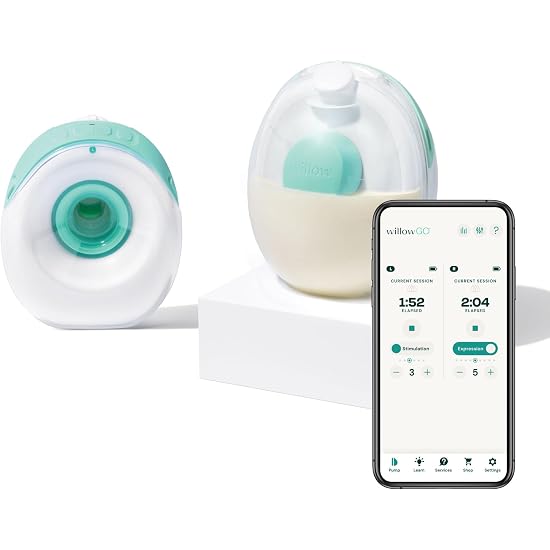
 The Willow Go — the fully in-bra, cord-free wearable: each side a self-contained hub with its own reusable 5 oz container, run from the Willow app
Wearable breast pump · Check #67 — from the Batch 5 review list
Willow Go Wearable Breast Pump
Babylist’s best wearable overall — real 280 mmHg output that tracks a plug-in pump for many moms, as long as you pump upright, fit it carefully, and budget the 90-day parts.
See current price ↗The pitch
a fully in-bra, cord-free, tubeless double-electric wearable — each side a self-contained hub with up to 280 mmHg suction, physical buttons plus app control, in a closed system with backflow protection; Babylist’s Best Wearable Breast Pump Overall
The catch
leak-proof only to 45° — no lying down or bending fully over (any-angle pumping is the pricier Willow 360); flanges, containers, valves and diaphragms are on a 90-day replacement clock (~$33/quarter), and there is no on-pump display or automatic volume tracking
FSA/HSA
eligible — breast pumps are qualified medical expenses; if insurance pays part, run only the out-of-pocket upgrade portion through FSA/HSA
What it is
A fully in-bra, cord-free, tubeless double-electric wearable (model PDL60) — each side is a self-contained hub (motor, flange, diaphragm, duckbill valve and reusable 5 oz container) that sits inside a nursing bra. In the double box: 2 pump motors, 21mm and 24mm flanges, container backs and bowls, diaphragms, duckbill valves and 2 USB charging cables (no wall adapter). Physical buttons on each hub plus Willow app control over Bluetooth. Two modes — stimulation (6 levels) and expression (9 levels), 15 total — up to 280 mmHg per side, closed system with backflow protection. 7 oz containers sold separately; containers only, no pump-into-bags option. Pump warranty 12 months; accessories 90 days; single-user device — sharing voids the warranty.
Claims vs. reality
Claim check — “hospital-grade suction”: The NUMBER is real — 280 mmHg maximum is specified consistently across the PDL60 spec records and independent testing files, above the Spectra S1’s verified 270 mmHg and below the eufy S1 Pro / Momcozy M9’s 300 mmHg. The LABEL is not proven: “hospital-grade” properly implies multi-user durability, and the Go’s own instructions describe a personal-use, single-user pump with a 12-month expected operating life. Hospital-strength suction, yes; a hospital-grade pump, no. Note: Willow’s current site copy for an updated Go kit prints 295 mmHg — that figure belongs to the newer brand copy, not the PDL60 specification pinned here.
Claim check — the leak confusion: The Go is NOT the leak-proof-at-any-angle Willow. Willow’s own words: the Go is “leak-proof up to 45° — you can still move around, but cannot use it while laying down or bending all the way over.” Any-position pumping is the pricier Willow 360’s feature, and only with its spill-proof bags; the Go pumps into open reusable containers only. Babylist lists the 45° limit as a headline con. Willow’s leak guide adds the everyday modes: lean forward briefly before removing the pump so milk left in the flange tunnel doesn’t leak, use a snug supportive bra, and keep the duckbill seated. SplashGuard containers reduce splashing but do not make the Go leak-proof — Willow says so itself.
Claim check — the app: The app genuinely controls the pump (start/stop, mode, suction per side, session time, battery, history), but it cannot see your milk. Willow’s own app guide: the 360 “can track your milk output in the app in real time; if you’re pumping with the Willow Go, you can enter your milk volume once you’re finished your session.” The Go has no volume sensors and no on-pump display — level and time live in the app or nowhere.
Claim check — battery: Sources spread from a 45-minute rated runtime to “up to 3 sessions” (Willow’s comparison copy), ~3–5 sessions (spec summary), up to 5 (Babylist/USA Today), and up to 8 in the current newer-kit copy. Plan on the low end: about 3 sessions per charge, charge nightly, carry the cables on long workdays. There is no charging case in this system.
Safety & recalls
Marketed as FDA cleared; its Instructions for Use carry the standard powered-breast-pump indications — express and collect milk, intended for a single user, no known contraindications (Class II powered breast pump pattern, 21 CFR 884.5160). A Go-specific 510(k) number was not verified in this check — the numbered clearances that surface belong to the Willow 360 family line and were not borrowed. No CPSC recall found for the Willow Go or Willow Innovations (checked Oct 19, 2026).
Manual rules that matter: inspect parts before each use and stop using damaged parts; monitor the marked 5 oz fill level — there is no auto-stop sensor, so the cup can overflow; wash parts after every session and transfer milk to storage (no fridge-hack — Willow’s own guidance).
Real reviews — what owners say
Amazon record for this listing: 8.2/10 across 2,630 ratings (price-tracker record). Babylist names the Go its Best Wearable Breast Pump Overall — “the best-performing wearable I’ve ever used” — with the 45° mobility and weight as its cons. Fathercraft’s long-term tester calls it a resounding yes while routing exclusive pumpers to a plug-in first. Praise: output matching a wall pump for many owners (the most repeated pattern in the recent Target/Willow owner file), genuine hands-free multitasking, gentler tug-and-release feel, dishwasher-safe parts, praised customer care. Complaints, in order: (1) assembly precision decides everything — cup on the motor first, then the flange, duckbill seated perfectly, or there is no suction; (2) output stays fit-dependent — some owners need longer sessions than their Spectra for the same or slightly less; (3) five washable parts per side is the daily cleaning load; (4) weight (~0.85 lb per side) and a visibly busty profile — a supportive bra is required; (5) battery at the conservative end; (6) no on-pump display; (7) the small pour opening spills until the lean-forward technique is learned; (8) occasional app quirks (left/right hubs swapping identity after charging; one-side disconnects).
Price & FSA/HSA
$299.99 list for the Double (Willow, Target), with a recorded $199.99 street at check time at Willow’s store and in the Amazon price record for this ASIN (recorded low $159.99; long stretches of 2025 anchored at $349.99 — paying full list, let alone a $349.99-era price, is a patience failure). Check insurance first: the Go is typically an upgrade option, not fully covered — Willow’s materials suggest up to ~40% help on many plans. Running costs: Willow directs replacing flanges, containers, duckbill valves and diaphragms every 90 days (the manual gives those parts a 3-month expected life) — a replacement bundle runs ~$33, so budget ~$33 a quarter, ~$130 a year, before optional 7 oz containers or extra flange sizes. Returns: opened boxes cannot be returned (single-user medical device; unopened within 60 days) — read the sizing guide before the first session.
FSA/HSA: eligible — breast pumps are qualified medical expenses and Willow sells the Go as HSA/FSA eligible, as do its insurance suppliers; replacement parts carry the same eligibility. If insurance pays part, run only the out-of-pocket upgrade portion through FSA/HSA.
The verdict
WORTH IT IF the Willow you need is the upright, everyday one. Conditions: (1) you pump upright — past 45° is the 360’s job; (2) you do the fit work up front — measure, use the right flange/inserts, learn the assembly order, seat the duckbill; (3) you budget the 90-day parts clock (~$33/quarter); (4) you accept manual app volume entry and no on-pump display; (5) you plan battery on ~3 sessions and keep a plug-in in the picture if you pump exclusively. NOT worth it if you need any-angle leak-proofing or pump-into-bags (buy the 360), real-time volume tracking (same answer), a like-for-like Spectra replacement as an exclusive pumper on a budget (the insurance-covered S1/S2 is the surer primary), or the price in front of you is a $322–$349.99-era listing rather than the recorded ~$199.99 street.
Sources: Willow’s own product pages, Instructions for Use (model PDL60), app guide, leak guide and comparison copy · babylist.com Best Wearable Breast Pump testing (Best Wearable Overall; the 45° limit listed as a headline con) · fathercraft.com long-term Willow Go review · target.com listing and owner file · Amazon listing record for ASIN B0B2SK47X6 via price-tracker record (8.2/10 across 2,630 ratings; $199.99 street at check time; recorded low $159.99) · USA Today battery-figure record · cpsc.gov recall search (no recall found for the Willow Go or Willow Innovations — checked Oct 19, 2026). Not verified: a Go-specific 510(k) number (the numbered clearances that surface belong to the Willow 360 family line and were not borrowed — see Safety); a single battery-life figure (sources spread from a 45-minute rated runtime to up to 8 sessions in the current newer-kit copy — reported as found, with planning tied to the low end); Willow’s current site copy for an updated Go kit prints 295 mmHg — that figure belongs to the newer brand copy, not the PDL60 specification pinned here. Check #67 — from the Batch 5 review list, checked October 19, 2026. Some links on this page may earn WorthItMama an affiliate commission — it never changes the answer.
Babylist’s best wearable overall — real 280 mmHg output that tracks a plug-in pump for many moms, as long as you pump upright, fit it carefully, and budget the 90-day parts.