
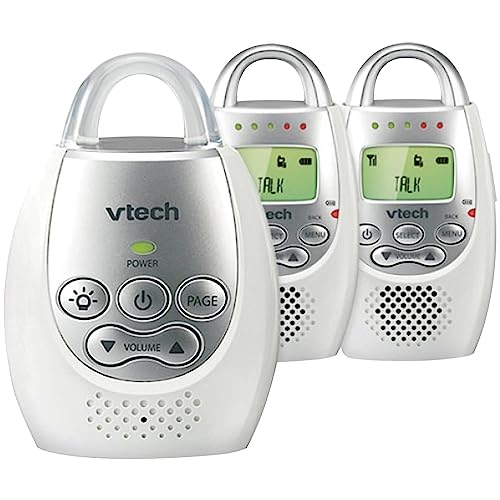
 VTech DM221-2 (1 baby unit, 2 parent units) — product photo via the ExpertBeacon Amazon listing record
Monitors & Sound · Check #153 — Batch 11
VTech DM221-2 Audio Monitor (2 Parent Units)
Worth It If…~$44 at Amazon — ASIN B007NG5UEU; independent records put the identical 2-unit set at $43.99 (Best Buy) and list the DM221 platform at $40 (BabyGearLab); Target’s $75.99 record is an outlier — see Price note
The best-sounding cheap audio monitor in the lab — worth it if your home fits its real indoor range (~90 ft through 5 walls, not the box's 1,000 ft open-field figure) and you accept an AC-only baby unit with no battery backup.
See current price ↗The pitch
a DECT 6.0 audio-only monitor with one baby unit and two rechargeable parent units — talk-back intercom, vibrating sound alert, 5-level LED sound indicator, backlit displays, belt clips and a night light on the baby unit — up to 1,000 ft of range and up to 18 hours per charge, with no Wi-Fi, no camera and no app
The catch
1,000 ft is line-of-sight — the lab’s indoor figure is ~90 ft through 5 walls (the manual’s own indoor number is 160 ft); the baby unit is AC-only, so a power outage ends monitoring until the lights come back; it is audio only (no temperature sensor, no video); and the parent units are factory-paired — you cannot add or replace one later
FSA/HSA
Not eligible — a general baby monitor is not a qualified medical expense, and VTech’s manual states plainly that it is not a medical monitor
What it is
The VTech DM221-2 Safe&Sound Digital Audio Baby Monitor pinned here: one baby unit plus two parent units, White/Silver, Amazon ASIN B007NG5UEU (model DM221-2, UPC 735078024169, VTech APN 80-8405-00). It is audio only — no camera, no screen, no temperature sensor, no lullabies, no app and no Wi-Fi. The link is DECT 6.0 digital on the 1.9 GHz band (manual spec: 1921.536–1928.448 MHz, 5 channels). The feature set that verifies from VTech’s own spec sheet and manual: talk-back intercom (push-to-talk from either parent unit), vibrating sound alert, a 5-level LED sound indicator for watching noise with the volume down, backlit parent-unit displays, adjustable microphone sensitivity (sound-activated listening vs. continuous), out-of-range and low-battery alerts, belt clips, a parent-unit paging locator, and a night light built into the baby unit’s carry loop, switchable from a parent unit. The parent units run on rechargeable 2.4 V Ni-MH battery packs (three AC adapters are in the box — one per unit). The baby unit is AC power only, with no battery backup — VTech Support confirms this in its own retailer Q&A. One baby unit means one room: this set cannot watch two nurseries, and because the units are factory-paired, extra parent units cannot be bought and paired later.
Claims vs. reality
- “Up to 1,000 ft range” — TRUE ONLY AS A LINE-OF-SIGHT NUMBER, AND THE FINE PRINT IS A 10× GAP: VTech’s own support answer splits the claim the box doesn’t: up to 1,000 ft outdoors, 160 ft indoors. BabyGearLab’s lab test of this platform (the DM221, the one-parent-unit sibling — same baby unit, same DECT link; the -2 adds the second parent unit) shows both halves. Outdoors, the hardware beats the claim: in an open-field test the out-of-range beeping started at ~1,000 ft but the sound was still fine, turned choppy around 1,200 ft, and the connection was lost at 1,325 ft. Indoors, the claim collapses: the lab managed ~90 ft through 5 walls before the out-of-range warning, held a beeping connection at 6 walls, and lost the signal after the 8th wall. So the number on the box is measured the way no baby sleeps — across an empty field. Ninety feet through walls covers most single-floor homes and many two-story ones; it is the documented failure point for large, spread-out or masonry houses, and it is the single fact that decides this verdict.
- “Up to 18 hours of monitoring time” — THE RARE CLAIM THAT UNDERSELLS THE PRODUCT: BabyGearLab measured an average run time of 46 hours per charge in sound-activated use — more than two and a half times the claim — and Mommyhood101’s hands-on test got 15+ hours of continuous listening. The honest asterisk is aging, not the rating: the Ni-MH packs lose capacity over a year or two of nightly charges (a standing note in the owner file), so budget for replacement packs over the monitor’s life rather than expecting 46 hours in year three.
- “Crystal-clear sound, no white noise, interference-free DECT” — THE CLARITY VERIFIES; “INTERFERENCE-FREE” IS STILL A MARKETING WORD: BabyGearLab scored the DM221’s Sound Clarity 9.5/10 with sound filtering rated “Excellent” (overall score 77) — the digital link really does replace analog hiss with clean audio, and its maximum volume (103 dB measured) is the loudest in the lab’s audio group. But the manual itself walks “interference-free” back: other electronics can cause interference, and parent and baby units placed under 3 ft apart squeal with feedback. Clear and clean, yes; immune to your house’s other electronics, no.
- “Secure transmission — digitized and encrypted, private” — VERIFIES, WITH THE SCOPE STATED: VTech’s spec sheet says the signal is digitized and encrypted so transmissions between baby and parent units are private, and the design removes the risk parents actually mean: there is no Wi-Fi, no internet path, no cloud account and no app, so the remote-stranger route that has hit Wi-Fi monitors does not exist here. The precise limit: it is a local radio link, and VTech’s own safety text for its monitors acknowledges a very low privacy risk for radio devices as a class — “encrypted local link, nothing on the internet” is the accurate claim, and it is a strong one. One measured footnote: BabyGearLab recorded 3.11 V/m EMF at 6 ft from the baby unit — the highest in its audio-monitor test group (peers measured 1.01–1.38 V/m). That is a lab comparison figure, not a standards violation, and it is one more reason to use the placement distance the safety rules already require.
- “Two parent units” — REAL, AND PERMANENT: both parent units arrive paired to the baby unit, each with its own charger, battery pack, belt clip and talk-back — one for each parent or one per floor is a genuine convenience at this price. What the box doesn’t say: the pairing is fixed at the factory. Owner Q&A with VTech Support confirms you cannot program additional or replacement parent units to an existing baby unit — lose or break one and the fix is a new set, not a spare part.
- Night light loop — VERIFIES, AT GLOW STRENGTH: the baby unit’s handle loop lights up as a night light and can be turned on and off from a parent unit, as claimed. VTech Support’s own answer on brightness: dimmer than a standard night light — enough to find a pacifier by, not enough to read or change a diaper by. Buy it as a glow, not a lamp.
🛡 Safety & recalls
No CPSC recall for the DM221 or DM221-2 was found on Oct 23, 2026. The VTech recall a search surfaces is a different product — a 2018 recall of the Shake and Sing Elephant Rattle toy (ears could break off) — and it does not attach to this monitor. This product’s real safety file: (1) Cord strangulation is the monitor category’s lethal hazard, and the manual’s loudest warning: keep the baby unit and its cord more than 3 ft (0.9 m) away from the crib at all times, never place the unit inside the crib or playpen, and do not use extension cords — children have strangled in monitor cords, which is why CPSC and the manual both print the warning on the cord tag itself. (2) The power-outage gap: the baby unit runs on AC only. If the power goes out, the nursery end stops transmitting; the parent units beep when the link is lost (per VTech Support), which wakes you — but restores nothing until power returns. In a home with frequent outages, a monitor whose baby unit has battery backup is the safer design. (3) The manual’s own limits, in its own words: the monitor is “intended as an aid… not a substitute for responsible and proper adult supervision” and “not intended for use as a medical monitor” — it detects no breathing or movement and carries no SIDS-protection claim, and none should be inferred. (4) Audio-only means no visual check — you hear the baby; you cannot see position, a covered face, or the room. For most families that is a fair trade for price and privacy; parents who need eyes need a different shelf.
Real reviews
Pinned pool: the Amazon listing record via ExpertBeacon — 4.7/5 across 12.3K+ reviews (ExpertBeacon data updated Mar 10, 2026; the ASIN and rating are the listing’s own, reproduced there). Retail corroboration: Best Buy rates the identical 2-unit set 4.7 (418 reviews) and the single-unit sibling 4.7 (506). Praise pattern across the owner file and the testers: clear sound above everything, dead-simple operation, the two parent units, durability for the price — BabyGearLab calls it “an excellent choice for most families,” and Mommyhood101, What to Expect and The Bump all carry it as a top audio pick. Complaint pattern, in order: (1) indoor range in larger homes — the lab’s ~90 ft / 5 walls figure explains exactly where the one-star “drops connection” reports come from; (2) parent-unit battery packs fading after a year or two (“the battery may not last very long” is the standing Best Buy review note); (3) the loud out-of-range beeping that announces a lost link at full voice; (4) occasional static or interference near other electronics, despite the “interference-free” pitch; (5) buttons and menus — BabyGearLab scored Ease of Use just 5.5/10 even while scoring its sound 9.5/10; (6) no battery backup on the baby unit, discovered by some owners during their first outage.
Price & FSA/HSA
Price note: the Amazon figure here is a range because the records disagree by seller, and one record is an outlier. Amazon’s own page refuses agent reads, so the pinned ASIN (B007NG5UEU) and its 4.7/5, 12.3K+ review file rest on the ExpertBeacon listing record, which does not publish prices. The price evidence: BabyGearLab lists the DM221 platform at $40; Best Buy’s record for this identical 2-unit set is $43.99; Target’s record for the same set reads $75.99 — treat that as an inflated outlier, not the shelf price. Ruling carried into the price line: ~$44 is the fair shelf for the DM221-2; $40–$45 is a buy. Before paying more, check the listing title says “-2” / 2 Parent Units — the one-parent-unit DM221 is the same shelf’s cheaper set (~$41 at Best Buy), and paying -2 money for the single is the standing mix-up. Running costs are close to zero: no subscription, no filters, no app tier — just replacement Ni-MH parent-unit battery packs (a ~$10-class part) every year or two as capacity fades, putting the honest multi-year cost around $45–$65 total. FSA/HSA: not eligible — a general-purpose baby monitor is not qualified medical care under IRS Publication 502 principles, VTech’s manual states the product is not a medical monitor, and no retailer record read flags the DM221-2 as FSA/HSA eligible (medical monitoring devices are a different category and a different shelf).
Worth It If… your home fits the real indoor range and you want ears-only monitoring with nothing to hack. The box’s “1,000 ft” is an open-field number: BabyGearLab’s lab beat it outdoors (sound held to 1,325 ft) but measured only ~90 ft through 5 walls indoors — about a tenth of the headline in a real house. The claims that do verify are the ones that matter at 3 a.m.: top-of-class sound clarity (9.5/10 in the lab), an encrypted DECT link with no Wi-Fi and no app, and a battery claim that understates reality (18 hours claimed, 46 hours lab-measured). It stops being worth it in a big or masonry house, in a home with flaky power (the baby unit has no battery backup), or if you need to see the baby or the room temperature.