
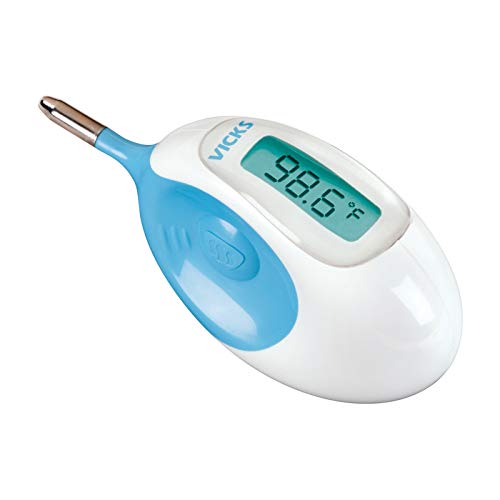
 The Vicks Baby Rectal (V934) — a rectal-only digital thermometer whose short flexible tip and flared guard physically stop over-insertion
Health & Home · Check #194 — Batches 11–15
Vicks Baby Rectal Thermometer
The AAP's most accurate method in its safest cheap form: a rectal-only digital thermometer (model V934) with a short flexible tip behind a flared insertion guard, finger grips, backlit display and a 10-second read at a manual spec of ±0.2°F — with one documented habit to learn, that first reads can run ~0.2° low, so confirm anything near 100.4°F with a second read.
See current price ↗The pitch
the gold-standard rectal reading, made hard to do wrong — short flexible tip, insertion guard, 10-second read, large backlit display, last-reading recall
The catch
first reads can run ~0.2°F low (re-read anything near 100.4°F), the storage cap loosens over time, and “waterproof” means clean the tip — soaking the whole unit can trap moisture in the screen
FSA/HSA
eligible — the Amazon listing flags this ASIN FSA or HSA eligible, and thermometers are a standard eligible OTC item
What it is
A rectal-only digital thermometer for babies — the Vicks Baby Thermometer, model V934 (Kaz Inc., under license from Procter & Gamble), pinned here against its multi-site Vicks siblings (SpeedRead, ComfortFlex), which are different products with longer tips and no guard. The teardrop body (about 3.5 × 1.5 × 0.5 in, ~2.2 oz in roundup spec records) carries a short, flexible probe tip that widens into a flared insertion guard — the wide base physically limits how far the tip can go — plus finger-grip indents on both sides, a backlit digital display, one-button operation with last-temperature recall, a storage cap, and a replaceable SR41/LR41 button cell (manual battery life: more than 200 hours of continuous use). Manual range 90.0–109.9°F; the manual’s normal rectal band is 98–100.4°F, and it notes a rectal reading runs about 1° above oral and 2° above underarm. It does one site, on purpose: there is no mode to set wrong.
Claims vs. reality
“Can’t insert too far” — VERIFIES, AND IT IS THE REASON TO BUY THIS ONE. The fear that stops parents using the most accurate method is over-insertion (the category’s real injury risk is rectal perforation from a pushed-too-far or struggling-against probe). The V934’s answer is mechanical, not instructional: the probe is short and the body flares wide behind it, so depth is capped by the shape itself. Babylist’s tester makes the same point independently — most rectal thermometers don’t have the wide taper and leave depth to parental judgment; this one and Frida’s Quick-Read are the exceptions she recommends. The manual’s technique still applies: lubricate the tip with petroleum jelly, insert no more than ½ inch, stop at any resistance, hold the thermometer (and the baby) steady until it beeps.
“10-second read” — VERIFIES. The manual’s test protocol and spec agree: peak temperature in about 10 seconds, with the beeper sounding for ~8 seconds when the peak is reached. (One editorial hands-on, MomLovesBest, says in passing that it “does not beep” — that conflicts with the manual and the spec records, which both describe the beep; carried here as an unresolved minor discrepancy, not a finding.) Ten seconds is slower than a 1-second forehead scan and faster than an old 30–60-second stick — and unlike the predictive 10-second flash on check #190’s Frida True Temp, this is the settled reading, not an estimate with a second number coming.
Accuracy — THE SPEC IS STANDARD, AND THE ONE DOCUMENTED QUIRK SITS EXACTLY AT ITS EDGE. Manual accuracy: ±0.2°F between 96.0–107.0°F at a 71°F room temperature, conforming to ASTM E1112 — the normal, credible spec for a contact thermometer, the same class of spec its lab-tested SpeedRead sibling met in TechGearLab’s testing (0.2°F measured deviation; that lab result belongs to the sibling and is not transferred to this model — no independent lab test of the V934 itself was found). The quirk: Babylist’s hands-on testing and the owner reports it quotes find the first reading of a session running ~0.2° low — “the first reading was almost always 0.2 degrees lower than the 2nd and 3rd (which were consistently the same).” 0.2° is inside the stated tolerance, and the repeats agree with each other, which is the signature of a cold-tip first read rather than Frida-style scatter — but 0.2° is also the whole distance between 100.2°F and the 100.4°F line that sends a baby under 3 months for prompt evaluation. The protocol costs ten seconds: if a first read lands anywhere near 100.4°F, take a second read immediately and act on the consistent number.
“Waterproof, easy to clean” — TRUE OF THE TIP; DON’T SOAK THE BODY. Listing copy calls the design waterproof for cleaning, and the manual’s cleaning method is soap and warm water or 70% isopropyl alcohol, wiped dry (never boil, dishwasher, or solvents). Babylist’s caution, from multiple owner reviews, is the asterisk: washing the whole unit under the tap can trap moisture in the screen or battery compartment and kill the display. Clean the probe, wipe the body — the rectal-only rule helps here too, since a dedicated rectal thermometer never needs the deep clean a shared oral one would.
The small print that is actually small. The storage cap loosens after a couple of months in Babylist’s testing and slips off in the drawer — annoying, not functional. The on/off button sits inside the finger grips, so a hard squeeze mid-read can reset the unit (Babylist) — hold it by the indents, not in a fist. There is no fever alarm and no colour coding (the SpeedRead sibling has Fever InSight; this one shows the number, backlit) and the screen, while readable in low light, is smaller than Frida’s Quick-Read. The V934 manual carries a lifetime warranty (repair or replace for the owner’s lifetime, misuse and battery excepted) — an unusual term for a $10 device, carried as the manual states it.
Safety & recalls
No CPSC recall for the Vicks Baby Rectal Thermometer / model V934 was found Oct 23, 2026. The safety story here is the method’s: the AAP holds that taking a rectal temperature gives the best reading, especially for infants under 3 months, and a rectal 100.4°F (38.0°C) or higher in a baby under 3 months means prompt medical evaluation — trust the baby and call the clinician whenever a number and the baby disagree. Technique is the safety system: petroleum jelly on the tip, ½ inch maximum, stop at resistance, never force it, hold the baby’s thighs steady, one hand on the thermometer throughout, and never leave the baby unattended mid-read. Designate this thermometer rectal-only forever (mark it; never use it orally), clean the probe after every use, and store it capped, out of reach — it is not a toy (manual), and its SR41/LR41 button cell is the standard coin-cell ingestion hazard: keep the battery cover secured and spares away from children, per the manual’s battery warning. Information only, not medical advice.
Real reviews — what owners say
There is no clean Amazon aggregate to quote for this ASIN (Amazon’s own crawled page shows active buying — “300+ bought” in one record, “50+ bought in past week” in another — but no rating this check could verify), so the owner evidence is the editorial testers who lived with it. Babylist (Best Baby Thermometers, hands-on tested): Honorable Mention — praise for the guard, the grips and the backlit screen; cons limited to the first-read quirk and the loosening cap. MomLovesBest: “Best Rectal Baby Thermometer,” 3.75/5 overall with Accuracy scored 5/5 — its lower ease/speed marks are the rectal method’s, not a defect: one site only, ~10 seconds. The long owner tail agrees on the shape of the experience: parents who dreaded the method call the guard the thing that settled their nerves (“it is impossible to stick it in too far” is the recurring phrasing in parent forums going back years), the grip indents get named as the fix for the fumbling its Frida rival suffers, and the complaints that recur are the cap, the grip-button resets, and moisture after whole-unit washing — the three asterisks carried above. Nobody’s file shows the failure that disqualifies a thermometer — comparator-backed readings degrees off, or back-to-back scatter (contrast check #190).
Price & FSA/HSA
$9.99 is the pinned figure — Babylist’s “from $9.99” for this thermometer, read Oct 23, 2026; older parent records put Amazon at ~$13, and the current Amazon listing for ASIN B0002AHVZU (verified across independent ASIN-bearing records — MomLovesBest’s Amazon link and the Amazon page record itself) presently shows marketplace offers rather than a single featured offer, so the exact Amazon checkout price moves with the seller; the card links the ASIN with the Associates tag and the $9.99 figure is the independently recorded price, not a scraped Buy Box. Running costs are effectively zero: no probe covers are required (lubricate, clean, cap), and the SR41/LR41 cell is rated past 200 hours — years of fevers. The ladder: sideways — Frida Baby Quick-Read Rectal, from $13.97 at Babylist, the same guard idea with a bigger, brighter screen and no finger grips; same money, more sites — its own sibling, the Vicks SpeedRead (from $9.65 at Babylist; $9.89 at Target), TechGearLab’s best-accuracy budget stick, usable orally/rectally/underarm for the whole family but with a long unguarded tip you must depth-judge yourself in a newborn; up — check #125’s Braun ThermoScan 7 (ear; not reliable under 6 months) and check #166’s iProven DMT-489 (ear/forehead dual-mode) for when the child outgrows rectal checks; and not the alternative — check #190’s Frida True Temp, Not Worth It on its owner accuracy file. FSA/HSA: eligible — the Amazon listing flags this ASIN “FSA or HSA eligible,” and thermometers are a standard eligible over-the-counter item; keep the receipt, plans vary.
This is the thermometer the AAP’s guidance points at, in its safest cheap form. Rectal is the most accurate way to take a baby’s temperature — the method pediatricians want under 3 months, where a rectal 100.4°F is the call-the-doctor line — and the Vicks Baby Rectal (model V934) is built only for that job: a short, flexible tip behind a flared insertion guard that physically stops the probe going too far, finger grips, a backlit display, a 10-second read and a manual accuracy spec of ±0.2°F (ASTM E1112). The one habit to learn is documented and small: the first read can run ~0.2° low (Babylist’s tester and owners taking sets of three; the second and third agree), so confirm any first reading near 100.4°F with an immediate second read. At $9.99, FSA/HSA eligible, with no probe covers or extras to buy, that is the whole catch list — and it is why check #190 points here instead.