
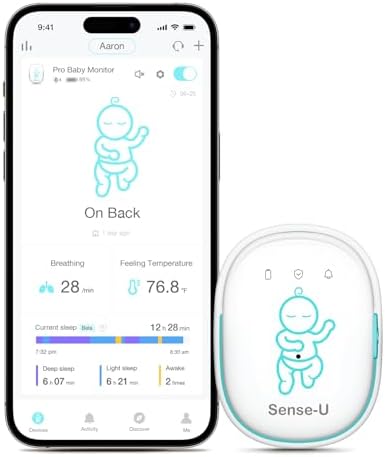
 Sense-U Pro (Bluetooth) — Amazon listing photo via BestReviews.guide record
Monitors & Sound · Check #182 — Batch 14
Sense-U Pro Baby Monitor
Worth It If…$134.99 at Amazon — Bluetooth version pinned (ASIN B089NQKWP6, InStock per BestReviews.guide JSON-LD record, Oct 23, 2026); brand-direct Bluetooth is $119.99 and the Long Range version with Base Station is $199.99 — see Price note. NOT the Long Range version and NOT the camera Bundle — this box has no camera and no base station
The clip-on third approach to wearable monitoring — abdominal movement, rollover and ‘feeling temperature’ at the diaper, with a manual-verified 15-second arousal vibration then alarm — that is explicitly not a medical device, reads no heart rate or oxygen, and reaches only ~50 ft by Bluetooth to one phone at a time.
See current price ↗The pitch
clip-on breathing-movement, rollover and overheating alerts with arousal vibration, free in-depth sleep analysis, 7+ day battery and FSA/HSA eligibility — “detects the cause, not the effect, faster than heart-rate monitors”
The catch
no heart rate, no oxygen, no video; “faster” is brand framing with no independent timing study; the AAP finds no data that consumer monitors reduce SIDS risk; and fit, walls and a loose diaper decide whether the alerts you get are real
FSA/HSA
Eligible — stated by the brand and corroborated by BestReviews.guide; your plan administrator’s rules govern
What it is
A small rechargeable clip-on sensor (manual model SU-N3DT-US) that fastens to the front of the baby’s diaper or snug sleepwear at the abdomen, plus the free Sense-U Baby app — the pinned record is the Bluetooth version, Amazon ASIN B089NQKWP6. It tracks exactly three things: abdominal (breathing) movement, sleep position / rollover, and “feeling temperature” around the abdomen, and builds a sleep report from them. Pin the variant: this is NOT the Long Range version ($199.99 brand-direct), which adds a Wi-Fi Base Station (2.4 GHz only) for anywhere alerts, local sound/light alerts and room temperature/humidity, and NOT the Bundle ($299.99 brand-direct) that adds a 2.5K PTZ camera — the pinned box contains no camera, no video and no base station (sensor, Type-C USB charging cable, user manual, app access). For healthy children up to 18 months per the manual (some retailer listings say 12 months — the manual controls). Brand terms: 45-night risk-free trial and 1-year limited warranty on brand sales (the manual itself states 30-day money-back / 1-year warranty — confirm your channel’s terms). Battery: 7+ days at ~8 hours/day per charge, Type-C, DC 5V 1A adapter only (no fast-charging adapters).
Claims vs. reality
- “No movement for 15 seconds — it vibrates to rouse baby, then alarms”: verifies as the manual’s own sequence. The Sense-U Pro user manual states it exactly: after 15 seconds of no abdominal movement, the device gently vibrates in an attempt to wake the baby; if movement is still not detected, it sounds audible alarms and sends mobile notifications — the brand FAQ puts the second step at another ~5 seconds after the vibration. Rollover onto the stomach and too-warm / too-cold readings trigger the audible + app alerts directly. What is detected, precisely, is the absence of abdominal movement at the clip — not breathing itself, not oxygen, not heart rate — and the manual lists the conditions that break the proxy: external movement (a pushed bassinet, a car ride) can register as the baby’s movement and suppress an alert; a bed-sharing baby’s sensor can read the other person’s movement instead; loose-fitting sleepwear loses contact and causes false notifications; a wet diaper left on can distort temperature readings or cause malfunctions. The sensor is splash-resistant, not waterproof.
- “Detects the cause, not the effect — faster than heart-rate monitors”: brand framing only. Sense-U’s headline line is that slow breathing, stomach sleeping or overheating are “causes” and a fallen heart rate is the “effect,” so its alerts come faster. No independent head-to-head timing study against an Owlet-style heart-rate/oxygen sock was found in the sources checked, so “faster” and “more reliable” are carried as the brand’s claim. What is true is narrower: it watches a different signal, and in practice the alert you actually receive depends on fit and connection — which is where the owner complaints live (see Reviews).
- “Temperature monitoring / overheating alerts”: verifies only in the brand’s own careful wording — “feeling temperature around the abdomen.” The manual repeats that phrase because the reading is not core body temperature and not a fever thermometer: an owner quoted in the brand’s own review file complains the number “is not body temperature… but ambient temperature around the baby” with a guidance range too wide to act on, and Babylist lists inaccurate temperature readings among the reported complaints. Use it as a too-warm / too-cold nudge about the baby’s microclimate — never as a temperature to make a medical decision from.
- “Free in-depth sleep analysis — deep and light stages, sleep quality”: the report exists; the stages are inferred. The app does produce free cycle reports with deep/light stages, awake times and a quality summary. Its only inputs are movement, position and feeling temperature from one clip — no EEG, no heart-rate signal, nothing that measures sleep stages directly. Read the stages as a movement-derived estimate for spotting patterns, not as a measurement.
- “Safe technology — BLE radiation 1/1000th of a phone”: the Bluetooth Low Energy (4.0+) connection verifies; the 1/1000th fraction is the brand’s figure, with no independent lab measurement of the Pro found. The manual’s practical number matters more: up to 50 ft (15 m) in open space, with walls and obstacles reducing it “dramatically.” For family context only — not transferred to the Pro — BabyGearLab’s lab test of the predecessor Sense-U Baby v3 measured 2.50 V/m EMF at the baby, the highest in its movement-monitor group; that neither condemns this device nor lets “lowest radiation” stand as verified.
- “Use it alone, smarter with the app”: verifies, with a one-phone catch. On-device vibration and audible alarm work with no phone at all. But the manual states one Pro can connect to only one smart device at a time (to pair a second phone, log out on the first), Android needs Location enabled “all the time” plus Critical Alerts permission, and Babylist names the one-phone app as a headline con. The anywhere-access, multi-user fix is the Long Range Base Station — a different, $199.99 product.
🛡 Safety & recalls
No CPSC recall for Sense-U baby monitors was found on Oct 23, 2026. One confusion headed off: the baby-monitor fire recall prominent in current reporting is the Babysense Max View — a different brand (Hisense) — it is not this product and is not counted against it. The governing frame for this category is the AAP’s 2022 safe-sleep guidance: direct-to-consumer movement / heart-rate / oxygen monitors are consumer wellness devices under the FDA definition — not medical devices — and there are no data that they reduce the risk of SIDS or other sleep-related deaths; using one is not a substitute for AAP safe sleep (on the back, firm flat bare surface, room-sharing without bed-sharing). Sense-U’s own documents say the same, to its credit: the manual’s first warning is “not a medical device… not intended for use in the diagnosis, cure, mitigation, treatment, or prevention of disease,” plus “do not use this product to justify unsafe sleep habits” and “should not be substituted for the care and oversight of an adult”; the brand’s safety page adds that readings are “an approximate representation… not guaranteed to be accurate or complete” and that alerts, or the absence of alerts, do not indicate or guarantee the baby’s health status. Manual specifics that change how it may be used: the baby must sleep in their own separate bed (bed-sharing defeats the sensing), charging cords stay more than 3 ft / 1 m away (strangulation warning), remove the sensor at any redness, swelling or skin irritation, keep it out of children’s mouths, and consult your doctor first if your child has a cardiovascular or respiratory condition — a prescribed medical monitor, not this clip, is that tool. Information only, not medical advice.
Real reviews
Files kept separate. Amazon pool: the pinned ASIN B089NQKWP6 is confirmed by the BestReviews.guide Amazon record ($134.99, InStock, JSON-LD offer; that site scores it 7.6 on its own scale — not converted to stars here); no trustworthy Amazon star rating or review count surfaced in the independent records checked, so none is quoted. Babylist’s Best Baby Movement Monitors roundup names the Pro its Best Affordable pick: pros — budget-friendly against the sock monitors, breathing + temperature + rollover in one clip, works standalone or with the app, and a surveyed parent’s “major plus for peace of mind at night”; cons — the app works with only one phone, connectivity and app glitches, occasional false alarms when the sensor is not clipped properly, and inaccurate temperature readings (correct placement near the belly button on a snug diaper helps). BabyGearLab’s lab test belongs to the predecessor v3 and is not transferred as a score — family pattern only: no false non-breathing alarms in lab testing, an occasional false “on his belly” position report. Retailer owner files (Best Buy; Target’s file is the Long Range version): praise — real peace of mind and better parental sleep, a light clip that stays put and does not bother the baby, fast movement/rollover notifications, multi-night battery. Complaints, in pattern order: (1) Bluetooth range through walls — “same-room works best,” one owner fixed drops by leaving an old phone/tablet in the nursery running the app; (2) app crashes — with the saving grace one owner noted: the on-device vibration and audible alerts kept working when the app closed; (3) fit-dependent false alerts — loose diaper, off-centre clip, and the standing chore of pausing/removing it for night feeds and diaper changes or the no-movement alarm fires; (4) temperature readings owners could not interpret or trust.
Price & FSA/HSA
Price note: pinned from independent records, the standing method for this library. Amazon: $134.99, InStock, ASIN B089NQKWP6 (BestReviews.guide JSON-LD offer, matching the candidates record) — the link above carries the Associates tag. Brand-direct context, kept separate: the brand store lists Bluetooth at $119.99 (a $129.99 sale figure also appears on its product page) and Long Range at $199.99 — so Amazon sits a little above brand-direct Bluetooth and far below anywhere-access; the version decision matters more than the channel gap. The value math inside this library: against the Owlet sock line and the eufy sock (both checked), the Pro is roughly half the money for movement + rollover instead of heart rate + oxygen — no sock sizes to outgrow, no physiological numbers either; against the Angelcare AC327 (check #189) it is the wearable fork of the same movement-only idea (clip on the diaper vs. pad under the mattress). Running costs: none required — no subscription (sleep analysis is free in the app) and no required accessories for the Bluetooth version; the Base Station is an optional upsell, not a requirement. FSA/HSA: eligible — stated by the brand (“FSA/HSA Eligible”; “use your FSA/HSA credit card at checkout”) and corroborated by BestReviews.guide and the candidates record; your plan administrator’s rules govern any given purchase.
Worth It If… you want the cheaper, third kind of wearable alert — a diaper clip that watches abdominal movement and rollover and vibrates on the baby after 15 seconds of no movement, before it alarms you — and you buy it as an extra set of eyes, not as protection: the brand’s own manual calls it not a medical device, its temperature is a “feeling temperature” around the belly rather than body temperature, and its Bluetooth reaches about 50 feet in open space, to one phone at a time.