What it is
A hybrid video monitor — the only design in this library’s AI tier that is both an app monitor and a self-contained local monitor. In the box: one 1080p Full HD baby unit (mains power only, no battery) with automatic night vision, digital zoom and pan, a room thermometer with high/low alerts, a night light with timer, and 5 lullabies, 5 soothing sounds and 5 white-noise sounds; and one 5-inch parent unit (1280 × 720 colour LCD, rechargeable, up to 12 hours in Eco mode) that links to the baby unit directly, peer-to-peer, with no Wi-Fi involved — Philips calls that configuration Privacy mode. A 2-in-1 wall/crib mount and two power supplies are included. Range is specified at up to 400 m outdoors / 50 m indoors; no independent lab has measured this model. The app adds anywhere-viewing, background audio, guest users and the two headline systems. SenseIQ analyses the video feed’s pixel motion to report sleep status, sleep sessions with a 30-day diary, and a breathing rate — with nothing on the baby: no sock, no band, no sensor pad. Warranty: 2 years, and Philips commits to software updates for only 2 years from purchase.
Claims vs. reality
SenseIQ tracking is real — and it has no alarm. The feature exists as described: camera pixel-motion analysis producing a breathing-rate readout and sleep status, shown on the parent unit and in the app, and it is genuinely subscription-free — Philips’ FAQ states no paid subscription is required for SenseIQ tracking. What does not verify is the thing the marketing lets a tired parent assume. Philips states in its own FAQ, manual and listing copy that the monitor “is NOT intended to detect breathing interruptions, breathing disorders or other medical conditions” and will not notify users of all breathing or sleep irregularities; it is not a medical device and holds no FDA clearance. Its notifications are baby-awake and no-signal alerts — there is no no-breathing alarm. Cry translation is two features wearing one name: Philips’ own Cry Detection is free; the translation layer that labels a cry hungry, sleepy, fussy, gassy or agitated is Zoundream AG’s cloud service, not Philips technology. Its “scientifically proven” base is real but belongs to the vendor: in March 2026, BBB National Programs’ NAD found translation claims for the same Zoundream model in another brand’s products supported on peer-reviewed research — substantiation for the technology, not a measurement of this device, whose in-home accuracy nobody outside Zoundream has measured.
Safety & recalls
No CPSC recall naming the SCD973/37, or any Philips Avent Premium Connected monitor, was found (Oct 26, 2026). One brand-history entry, clearly separated from this product: in August 2023 Philips recalled about 12,850 of its earlier Philips Avent Digital Video Baby Monitors because the parent units’ rechargeable batteries could overheat during charging — 23 reports in Europe, 7 with minor burn injuries, none in the US. That recall does not cover this model; it is the same brand, category and component type, so it belongs in the file as history, not as a finding against this unit. Two rules decide safe use here. Cords: the camera is mains-powered and crib-mounted by design, so route and secure its cord exactly as the manual directs — this library’s standing CPSC rule is camera and cords at least 3 feet from the crib and out of reach. The alarm gap is the safety section: this monitor will not wake you for stopped breathing, because it has no such alarm; if breathing surveillance is the need, the conversation is the FDA-cleared Owlet (check #12) and a pediatrician, and AAP safe sleep remains the only intervention with evidence behind it. Privacy mode is the one configuration in this tier that keeps the nursery entirely off the internet.
Real reviews — what owners say
A small pool, warmer than the shelf’s average, with caveats that shape how much weight it can bear. Amazon records 4.3/5 across 209 reviews (ExpertBeacon listing record, updated Mar 10, 2026), with later snapshots of the same growing pool at 216–285 ratings. Philips’ own pool reads 4.6/5 across 195 reviews, 96% recommend — pooled across the SCD971/37 and SCD973/37 and dominated by promotion-marked panel reviews, so read it as a ceiling, not a measurement. No tested review from Wirecutter, BabyGearLab, MommyHood101 or The Bump was found — there are no instrumented video, range, battery or SenseIQ-accuracy measurements for this model anywhere in this check. Praise is consistent: sharp day and night picture, an app owners call easy and reliable with quick notifications, simple setup, temperature alerts landing, and the dual-mode itself — a dedicated screen plus anywhere app access. The pool’s most important review is a 4-star one: “it WILL NOT NOTIFY/ALERT you if your child stops breathing” — that owner paired it with a separate movement monitor. Other fault lines: the trial cliff at day 91, SenseIQ working only while the baby is in the crib in view, and occasional disconnects in larger homes — softened by the parent-unit link, which keeps working when the Wi-Fi does not.
Price & FSA/HSA
$349.99 at Amazon, with a demonstrated deal depth to $209.99 — a 40%-off snapshot worth waiting for on a promotion-prone product; treat anything under about $280 as a good sale. The $499.99 figure attached to this product comes from Canadian records only (Philips.ca and amazon.ca) — it is not a verified US list price, and no US buyer should treat it as one. Running costs are this product’s strongest structural fact: $0 required — SenseIQ, cry detection, the app, the sleep diary and the parent unit are all included, forever. The exception is Cry Translation: a 90-day free trial that starts when you activate it (start it when the baby comes home, not at the shower), then a monthly subscription billed with Zoundream, at a US price Philips publishes nowhere — it appears only at the in-app paywall. Against the shelf: the Nanit Pro (check #17) lists about $299 for an app-only camera whose full analytics are subscription tiers; the Cubo (check #73) reaches about $299–$380 over three years once its Premium renewals are counted. The Philips is the highest day-one price of the three and the lowest by year three if you skip the translator — and the only one whose box contains a screen. FSA/HSA: not eligible as listed.

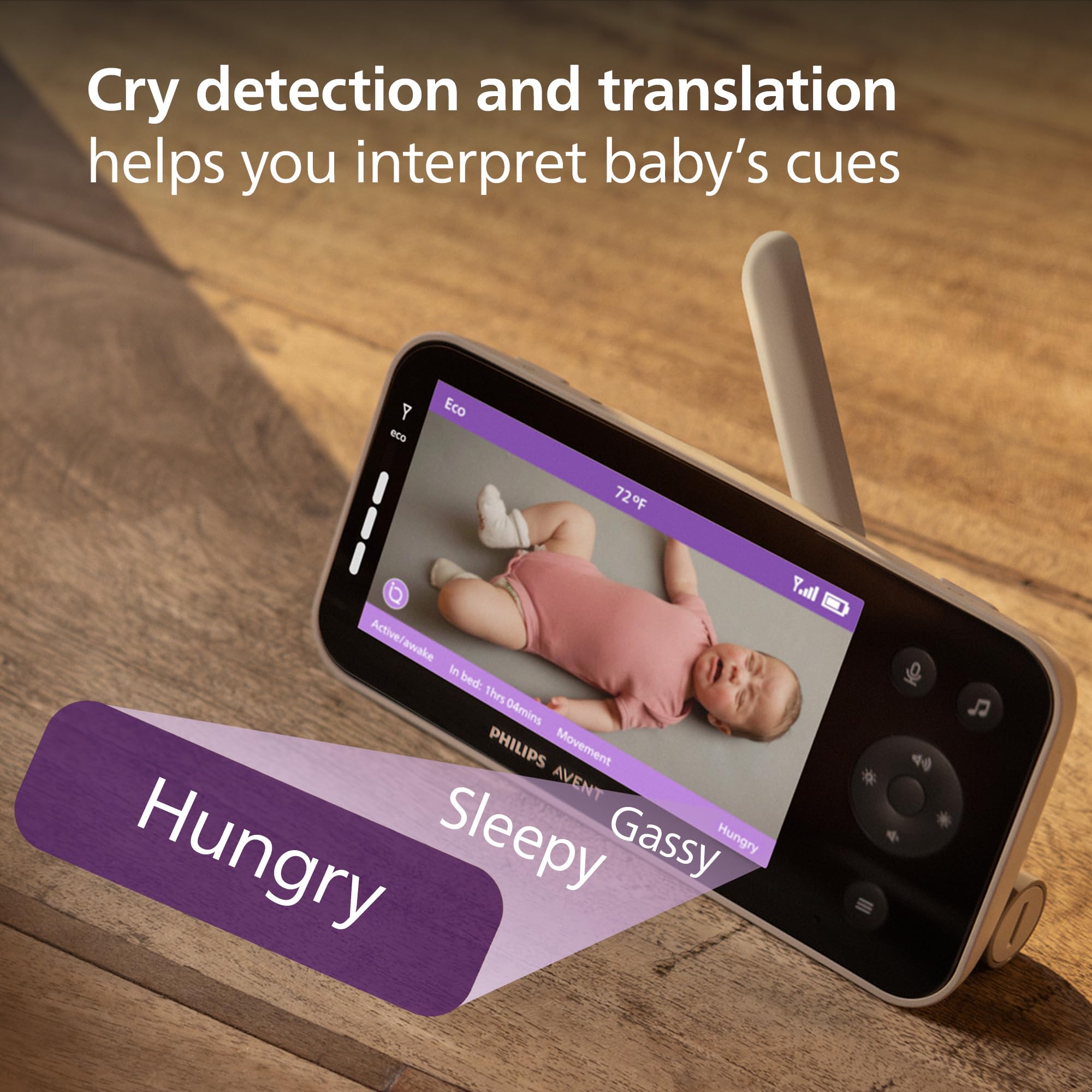 The SCD973/37 parent unit — a real 5-inch screen showing SenseIQ and a cry-translation result