
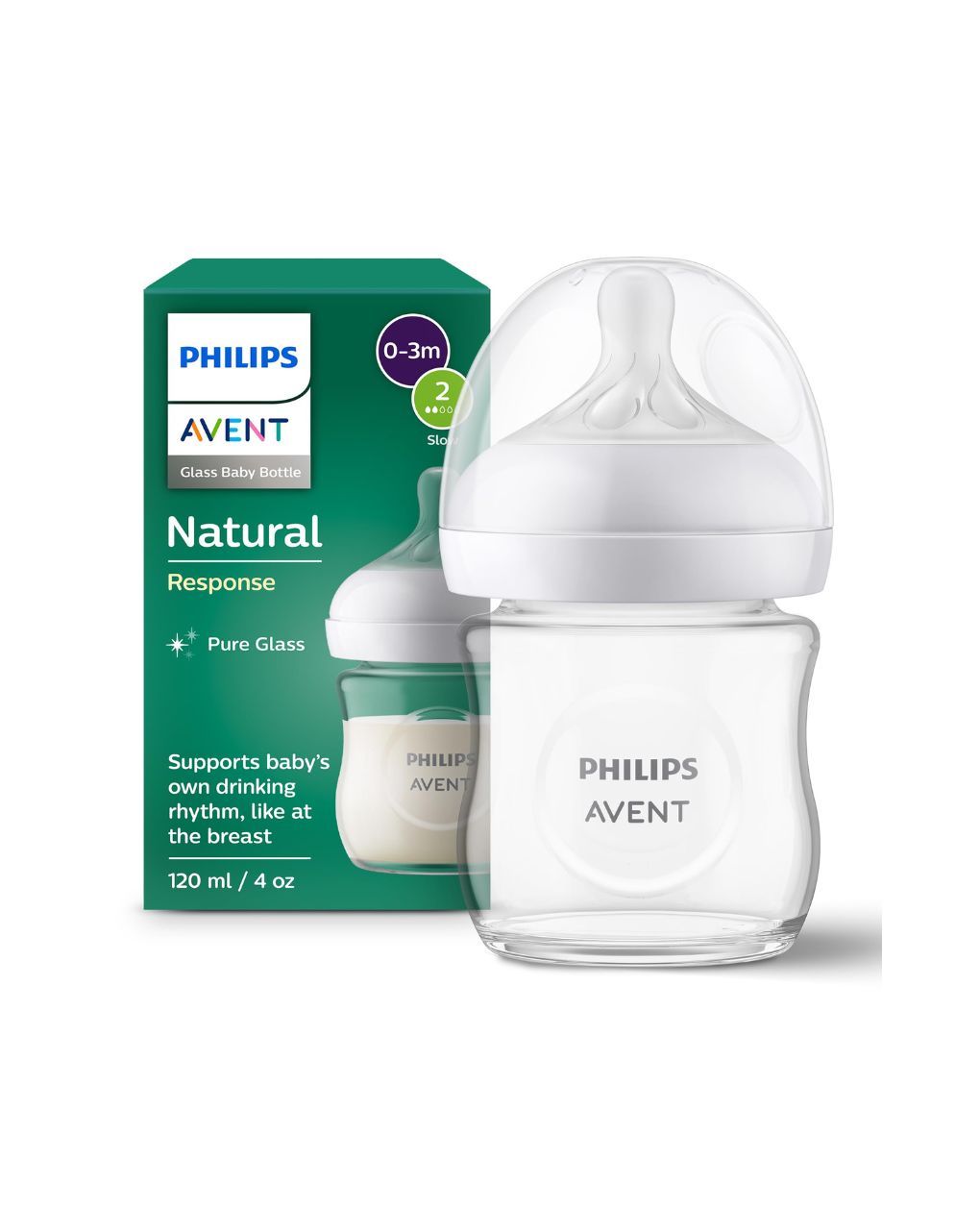
 The 4 oz glass single with its Flow 2 nipple — borosilicate body, silicone nipple, polypropylene ring and cap; no sleeve outside the Baby Set
Glass baby bottles · Check #35 — from the overnight review list
Philips Avent Glass Natural Baby Bottles with Natural Response Nipple
Worth It If… the glass is the point and your baby accepts the Natural Response nipple — Babylist’s Best Glass Baby Bottle Overall, pharmaceutical-grade borosilicate with only four parts including the cap, but BabyGearLab scores that nipple 4/10 for too-slow flow and collar leaks are the #1 owner complaint.
See current price ↗The pitch
pharmaceutical-grade borosilicate glass with a nipple that releases milk only when baby actively drinks — the most breast-paced bottle in this library
The catch
too-slow / frustrated-baby reports are a pattern, not outliers — and the milk owners lose is at the collar, not the honest no-drip tip
FSA/HSA
not eligible — baby bottles are personal feeding items, not qualified medical expenses
What it is — the glass bottle with the breast-paced nipple
A wide-neck borosilicate glass bottle with a wide, soft silicone nipple and only a few parts — bottle, nipple, screw ring/collar and cap: owners count 4 pieces including the cap, against check #34’s 5–6 for Dr. Brown’s. Philips calls the glass pharmaceutical-grade borosilicate: heat- and thermal-shock-resistant, so it can go from fridge to warming to sterilizing (boiling up to 5 minutes, steam sterilizer, top-rack dishwasher per retailer/brand guidance), with glass made in the USA per pack copy. This check covers the current US glass line — 4 oz with Flow 2 slow (SCY910 series) and 8 oz with Flow 3 medium (SCY913 series), in singles, 2-, 3- and 4-packs and the 5-bottle Baby Set. The nipple system is the headline: Natural Response nipples (flows 1–5, plus a First Flow 0) have a unique opening that releases milk only when the baby actively drinks, an integrated anti-colic valve in the nipple, and a no-drip tip. Standalone bottles carry a 2-year warranty on Philips’ product pages. The older discontinued Natural glass generation (petal nipple) and Avent’s separate Anti-Colic / AirFree Vent plastic line are different products.
Claim check — “releases milk only when baby actively drinks”
“Releases milk only when baby actively drinks / works like a breast”
The mechanism is real — and it is both the product’s best feature and its biggest rejection risk; the two are the same fact. Owners across Philips, Target and Babylist pools verify the no-drip behavior directly (a bottle tipped or even squeezed upside down does not leak from the tip; milk flows with sucking), and breastfed babies who pace, pause, swallow and breathe do well on it, which is why combo-feeding parents praise it. The flip side is documented just as consistently: Philips itself warns it is “totally natural for your baby to take 2–3 tries to get milk flowing,” tells parents to switch to First Flow if a feed takes longer than 20 minutes for 50 ml, and owner pools carry a steady stream of “flow too slow / baby frustrated / can’t get any milk out” reports — including a July 2026 verified Target review of the newborn slow flow (“incredibly slow… my baby got very frustrated. I could barely squeeze a drop out”). BabyGearLab’s instrumented program lands in the same place: the Avent Natural Glass scores 63/100 overall with Nipple at 4/10 — the joint-lowest nipple score in its group — summarized as “a classic glass bottle option, but it’s heavy and some babies struggle to drink from the nipple.” Two setup details decide many of the failures, and neither is obvious from the box: the anti-colic valve must be aligned with the notch in the ring and pointing up in use, and the valve can seal shut after sterilizing unless it is massaged open — misaligned, the bottle vacuum-locks and the baby gets almost nothing. Honest translation: for a baby who accepts it, this is the most breast-paced bottle nipple in this library; for a baby who doesn’t, no amount of glass quality matters. Buy one or two bottles first, not a set.
“Designed to reduce colic and discomfort” (anti-colic valve): the valve is real as a vent — it is integrated into the nipple and is designed to send air into the bottle rather than the baby’s tummy — but there is no clinical trial of the Natural Response system behind the colic wording, and buyers should not import one from Avent’s history. The “clinically proven to reduce colic / significantly reduce fussing (~28 minutes a day)” study Philips cites belongs to the discontinued Classic bottle’s valve system — a different bottle and nipple generation. That is the same evidence pattern as check #34, except here the trial that exists is not even for this product. Treat the valve as a sensible anti-air vent in a few-parts bottle, not as a proven colic treatment; this check makes no medical claim either way.
“No-drip design prevents spills and lost milk”: true at the tip, and routinely false at the collar — the distinction is the single most useful thing in this check. The no-drip claim is about the nipple opening, and it holds. The leak owners actually lose milk to is at the screw ring: cross-threading, a collar that looks even and tight but is not seated, or a nipple not pulled fully through the ring. That failure is the dominant complaint in every pool this check read, including on the glass bottles specifically. A bottle can be honestly no-drip and still soak a onesie; both sentences belong on the card.
Claim check — the glass itself, and what it does and does not solve
The bottle body is genuinely borosilicate glass — non-porous, no odor or stain retention in owner reports, still clear after repeated dishwasher/sterilizer cycles where polypropylene fogs — and that is the honest core of the purchase, especially for parents reacting to the June 2024 class actions alleging Philips Avent’s polypropylene bottles release microplastics when heated as directed under a “BPA FREE” label. The status of that litigation, stated carefully: the Avent case (N.D. Cal. 3:24-cv-03781) was partially dismissed on Feb 20, 2025 — the court dismissed the breach-of-warranty claims, holding “BPA Free” is true as stated and does not promise microplastic-free; those are allegations only — no court has found the plastic bottles unsafe or defective, and regulators have not recalled them. Glass removes the heated polypropylene bottle wall from that question entirely. What it does not do is make the system plastic-free: the screw ring/collar and cap are polypropylene and the nipple is silicone — the milk’s main container is glass; the parts around it are not all glass. Also note the brand variance in the durability copy: retailer and Philips copy says the thermal-shock-resistant glass can be sterilized “without worry of breakage,” while Babylist’s staff Q&A for the same line says the glass bottles are NOT recommended for freezer use — fridge yes, freezer no.
Safety & recalls — no bottle recall; the hazards here are glass ones
No CPSC recall of Philips Avent baby bottles found (checked Oct 17, 2026). The Avent recall that dominates search results is a different product: the Aug 3, 2023 recall of about 12,850 Philips Avent Digital Video Baby Monitors (models SCD630 and SCD843) for a parent-unit battery burn hazard — monitors, not bottles. The category hazards for THIS product are glass-specific and everyday: it is breakable — Babylist lists “Heavy / Breakable” as the cons of its own Best Glass pick, and Target’s guest summary flags durability/chipping reports (chipped glass should be retired, not used). The Baby Set’s included silicone sleeves exist precisely to improve grip and reduce break risk — note that standalone bottles and packs do NOT include a sleeve (BabyGearLab lists “no sleeve” as a con), so the sleeve protection in Babylist’s award write-up applies to the $54.99 set, not to the $12.99 single. Weight is the second daily fact: BabyGearLab measured the bottle at 181 g / 6.4 oz empty — roughly three times a plastic bottle’s ~2 oz — fine in a parent’s hand, heavy for a baby learning to self-hold and a real diaper-bag load in multiples. Category rules otherwise: replace nipples about every 3 months per pack guidance and at signs of wear, do not use a cracked or chipped bottle, and warm milk in a warmer or water bath rather than microwaving the feed itself.
What parents say — the category’s crowd favorite, with a split personality
Babylist names the Philips Avent Glass Natural Bottle Baby Set its Best Glass Baby Bottle Overall, reporting glass as the preference of a little under 50% of surveyed Babylist parents and these as their favorite glass bottles, praising the few parts, the thermal-shock-resistant glass and the ability to hand the same bottles down baby-to-baby without plastic aging. BabyGearLab is cooler: 63/100 overall, Leakage 7.0, Ease of Cleaning 7.0 (“excellent” for few parts and wide opening), Eco-Health 8.0 — the highest eco-health score in its group — Ease of Use 6.0, Nipple 4.0. Retail pools are large: Target’s main glass listings run 4.3/5 across ~1,670 ratings (multi-pack pool) and 4.5/5 across ~1,227 ratings (4 oz single); Philips’ own SCY913 page runs 4.3/5 across 359 reviews with 83% recommend, and Babylist’s 4-pack pool runs 4.4/5 across 1,115 ratings — with the caveat that much of the warmest Philips/Target volume is Stellar Product Testing Panel promotion-collected and should be discounted accordingly. Praise is consistent: glass clarity and no odor/staining, few parts and genuinely easy cleaning (the antithesis of check #34’s vent brush), even warming, sturdy-feeling thick glass with repeated owner stories of drops onto hard floors survived unbroken, and breastfed babies pacing well. The complaint pattern is equally consistent and three items long: (1) collar leaks — the dominant negative by a wide margin across Target, Babylist and Philips pools, from “leaks bad from the top” (Oct 10, 2026) to a Babylist reviewer who soaked bed sheets twice at night feeds; owners and Philips responses trace it to collar seating/cross-threading and nipple alignment, which fixes it for some and not others; (2) the too-slow / frustrated-baby nipple pattern, including babies who never accept Natural Response after loving the old Natural nipple; and (3) weight and breakability worry, plus hard-to-remove caps for some caregivers. No pattern of glass shattering in normal use surfaced — breakage appears as drops/chips, not spontaneous failure.
Price & FSA/HSA
Glass Avent pricing is per-bottle premium but not luxury. Target: 4 oz single $12.99; 4 oz 3-pack $29.99 (~$10/bottle); 8 oz 2-pack $23.99 (~$12/bottle). Babylist: 4 oz 3-pack $29.99, 8 oz 4-pack $39.99 (~$10/bottle), and the 5-bottle Baby Set (three 4 oz + two 8 oz + two silicone sleeves) at $54.99 list. The honest comparisons: check #34’s Dr. Brown’s plastic runs ~$5–7 a bottle in multi-packs, so glass Avent is roughly double per bottle; Dr. Brown’s own glass singles run ~$10.49, so within glass the Avent is priced normally. A realistic full glass setup (six to eight bottles across sizes, plus spare nipples in the next flow) lands around $60–$90 against ~$30–$45 for the plastic Dr. Brown’s setup in check #34. Mitigations: glass does not fog, stain or age the way polypropylene does, owners hand sets down between siblings, and the 2-year warranty is longer than the category norm. Buy the trial bottle at $12.99 before any of the sets — nipple acceptance, not glass, is the gamble.
FSA/HSA: not eligible as a standard purchase. Baby bottles are personal feeding items, not qualified medical expenses — the same basis as check #34. Specialized feeders for a medical condition with a Letter of Medical Necessity are the narrow exception, not checkout eligibility for a retail glass bottle. Budget it as a regular purchase.
Sources: usa.philips.com SCY913/01 and SCY913/04 Glass Natural Response pages (8 oz / Flow 3 medium, “nipple releases milk when baby actively drinks,” First Flow guidance — switch if a feed takes over 20 minutes for 50 ml — 2-year warranty, 4.3/5 across 359 reviews, 83% recommend) and usa.philips.com discontinued pages for the prior generations (SCF673/27 and SCF671/17 original Natural glass — pharmaceutical-grade borosilicate, heat/thermal-shock resistance; SCF685/57 Classic — “clinically proven to reduce colic” with the randomised fussing trial, ~28 minutes a day, expressly for the Classic valve system — the generation distinction used in the claim check) · babylist.com best baby bottles (Philips Avent Glass Natural Bottle Baby Set as Best Glass Baby Bottle Overall, from $54.99 — pharmaceutical-grade heat/thermal-shock-resistant glass, included silicone sleeve improves grip and reduces breaking, Heavy / Breakable cons, a little under 50% of surveyed parents preferring glass, hand-down durability) and babylist.com shop listings (4 oz 3-pack $29.99, 8 oz 4-pack $39.99, 4.4/5 across 1,115 ratings on the 4-pack pool, Baby Set contents — 3x 4 oz Flow 2, 2x 8 oz Flow 3, 2x silicone sleeves — boiling up to 5 minutes for sterilization, NOT recommended for freezer, valve-alignment owner guidance — massage the valve after sterilization and line the nipple up with the ring indentation or vacuum forms — and the Sep 17, 2026 collar-leak review that soaked sheets twice) · babygearlab.com best-baby-bottle program and comparison table (Philips Avent Natural Glass #4, 63/100 overall, $40 list, Leakage 7.0, Nipple 4.0, Ease of Cleaning 7.0, Eco-Health 8.0, Ease of Use 6.0, measured weight 181 g / 6.4 oz, borosilicate glass / silicone / BPA-free plastic materials, sizes 4 and 8 oz; bottom line “a classic glass bottle option, but it’s heavy and some babies struggle to drink from the nipple”; cons Heavy / no sleeve / nipple may not flow enough) · target.com glass listings (4 oz single $12.99 at 4.5/5 across 1,227 ratings; 4 oz 3-pack $29.99 and 8 oz 2-pack $23.99 in the 4.3/5 across ~1,670 ratings pool; owner reports — Oct 10, 2026 “bottle leaks bad from the top,” Sep 2026 “leak almost every time,” Jul 2026 verified cross-threading and newborn slow-flow frustration reviews) · bestbuy.ugc.bazaarvoice.com syndicated Philips reviews for SCY913/04 (Stellar Panel text — borosilicate drop survival, even heating, vent alignment blocking milk flow when misaligned, microplastics concern as the stated reason for choosing glass) · cpsc.gov recall record surfaced for Philips Avent (Aug 3, 2023 — Digital Video Baby Monitors SCD630/SCD843, ~12,850 units, battery burn hazard — a monitor recall, NOT a bottle recall; no bottle recall found, Oct 17, 2026) · perkinscoie.com court filing, Case 3:24-cv-03781, Document 46, Feb 20, 2025 (Philips microplastics class action — breach of warranty claims dismissed because “BPA Free” is true as stated), topclassactions.com and law.com, May 2025 — allegations and dismissal posture only, no finding that plastic bottles are unsafe · theverdictlist.com materials audit (borosilicate glass body, silicone nipple, polypropylene cap/ring — “not a plastic-free system”) · livelyme.com / withflex.com FSA/HSA guidance as applied in check #34 (baby bottles not eligible as a standard purchase). No Amazon ASIN was verified for this check, so the click-through uses the Philips brand product page rather than an Amazon link. Check #35 — from the overnight review list, checked October 17, 2026. Some links on this page may earn WorthItMama an affiliate commission — it never changes the answer.
Worth It If… the glass is the point and your baby accepts the Natural Response nipple — Babylist’s Best Glass Baby Bottle Overall, in pharmaceutical-grade borosilicate with only four parts. Buy a $12.99 single first, not a set: the nipple is the gamble (BabyGearLab scores it 4/10), and collar leaks are the #1 complaint.