
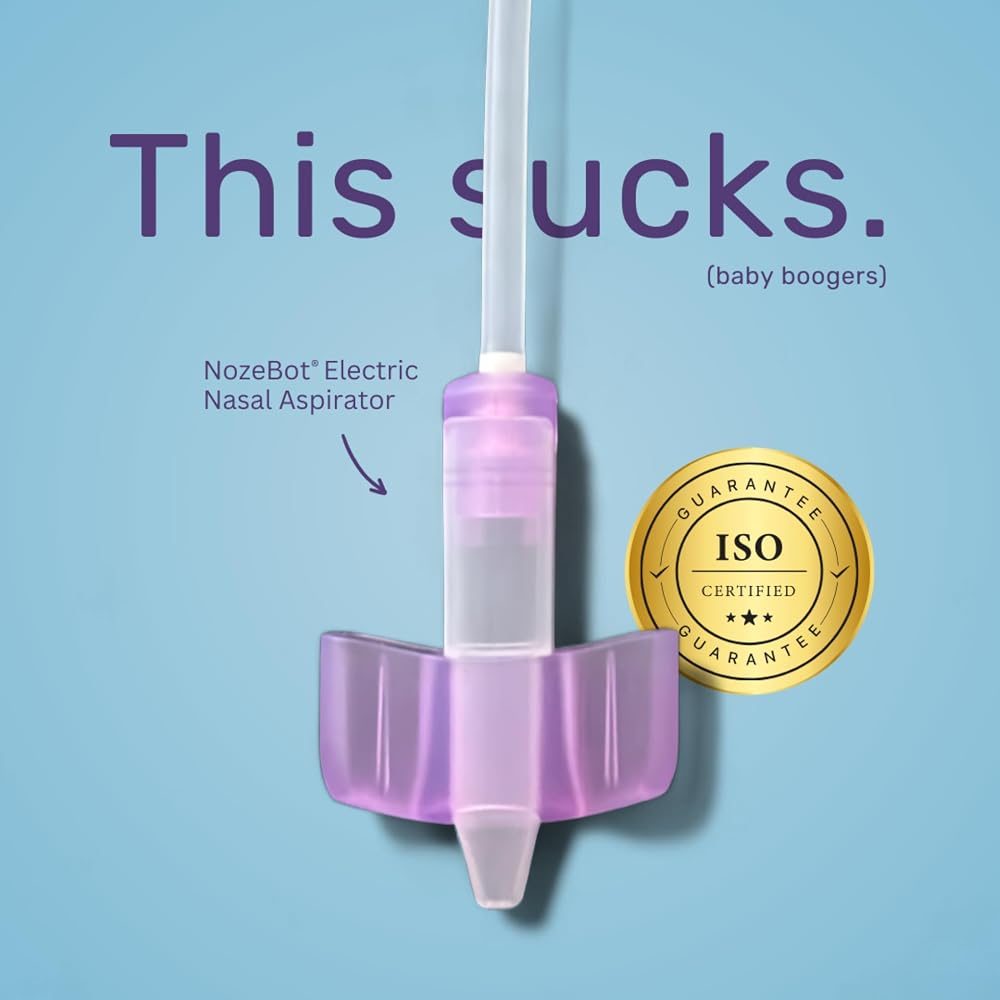
 The original NozeBot — a rechargeable pump unit with tubing, disposable filters and the patented two-finger nosepiece that frees your thumb to steady the baby’s head
Electric nasal aspirator · Check #82 — tester request
Dr. Noze Best NozeBot Electric Baby Nasal Aspirator
The strongest home electric aspirator in the owner file — a real paediatric ENT’s design with three suction levels and a two-finger nosepiece — worth it if congestion in your house is recurrent or heavy and you’ll keep it charged and change its filter every use; for a few mild colds a year, the $14.99 manual in check #47 does the job.
See current price ↗The pitch
hospital-grade suction at home — three levels, a patented two-finger nosepiece, cordless and rechargeable, designed by a paediatric ENT
The catch
$119.97–$134.99, an ~8-hour charge for ~2 hours of use, a motor that gets louder (and scarier) as the levels rise, a disposable filter to replace every use, and only a 6-month warranty
FSA/HSA
eligible — sold as FSA-eligible at FSA Store, flagged eligible at Babylist, and confirmed by the brand
What it is
A cordless, rechargeable electric nasal aspirator for infants and toddlers (model NNA2280, 4.8 × 3.7 × 2.4 in, 1.8 lbs): a palm-sized pump pulls suction through flexible tubing to a patented two-finger nosepiece — index and middle fingers go in the grip, freeing your thumb to steady the baby’s head, so one person can do the whole job. Three suction levels (low / medium / high). A disposable filter in the nosepiece path keeps mucus out of the tubing and pump and is replaced after each use. The nosepiece and tubing are top-rack dishwasher safe; the pump unit is not washable. In this listing’s box: pump, tubing, nosepiece, three replacement filters and a charging cable (the brand’s direct bundles include 12 filters — the count depends on channel). The designer checks out in full: Dr. Steven Goudy, a paediatric ENT surgeon, division chief of otolaryngology at Children’s Healthcare of Atlanta and an Emory professor, who built the NozeBot in 2021 with Georgia Tech students after his own family was sent home with a hospital bulb syringe. This is the original NozeBot — not the single-level, AA-battery NozeBot On the Go ($59.99), whose own owner file says the original is stronger.
Claims vs. reality
“Hospital-grade suction” — the brand publishes a number; nobody independent has measured it. Dr. Noze Best’s own guide states a maximum suction of 78 kPa (585 mmHg), average 60 kPa (450 mmHg) — more documentation than any rival in this library offers (checks #47–#50 publish no figures at all). But no independent lab test was found, the “up to 3× competitors” multiplier never names the competitors or a method, and “hospital-grade” has no consumer standard behind it. The verifiable regulatory facts are plainer: the brand states the NozeBot is a Class II, 510(k)-exempt medical device, registered with the FDA (registered — not approved or cleared) and TÜV SÜD America safety certified. Buy it on the owner file below, not on the mmHg.
“Designed by a paediatric ENT” — verified, in full. Goudy’s Children’s Healthcare of Atlanta and Emory roles, the 2021 Georgia Tech collaboration and the hospital-bulb origin story are stated identically by Atlanta Magazine, Modern Luxury and Simply Buckhead, and hands-on reviewers confirm the two-finger grip works as described. A real clinician designer is evidence the brief was serious — it is not a performance guarantee for any individual unit.
Charging — the glossed-over flank. The manual for this listing puts a full charge at ~8 hours for ~2 hours of run time; one hands-on reviewer needed over 12 hours to reach half a charge, the unit cannot be used while charging, and the paperwork cannot even agree on the cable (the manual’s box list says Micro-USB; its setup text and Babylist say USB-C — check the box, not the listing). Keep it charged through cold season: a flat NozeBot at 2 a.m. is a $120 paperweight.
Cleaning — hygienic, with a consumable attached. No opaque bulb interior to grow mould unseen, and the contact parts go in the dishwasher. The cost is the disposable filter, replaced after every use — the manual names a clogged filter as the first cause of lost suction, and an owner reports moisture reaching the tubing when the filter wasn’t changed. Standalone filter-pack pricing could not be verified (the brand’s own bundle prices disagree across its pages), so budget filters as an ongoing, brand-priced consumable. The smaller newborn nosepiece (25% smaller) is a separate purchase, not in this box.
Noise — the complaint the praise steps around. Hands-on and roundup sources agree the motor is loud and gets louder per level, and can startle the baby — awkward, because the babies who need level 3 are the ones most likely to fight it. No decibel figure is published anywhere.
Safety & recalls
No CPSC recall was found for the NozeBot or Dr. Noze Best (checked Oct 21, 2026). The rules that make any aspirator safe apply in full: saline first to loosen mucus — dry mucus defeats every suction level; start on the lowest level and step up only as needed; aim the nosepiece outward, toward the ears, not inward, and never force it deep — it is shaped to sit at the front of the nose; and respect the manual’s own warning — overuse can swell the nasal passages — with paediatric guidance capping saline-and-suction at about 4 times a day, before feeds and sleep. Replace the filter after each use so mucus never reaches the tubing. And the brand’s own red-flag list stands: difficulty breathing, persistent wheezing, fever over 100.4°F under 3 months, refusal to eat or drink, fewer wet diapers or lethargy are a doctor call, not a higher suction level. Information only, not medical advice.
Real reviews — what owners say
The deepest owner file of any electric aspirator in this library. Amazon’s record for this listing aggregates to about 4.4/5 across 2,877 reviews (pricehistory.app, Oct 2026); Babylist rates it 4.7/5 across 51 ratings (90% five-star, reviews syndicated from the brand’s site); MomLovesBest’s tested roundup scores it 4.25/5 and names it Best Rechargeable Nasal Aspirator; a hands-on reviewer found the top level “actually pretty powerful… cleared severe congestion with ease.” The praise repeats in one voice: it clears what bulbs, mouth-suction and $40 handheld electrics could not — an ICU nurse and second-time mother calls it “so much stronger than everything else”; RSV and daycare-nose accounts credit it with ending ER trips and sleepless nights; sessions end in “a minute or less” because the speed ends the fight. The complaint spine: price (the standing asterisk, even in five-star reviews); noise rising with level; charge time; moisture past a stale filter; and a 6-month warranty that is short for the money. Notably absent: the repeating stopped-working pattern that fills the Electric NoseFrida’s file in check #48.
Price & FSA/HSA
$119.97 at Amazon is the verified anchor for this listing (tracked Oct 20, 2026; the listing’s tracked range runs $95.98–$134.99) — Babylist matches it at $119.97 and FSA Store sits at $119.99. Do not pay the brand promo pages’ $134.99 for the same unit; the brand’s own refurbished unit (tested suction and battery, new nosepiece, tubing and filters) is $79.99 direct and is the legitimate budget route. Against this library’s shelf: the manual NoseFrida (check #47) is $14.99 at 4.7/5 and remains the most effective aspirator per dollar for ordinary colds; the Electric NoseFrida (check #48) is $35.49–$39.99 with a much weaker owner file. Running costs: disposable filters every use, the optional newborn nosepiece, and battery wear past a 6-month warranty.
FSA/HSA: eligible — sold as an FSA-eligible product at FSA Store, flagged FSA & HSA eligible at Babylist, and confirmed by the brand. Verify against your own plan before checkout and keep the receipt.
The verdict
WORTH IT IF… your household’s congestion is recurrent, heavy or high-stakes: repeated colds, RSV seasons, chronic daycare nose, or the narrow nasal passages the designer built this for. Then the file supports the premium: the strongest owner-verified clearing of any home aspirator checked here, one-person two-finger operation, three levels starting gentle, dishwasher-safe parts, FSA/HSA eligibility and no recall. The conditions: saline first, lowest level first, a fresh filter every use, sessions capped (overuse can swell nasal passages — the manual’s own warning), the device kept charged (about 8 hours to full, unusable while charging), the motor noise accepted, and the purchase made at about $119.97, not $134.99. Not worth it if your baby gets a few mild colds a year — check #47’s $14.99 manual is the rational buy and this is $105 of overkill — or if you need a gadget that works after months forgotten in a drawer: a sealed battery and an 8-hour charge are the opposite of that product.
Sources: FormSubmit tester request (Oct 21, 2026 — product named, a.co link resolved by the form to amazon.com/dp/B08G6SZ2LT; an identical duplicate submission 7 seconds later deduped); amazon.com listing index for ASIN B08G6SZ2LT (model NNA2280, first available Jan 15, 2021, #9 in Baby Nasal Aspirators; listing FAQ on filter changes) and manuals.plus manual for B08G6SZ2LT (box contents — pump, tubing, nosepiece, three replacement filters, charging cable listed as Micro-USB while the setup text says USB-C; full charge ~8 hours, ~2 hours’ run time; overuse/swelling safety warning; start-lowest instruction; clogged-filter troubleshooting); pricehistory.app ASIN record (Amazon $119.97 on Oct 20, 2026, tracked range $95.98–$134.99, 8.8/10 across 2,877 reviews); drnozebest.com (product metadata $119.98; how-to guide — maximum suction 78 kPa / 585 mmHg, average 60 kPa / 450 mmHg, aim outward toward the ears, filters replaced after use; evergreen page — Class II, 510(k)-exempt, FDA-registered, TÜV SÜD certified, 6-month limited warranty; promo pages at $134.99; refurbished unit $79.99; On the Go $59.99 single-level sibling and its red-flag symptom list); atlantamagazine.com, modernluxury.com and simplybuckhead.com founder profiles (Dr. Steven Goudy, paediatric ENT surgeon, Children’s Healthcare of Atlanta / Emory, 2021 Georgia Tech collaboration, Down syndrome population focus); babylist.com ($119.97, FSA & HSA Eligible, box contents incl. USB-C cable and three filters, newborn nosepiece 25% smaller; 4.7/5 across 51 ratings, brand-syndicated reviews); target.com (original NozeBot pool syndicated from drnozebest.com — the Oct 19, 2026 moisture-past-the-filter review, the Sep 18, 2025 weak-result review); momlovesbest.com tested roundup (4.25/5, Best Rechargeable Nasal Aspirator, loud-motor and slow-charge cons); ttpm.com hands-on (>12 hours to half a charge, noise rising per level and scaring the baby, level 1 still clearing); babytochild.com hands-on (top level powerful, severe congestion cleared); productreviewcrew.com (cannot use while charging); fsastore.com ($119.99, FSA-eligible); site:cpsc.gov searches (no NozeBot / Dr. Noze Best recall found, Oct 21, 2026); report.md checks #47 (manual NoseFrida, $14.99, 4.7/5) and #48 (Electric NoseFrida, $35.49–$39.99, 3.8/5). NOT verified: Amazon’s live buy-box read (Amazon blocks automated reads; price and rating rest on the pricehistory.app ASIN record, price corroborated by Babylist and FSA Store); any independent laboratory suction measurement (the kPa/mmHg figures are the brand’s own); the cable type and filter count in the current Amazon box (sources conflict — Micro-USB vs. USB-C, three filters here vs. 12 in brand bundles — flagged in the check); the standalone replacement-filter pack price (brand bundle pricing disagrees across its own pages); any published decibel figure (none exists).
The strongest home electric aspirator in this library’s owner file — designed by a real, checkable paediatric ENT surgeon, with three suction levels and a two-finger nosepiece that turns clearing into a one-person job — worth it if your household faces recurrent or heavy congestion (RSV seasons, daycare nose, chronic stuffiness) and you’ll keep it charged and change its disposable filter every use, because at $119.97 it is three to eight times the price of the alternatives, its full charge takes about 8 hours, and for a few mild colds a year the $14.99 manual in check #47 does the job.