
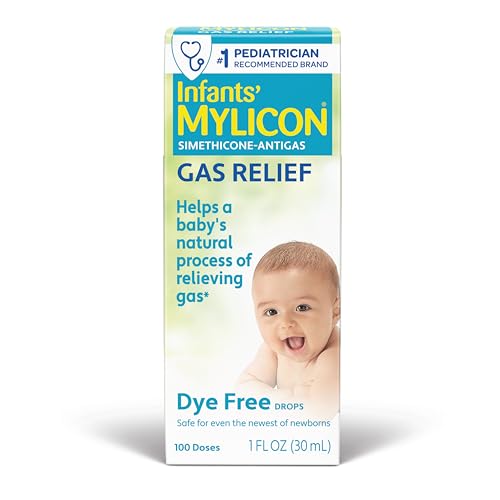
 The Dye-Free 1 oz carton — 100 doses of simethicone, the identical drug Equate sells for $4.34
Health & Home · Check #223
Mylicon Gas Relief Drops for Infants (Dye-Free, 1 fl oz)
A $9.86 bottle of simethicone drops whose colic-crying relief does not beat placebo in randomized trials — and whose identical drug, strength and 100-dose bottle sells as Walmart Equate for $4.34.
See current price ↗The pitch
gentle relief that “breaks up gas bubbles” so baby can burp it out — safe for even the newest newborns, and the “#1 pediatrician recommended brand” (a brand claim with no published survey behind it)
The catch
the relief being sold fails its trials — no better than placebo for colic crying — and identical simethicone 20 mg/0.3 mL, 100 doses, sells for $4.34 as Walmart Equate
FSA/HSA
eligible — an OTC medicine, no prescription needed (CARES Act); buy it at Amazon or Walmart, not at the FSA Store’s $13.99
What it is
An OTC antiflatulent (“antigas”) liquid: simethicone 20 mg per 0.3 mL, dosed with the enclosed syringe into the inner cheek after meals and at bedtime. Label (DailyMed; made for Infirst Healthcare): under 2 years / under 24 lb get 0.3 mL, over 2 / over 24 lb get 0.6 mL, mixable with 1 oz of cool water or formula, never more than 12 doses a day. The 1 fl oz bottle is 100 infant doses. The Dye-Free variant is the right one of the two: per the two DailyMed labels it is identical to the Original in active, strength and directions — the Original simply adds two red dyes (D&C Red 22 and D&C Red 28). One records conflict, printed in the full check: the brand’s current website FAQ lists a longer inactive-ingredient set than the DailyMed/listing label for this ASIN, so the carton in hand governs.
Claims vs. reality
The mechanism is real; the outcome is unproven. Simethicone is a defoamer — it lowers surface tension so small gas bubbles merge into ones that pass as burps — and it is not absorbed, passing through unchanged. But the trials measured crying, not burping, and there it fails: the Cochrane review of the three placebo-controlled trials (136 infants) concludes there is “no evidence to support the use of simethicone as a pain-relieving agent for infantile colic”; in the largest trial 28% improved on simethicone vs. 37% on placebo, and the AAFP states flatly that simethicone is “no better than placebo.” The regulatory file agrees with the scepticism: simethicone sells under FDA OTC Monograph M002, an ingredient-level “generally recognized as safe and effective” determination from the 1970s review that permits claims about “bloating, pressure, fullness” — it contains no infant indication and no colic finding, and Mylicon is a monograph drug, not an FDA-approved product. Two carton claims do not verify: “#1 pediatrician recommended” has no published survey or methodology behind it, and the “#1 Best Seller” framing is stale — the pinned ASIN’s mirrored rank is #20 in Baby Colic & Gas Relief.
Safety & recalls
The safety claim is the strongest thing on the box, and it holds. Non-absorbed, no systemic exposure, no known contraindications, no minimum age on the label — and a maximal labelled day for an infant (12 × 0.3 mL × 20 mg = 72 mg) sits far under the monograph’s 500 mg/day ceiling. The label’s entire Warnings section is “keep out of reach of children” plus the Poison Control line (1-800-222-1222) — it prints none of the red flags parents actually need, so they are printed here: fever in a baby under 3 months, blood or mucus in stool, green/yellow or projectile vomiting, poor feeding or weight gain, a hard distended abdomen, or inconsolable crying mean a pediatrician, not another dose. One real recall, exactly this product, long past: in November 2008 about 12,000 units of the Dye-Free 1 oz (lots SMF007/SMF008) were voluntarily recalled because bottles could contain metal fragments from manufacturing; those lots expired in 2010. No later Mylicon recall surfaced in Oct 2026 searches. Use only the enclosed syringe; shake well; store at room temperature, do not freeze.
Real reviews — what owners say
Pools kept separate. The Amazon dye-free family pool is 4.8/5 (86% five-star across 15,617 ratings — a variant-shared pool; the pinned 1 oz ASIN’s own mirrored counts run 674–846). Target 4.8/5 across 652 ratings, Walmart 4.8/5 across roughly 1,450–1,630, FSA Store 5/5 across 22. The praise is consistent: “works in minutes,” a burp or toot follows, the baby settles, and the updated dose-stopping syringe gets specific love. The negative cluster is the trial literature in anecdote form: the fullest Target review is a twin mom whose daughter got “night and day” relief in under a minute while her son was not helped at all; other owners report the store brand working “just as well” for significantly less, and that one bottle does not last long at up to 12 doses a day. Both files can be true — a safe defoamer, a symptom that resolves on its own within minutes, and a strong placebo-by-proxy effect on the parent holding the syringe.
Price & FSA/HSA
$9.86 at Amazon for 1 fl oz / 100 doses — about 9.9¢ per dose, $1.18 for a maximal 12-dose day. Also $9.86 at Walmart, $9.89 at Target and $13.99 at the FSA Store; against a $9.59 long-run Amazon average, $9.86 is a fair street price for the brand. The alternatives are the same drug at the same strength in the same 100-dose bottle: Walmart Equate Infants’ Gas Relief Drops, Dye-Free — $4.34 (its carton literally invites comparison to Mylicon’s active ingredient; 4.7/5 across 511), Little Remedies Gas Relief Drops — $7.66–$8.19, and Mommy’s Bliss (simethicone plus ginger) at $7.99–$9.97. The roughly $5.50 over Equate buys no verifiable difference in active ingredient, strength, dose count or evidence — simethicone is a commodity molecule. FSA/HSA: eligible — OTC medicines have been eligible without a prescription or a letter of medical necessity since the CARES Act (2020); spend the account at Amazon or Walmart rather than paying the FSA Store’s $4 eligibility premium.
A perfectly safe simethicone drop — not absorbed by the body, labelled for up to 12 doses a day from birth — sold for relief that does not beat placebo: Cochrane and the AAFP both find simethicone no better than placebo for infant colic crying, and the FDA monograph behind its “antigas” label never evaluated infants at all. At $9.86 — 2.3× the $4.34 Equate price for the identical drug, strength and bottle — the premium buys a name and a dose-stopping syringe, not medicine. Not Worth It.