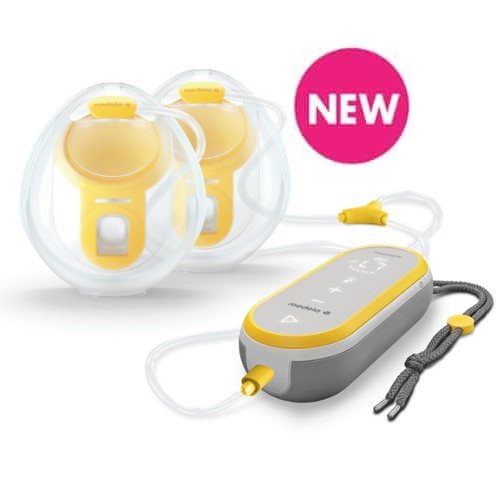
 The Freestyle cups in-bra, motor in pocket (brand photo)
Feeding & Pumping · Check #278
Is the Medela Freestyle Hands-Free worth it?
Medela Freestyle Hands-Free
The lightest cups in the wearable field (76 g, three parts to wash) on a pocket motor with real 245 mmHg suction — but Medela's own FAQ says the cups are not hospital-grade, output trails a plug-in pump for a split share of owners, and the $349.99 list price is the highest of the wired wearables.
See current price ↗The pitch
Medela’s first hands-free pump: 76 g in-bra cups with only 3 parts to wash, 105° shields, 2-Phase Expression with 9 vacuum levels per phase, a 273 g pocket motor, Bluetooth app tracking, and up to eight 15-minute sessions per charge
The catch
245 mmHg max — below the Spectra S1’s verified 270 mmHg — behind “hospital performance” language Medela’s own FAQ undercuts (the cups are “not hospital grade” and not part of the Symphony system); 5 oz cups with no auto shut-off, membranes every 3–6 months at $19.99, and a manual-rated operating life of 250 hours
FSA/HSA
eligible — breast pumps are qualified medical expenses under IRS Publication 502; if insurance pays part, run only the out-of-pocket upgrade portion through FSA/HSA
What it is
Medela’s first hands-free pump: a wired wearable — two in-bra collection cups on tubing to a separate pocket motor (273 g), not motors on the breast. The cups are the lightest in the library’s wearable field at 76 g each, hold 150 mL / 5 oz each, and break into just three parts per cup (shield, membrane, shell), all dishwasher-safe. The box includes 21 mm and 24 mm shields; the touchscreen motor adds a session timer and Bluetooth sync to the Medela Family app (time and level auto-log; volume is manual). Suction is Medela’s 2-Phase Expression pattern with 9 vacuum levels in each phase, single or double pumping, and a 30-minute auto shut-off. Warranty is 1 year on the motor, 90 days on parts, and the pump is single-user — once the seal is broken it cannot be returned unless faulty.
Claims vs. reality
“Hospital performance”: Medela’s own FAQ answers the question directly — “No, the Hands-free Collection Cups are not part of the hospital grade pump system Symphony® PLUS. These cups are not for hospital use.” For building supply in pump-dependent mothers, Medela itself recommends the Symphony rental and positions the Freestyle for after supply is established. 2-Phase Expression is a real sucking-rhythm pattern, not a hospital-grade certification. Suction: the maximum vacuum is 245 mmHg — 25 mmHg below the Spectra S1 benchmark’s verified 270 mmHg (check #18) and at the low end of a wearable field that runs to 280–300 mmHg. Enough to empty many mothers; not the hospital-strength number the brand halo implies. “Up to 11.8% more milk”: that figure is a shield-angle result — Medela’s 105° shields vs. traditional 90° shields across 1,000+ sessions — not the Freestyle measured against any other pump. 5 oz cups: the brim number shrinks in use — there is no auto shut-off when full (Medela’s FAQ confirms it), an owner test found suction dropping once milk reaches the nipple-tunnel level, and the open pouring spout means Medela warns against bending fully or intense exercise while pumping. Battery: rated at eight 15-minute sessions ≈ 2 hours, the shortest of the wired wearables in independent comparison — though it can charge while pumping, a rare plus — and the manual rates the pump’s operating life at 250 hours, a figure that appears nowhere on the product page. Parts: three parts to wash is real, but the membrane is a consumable — Medela directs replacement every 3–6 months at $19.99 a 2-pack, with tubing at $19.99, shields at $29.99 and a full cup set at $89.99, all proprietary.
Safety & recalls
No CPSC recall names the Medela Freestyle Hands-Free (checked Nov 1, 2026). The 2016 Medela “recall” in the headlines was a UK/Australia voluntary plug-replacement program for the original Freestyle’s detachable wall plug (pre-Oct 2016) — a different, discontinued pump, and a plug this USB-C model does not have. An August 2025 FDA MAUDE report describes a unit sold as new through a marketplace arriving apparently used with the charger missing — an incident report, not a recall, but a concrete reason to follow the manual’s rule: single-user device, never share it, and be wary of marketplace “new” listings. The system is closed when used as instructed (never rinse inside the tubing); wash parts after each use, sanitize daily, and do not store milk in the cups.
Real reviews — what owners say
Target rates the pump 4.0/5 across 420 ratings and 407 reviews — its summary praises multitasking, suction and easy cleaning and flags battery life, touchscreen sensitivity and leaks, and notes incentivized reviews are included; the wider syndicated pool sits at 3.6/5 across ~1,899 ratings with 21% one-star. On output, owners split down the middle: one camp matches a plug-in (“comparable results with only about 4 extra minutes”; output level with a rented Symphony after three weeks), while another trails — one four-week test pulled 5 more ounces with a Spectra S2 immediately after a Freestyle session, and a competitor-run comparison (Momcozy’s blog, flagged) timed the Medela 5–10 minutes slower to the same output. Recurring specifics: the touchscreen has no lock, so pocket bumps pause or re-mode it mid-session; the motor is louder than “discreet” implies (Medela publishes no dB figure); un-snapped cups leak at the seam; there is no belt clip, only a lanyard; and a failure tail reports batteries that stop holding a charge inside the first year. Cleaning praise is near-universal — three parts is the most-cited like. Independent reviewers agree: whichbreastpump calls the suction “not that strong” and the battery the shortest of the wired wearables; Mother&Baby’s expert test scored it 4.0.
Price & FSA/HSA
$349.99 list at Medela US, Aeroflow and DME retailers — the highest list price among the library’s wired wearables, $124.01 above the Spectra S1’s $225.99. Street price is the real price: CamelCamelCamel’s record for the US listing shows an average Amazon price of $203.15 and a most recent tracked $188.80, and Target has crawled between $189.99 and $279.99. Add the running costs: membranes $19.99 every 3–6 months ($40–$80 a year), tubing $19.99, shields $29.99, full cup set $89.99. Through insurance it is an upgrade pump — the plan covers a portion and the balance is out of pocket, while the Spectra class is commonly the fully covered option (verify your own plan). Breast pumps are FSA/HSA eligible under IRS Publication 502; if insurance pays part, run only the out-of-pocket upgrade portion through FSA/HSA. At ~$190–$205 street it is a respectable established-supply workday pump; at $349.99 list, it is the category’s top price for its lowest wearable suction number and shortest battery.
The lightest cups in the wearable field (76 g, three parts to wash) on a pocket motor with real 245 mmHg suction — but Medela’s own FAQ says the cups are not hospital-grade, output trails a plug-in pump for a split share of owners, and the $349.99 list price is the highest of the wired wearables. Worth It If…