
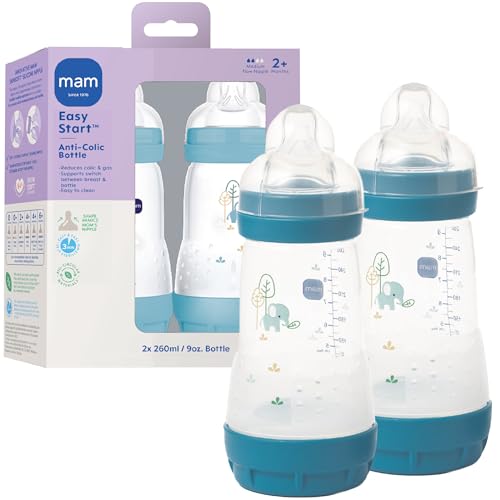
 The pinned 9 oz 2-pack (Blue Teal) — vented screw-down base and flat SkinSoft nipple; the 5 oz pack is a different listing
Baby bottle · Check #89 — Batch 6
MAM Easy Start Anti-Colic Bottles, 9 oz 2-Pack
The “clinically proven to reduce colic in 80% of babies” headline is not what MAM’s own footnote says — it is two mother-report surveys totalling 108 mothers — but the vented-base bottle underneath sterilises itself in the microwave, unscrews at both ends for cleaning, and carries a deep nipple-acceptance file: worth it if sterilising and travel are your problem and you will learn the valve assembly, because…
See current price ↗The pitch
a vented base clinically proven to reduce colic symptoms in 80% of babies, a flat breast-shaped SkinSoft nipple with 94% acceptance, and self-sterilising in the microwave in 3 minutes
The catch
the 80% is mother-report field/market research (n=73 + n=35), not a clinical trial; it leaks when the base valve is mis-seated (BabyGearLab Leakage 5.0, overall 46/100); markings start at 2 oz and wear off
FSA/HSA
not eligible — bottles are feeding containers, not lactation supplies (pumps and lactation supplies are eligible; feeding bottles are not)
What it is
Two 9 oz (260 ml) bottles built around a vented screw-down base: ventilation holes in the base admit air at the bottom as the baby drinks and a silicone anti-colic valve in the base regulates it, so milk flows without bubbling back through itself and no vacuum builds. Six parts per bottle — body, base, valve, screw ring, flat symmetrical SkinSoft silicone nipple and a cap that doubles as the 20 ml measure for sterilising. This pack ships with Level 2 Medium Flow nipples (2+ months); flows 0 (extra slow) through X are sold separately and all fit the same bottles, and the 5 oz sibling ships with Level 1. BPA/BPS-free, made in Europe, EN 14350 on the pack. The brand’s own rule makes teats a consumable: replace every 1–2 months. The 5 oz pack, the glass version and the Easy Active line are different listings.
Claims vs. reality
“Clinically proven to reduce colic symptoms in 80% of babies.” Read the footnote, the way check #34 read Dr. Brown’s: it resolves to a 2011 Austrian field study (73 mothers of colicky babies) and 2010 US market research (35 mothers) — the pack’s own wording is “80% of mothers confirmed less colic.” That is mother-report with no control group and no published crying-time data, and the one actual clinical study in the pack’s footnotes (Argentina 2012, 34 preterm infants) is about relaxed feeding, not colic. Colic itself is unexplained, peaks around 6 weeks and resolves by 3–6 months with no correlation to breast vs. bottle feeding (AAFP) — so switches at peak misery improve on their own schedule. The vent’s mechanical job is real, and owners do report less gas and spit-up; the sentence as printed is not earned.
“Self-sterilising in 3 minutes, sterile for up to 48 hours.” True — the strongest verified claim in this check, and unique in this library. Wash first, stack the parts with 20 ml of water in the base (body resting on top, not screwed down), microwave 3 minutes for one bottle (up to 8 for six) at 500–1000 W, cool 10 minutes, and a bottle left stacked stays disinfected up to 48 hours (brand manual, read in full). Babylist names it its Best Self-Sterilizing Bottle for Travel. The price is procedural: exact water volume, a clean microwave, never run dry.
“94% nipple acceptance.” A market-research tally (2009–2022, 1,643 babies), not a trial. The flat nipple’s acceptance file in owner pools is genuinely strong — bottle-refusers taking it when round nipples failed — but BabyGearLab scored the nipple 5.0/10, and a peer-reviewed flow study (Pados et al., 2016) measured this line’s Level 1 as the most variable flow of 26 nipples tested (CV .37). Start newborns on Level 0 and judge by the feed, not the box.
Safety & recalls
No CPSC recall was found for MAM bottles (checked Oct 21, 2026). Naming trap: the “Mam…” recall results are Mamibaby loungers — a different brand and a sleep product (check #2); nothing in that file attaches to MAM. The rules that matter: (1) Seat the valve right — flat, “THIS WAY UP,” base screwed on slow and tight over dry threads; a mis-seated valve is the documented cause of both base leaks and lost venting. (2) Never warm or cool a sealed bottle in water — remove the top first or the vented base draws water in; the thick base also warms slowly. (3) Teat discipline — inspect and pull-test before each use, replace at first damage and every 1–2 months regardless. (4) Sterilising hygiene — exact 20 ml, never without water, clean microwave, 10-minute cool before handling. Information only, not medical advice.
Real reviews — what owners say
Amazon’s family pool for this pack runs ≈4.8/5 (pricehistory.app’s record for this ASIN: 9.6/10 across 7,617 reviews; variant-shared pool — mirrors read up to ~19,700, flagged in the full check); Target’s cleaner pools read 4.6/5 across 96 (5 oz 2-pack) and 4.4/5 across 1,311 (5 oz 3-pack). Praise: nipple acceptance by babies who refused rivals, less gas and spit-up after switching, a bottom that unscrews so there is no blind interior to scrub, and self-sterilising on trips. Complaints, in order: leaks from the base when the valve/base assembly is rushed — the spine of every pool, and the lab hit it too (BabyGearLab overall 46/100, #13 of 14: Leakage 5.0, Nipple 5.0, Cleaning 4.0); measurements — the opaque base hides everything under 2 oz and the print wears off in months (Babylist’s file agrees); flow surprises — too-fast Level 1 reports and one box labelled 0 containing a 1; and slow warming through the thick base.
Price & FSA/HSA
$13.38 at Amazon (Oct 20, 2026) for the pinned 9 oz 2-pack — tracked low $10.81; the $20.41 “average” and $57.26 high are marketplace-listing artifacts, and ~$13–$18 is the real band. Target corroborates the system’s pricing: 5 oz 2-pack $12.99, 5 oz 3-pack $19.49, single 5 oz $7.59; Babylist’s 5 oz 4-pack runs from $29.99. Running costs are replacement nipples as flow steps up, teats on the brand’s 1–2-month replacement rule, and spare valves — offset by never buying a steriliser, bags or tablets. At ~$6.70 a bottle it lands beside Dr. Brown’s commodity pricing (check #34) and ~$9 under Comotomo’s 2-pack (check #86).
FSA/HSA: not eligible — the FSA/HSA Store eligibility list states baby-bottle reimbursement is not eligible, and IRS Publication 502 covers pumps and lactation supplies while excluding feeding bottles. The pump is eligible (checks #18, #84); the bottle you feed from is not, even when it sterilises itself.
The verdict
WORTH IT IF… sterilising is a daily tax in your house or you travel with bottles — the self-sterilising base is real, verified in the brand’s own manual and crowned by Babylist for travel — and you want a vented bottle whose bottom unscrews for cleaning, at a commodity ~$13 per 2-pack, with a nipple that picky babies demonstrably accept. The conditions: you retire the headline on day one (the 80% colic figure is mother-report surveys, n=108, not a clinical trial; persistent inconsolable crying goes to the pediatrician, not a second bottle system); you learn the valve assembly, because leaks and lost venting are the same rushed step failing two ways; you don’t track ounces precisely (markings start at 2 oz and fade); you start flow by the baby, not the box; and you budget teats every 1–2 months. Not worth it if: the colic sentence is the purchase (no bottle earns it); precise intake tracking matters (marked glass — check #35); or a six-part assembly ritual will fail at 3 a.m. (check #86’s three-part Comotomo is the simpler, best-tested machine).
Sources: Batch 6 queue and batch-6-candidates.md (Joe-approved Oct 21, 2026); pricehistory.app Amazon records for ASIN B07FNB3MHM (model 5673-006-0-1, $13.38 on Oct 20, 2026, 9.6/10 across 7,617 reviews, tracked low $10.81 / high $57.26) and sibling B00DYOQKQW; mambaby.com Easy Start instructions (EN 09/2025) and teat leaflet (replace every 1–2 months); pack-copy footnote reproductions at Publix, ASDA and grocefully (field study Austria 2011, n=73; market research USA 2010, n=35; Argentina 2012 preterm study, n=34); BabyGearLab best-baby-bottle tested program (MAM overall 46/100, #13 of 14; Leakage 5.0, Nipple 5.0, Cleaning 4.0, Eco-Health 3.0, Ease of Use 6.0); Babylist best-bottles guide (Best Self-Sterilizing Bottle for Travel; con list); Pados et al., MCN 2016 (PMID 27008466 — MAM Nipple 1 variability CV .37, widest of 26); AAFP infantile colic review; Target Easy Start pools and reviews; shopabunda/Ubuy Amazon mirrors; manuals.plus valve manual; site:cpsc.gov searches (no MAM bottle recall found, Oct 21, 2026). Full source notes, method and NOT-verified list in report.md, Verdict 89.
“Clinically proven to reduce colic in 80% of babies” is not what MAM’s own footnote says — it is two mother-report surveys totalling 108 mothers — but the bottle underneath is a sound vented-base design with the one feature no rival here has: it sterilises itself in the microwave. Worth it if travel and daily sterilising are your problem, you’ll learn the valve assembly that keeps it leak-free, and you don’t need to read the last 2 ounces.