
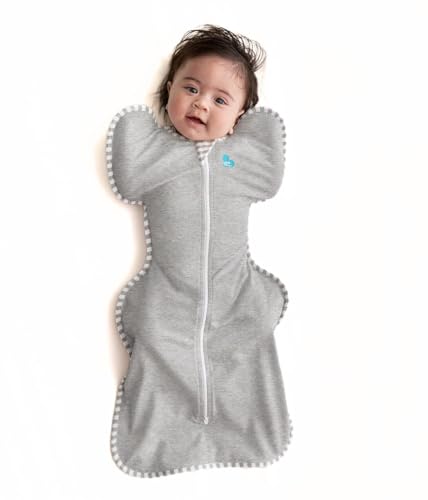
 The pinned Original Cotton 1.0 TOG in Gray, Small — patented arms-up wings and a two-way zip; transitioning out of it is a separate $49.95 bag
Arms-up swaddle · Check #92 — Batch 6
Love to Dream Swaddle UP Original 1.0 TOG (Gray, Small)
The best-built arms-up swaddle in the library — BabyGearLab’s Easiest to Use pick, Mumsnet’s Best Buy, ≈4.6/5 across ~12,500 Amazon ratings — worth it if your baby sleeps with their hands by their face and fights arms-down wraps, because ‘almost double the sleep’ is the brand’s 2017 customer survey (self-estimated, uncontrolled for age, averaged over only the 82% who improved), the neck fit is exact and…
See current price ↗The pitch
patented arms-up wings let baby self-soothe for more sleep, hip-healthy shape, TOG-rated warmth, swaddle in seconds with a two-way zip
The catch
“almost double the sleep” is a brand customer survey, not a study; fit runs snug with narrow 5-lb size bands; the window ends at first roll signs and the Transition Bag out is $49.95
FSA/HSA
not eligible — swaddles are general sleepwear, not a medical expense, and no eligibility listing was found
What it is
A one-piece zip-up swaddle — not a blanket, not an arms-out sack. A two-way zipper closes a snug, stretchy torso while the arms rest in fixed patented wing pockets in the arms-up position beside the face, and the bottom bells out roomy over the hips and legs. Pinned build: Original Cotton (93% cotton / 7% elastane), 1.0 TOG, brand-rated for rooms of 68–75 °F, size Small, 8–13 lbs (size by weight: Newborn 5–8, Medium 13–19). Stage 1 of the brand’s 3-Stage Sleep System — the Transition Bag and arms-out sleep bags that follow it are separate purchases.
Claims vs. reality
Arms up = self-soothing. The position is real: the wings genuinely hold the hands beside the face for cheek-stroking and hand-sucking, with nothing to break out of — every hands-on source confirms the mechanism. The “= more sleep” step is a preference, not a property: Babylist’s file is babies who resist traditional swaddles (14% of its surveyed parents named it their favorite — a strong minority), and BabyGearLab found it may not compress enough to soothe the youngest newborns. The AAP adds the boundary: no evidence swaddling reduces SIDS risk — this is a sleep-preference tool, never a safety device.
“Almost double the sleep.” The 3h 45m → 7h 25m figure on every product page is the brand’s 2017 Customer Survey of 1,242 existing customers — and the survey page’s own notes give it away: parents estimated sleep retrospectively from time ranges; the figures are total sleep across the night, not one uninterrupted stretch; the survey did not control for age, in the exact months when night sleep grows on its own; and the average is computed only among the 82% who reported an increase. A satisfaction signal, honestly labelled — not a study.
“Hip-healthy.” The IHDI acknowledgment is real (brand FAQ: the Swaddle UP and Transition Bag are “acknowledged as a hip-healthy product”), and the bell-shaped bottom genuinely lets legs flex and splay. As in checks #60 and #87: acknowledgment is a design acknowledgment, not a certification or proof of prevention. Babies in a hip harness need the brand’s separate Hip Harness version — and their clinician — not this one.
TOG guidance. A real scale, clearly charted: 0.2 TOG for 75–81 °F, 1.0 for 68–75 °F, 1.5 for 64–72, 2.5 for 61–68, 3.5 below 61. The pinned 1.0 band brackets the AAP temperature zone honestly. The catches: the brand concedes the chart “is only a guide” (layers underneath change it — you still monitor the baby), and a nursery that crosses bands needs another TOG at $34.95–$52.95, in every size.
Safety & recalls
No CPSC recall was found for the Love to Dream Swaddle UP (checked Oct 21, 2026). The brand name does carry a current recall — of a different product: on Sep 24, 2026 CPSC recalled about 4,000 Love to Dream Portable Sleep Machines with Night Light (model LTD-SM23, date code 7W15TN, Recall 26-798) for a battery fire hazard, with a full refund. If you own that machine, check its codes; it says nothing about this fabric swaddle. The swaddle’s rules: stop at the first sign of rolling (AAP 2022 — usually 3–4 months, may be earlier; the brand’s US page says the same, sometimes as early as 8 weeks) — ignore older copy claiming the wings impede rolling; back, flat and bare, nothing over or under the swaddle; neck fit is a per-use check (1–2 fingers at the opening, no fabric able to pass over the mouth — size down between sizes, size up when the neck strains); match TOG to a measured room temperature and never add a blanket over a swaddle; no swaddle in car seats, strollers or carriers. It is not weighted.
Real reviews — what owners say
Pools: Amazon 9.2/10 (≈4.6/5) across 12,498 reviews (pricehistory.app record for this ASIN — its storefront label reads amazon.in, flagged in the full check); Target 4.7/5 across ~2,984; Walmart 4.8/5 across 1,084 (Gray Small). Editorial: BabyGearLab’s Easiest to Use pick, 68/100 (Comfort 6.0, Ease of Use 8.0, Durability 6.0); Mumsnet Best Buy; Babylist’s Best Sleep Sack for Newborns and its Most Loved runner-up. Praise is one voice: arms-up babies finally sleeping, the quiet two-way zip at 2 a.m., second and third purchases for rotation. Complaints, in order: sizing economics (narrow 5-lb bands outgrown in weeks — “finicky and expensive”); neck/chin fit (“neck line is too tight”; one five-piece owner reports fabric folding up over the chin/mouth — the reason the neck rule above is per-use); preference rejection (a real minority of babies hate arms-up or want deeper compression); and price per week of usable life. No repeating seam or zipper-failure pattern surfaced.
Price & FSA/HSA
$34.95 for the pinned swaddle — the same at the brand store and Walmart, $34.99 at Target, BabyGearLab list $35 (Amazon’s live buy-box could not be read directly; the candidates file’s Amazon range for the line was $29.99–$39.99 by size/stage — treat anything well above that as a reseller outlier). The unit price is disciplined; the system total is the story: two per size for laundry rotation is $69.90 per size, a typical baby crosses two to three sizes before roll signs (~$140–$210 bought new in pairs), a second TOG adds $34.95–$52.95 per size, and the Transition Bag out is $49.95. Start with ONE to test the preference; fabric swaddles pass down and resell safely (inspect zipper and neck stretch). Shelf context: check #24’s HALO sack is $34.99 and lasts past rolling; check #32’s Woolino is $109 once for 2 months–2 years.
FSA/HSA: not eligible — swaddles are general sleepwear, not qualified medical expenses (the category basis documented in checks #24 and #75); no eligibility listing was found, and Love to Dream offers no letter-of-medical-necessity program like Happiest Baby’s.
The verdict
WORTH IT IF… your baby sleeps with their hands by their face and fights arms-down wraps — and you buy it as a tested preference, in the exact size, for the short window allowed. Conditions: buy one first and test it over 2–3 naps before buying the rotation second (a compression-loving baby will reject the signature feature, and check #24 is that baby’s buy); size by weight and re-check the neck every use; match the 1.0 TOG to a 68–75 °F room (a cold nursery means the 2.5 TOG, never a blanket over it); stop at the first roll sign, as early as 8 weeks, and budget the $49.95 transition as part of this purchase; and read “almost double the sleep” as a 2017 customer survey, not a promise. NOT worth it if your baby already sleeps well in a basic wrap, if roll signs are already showing (go straight to an arms-out sack), or if the budget only works as a single $34.95 purchase covering the whole swaddle era — it doesn’t.
Sources: Batch 6 queue and batch-6-candidates.md (Joe-approved Oct 21, 2026); pricehistory.app ASIN record for B0081GJ038 (model 16-10101, 9.2/10 across 12,498; storefront label amazon.in, flagged); experiencedmommy.com and glowing.com US Amazon links to dp/B0081GJ038; lovetodream.com product pages ($34.95, 93% cotton / 7% elastane, 1.0 TOG 68–75 °F), 2017 Customer Survey page (1,242 families; 82% reported more sleep; estimated averages from time ranges; total night sleep, not one stretch; did not control for age), FAQ (IHDI hip-healthy acknowledgment; 3-Stage Sleep System; standards), TOG guide and “When to Stop Swaddling” page (stop at roll signs, 2–6 months, sometimes 8 weeks); aap.org 2022 safe-sleep release (no evidence swaddling reduces SIDS; stop swaddling at roll attempts); CPSC recall 26-798 coverage (the brand’s Portable Sleep Machine LTD-SM23 — a different product); babygearlab.com (Easiest to Use, 68/100); babylist.com (Most Loved runner-up, 14%; Best Sleep Sack for Newborns; size-down warning); mumsnet.com (Best Buy); target.com (4.7/5 across ~2,984; the neck-tight, runs-small, fold-over-chin and rejection reviews quoted); walmart.com ($34.95, 4.8/5 across 1,084); albeebaby.com (size chart; Hip Harness version; Transition Bag $49.95); productreview.com.au owner file; checks #24, #31, #32, #60, #75 and #87 in the full research file. Full check: research file, Verdict 92.
The best-built arms-up swaddle in the library — BabyGearLab’s Easiest to Use pick, Mumsnet’s Best Buy, ≈4.6/5 across ~12,500 Amazon ratings — for the babies who sleep with their hands by their face and fight arms-down wraps. But the “almost double the sleep” headline is the brand’s 2017 customer survey (self-estimated, uncontrolled for age, averaged over only the 82% who improved), sizing is exact and safety-critical at the neck, and all swaddling stops at the first sign of rolling — as early as 8 weeks.