
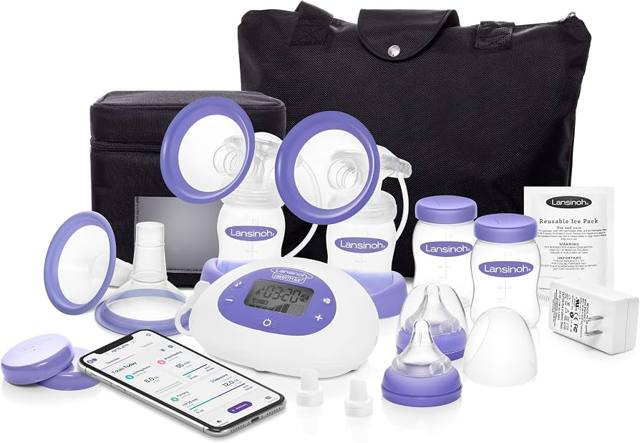
 The Smartpump 3.0 Lifestyle Set — the rechargeable, Bluetooth sibling of the plug-in SignaturePro; the pump in the middle is the product, the app on the phone is the bonus
Double electric breast pump · Check #109 — Batch 8
Lansinoh Smartpump 3.0 Double Electric Breast Pump
A rechargeable primary pump with an FDA-filed 280 mmHg ceiling that undercuts the battery Spectra by about $100 — worth it if insurance covers it or you want cordless on a budget, because no lab has measured its suction or output, its battery is rated ~2 hours at max settings, its box flanges run large, and its headline Bluetooth app rates 2.5/5 with data-loss reports.
See current price ↗The pitch
hospital-strength suction, 3 pumping styles, cordless rechargeable battery, Bluetooth app that automatically tracks your sessions
The catch
suction/output never independently measured; ~2-hour battery at max settings per the manual; app 2.5/5 with data-loss reports; not the plug-in SignaturePro in a smarter box — or vice versa
FSA/HSA
eligible — breast pumps are qualified medical expenses (IRS Pub 502); if insurance pays, only the out-of-pocket upgrade portion counts
What it is
A single-user, tabletop double-electric primary pump — tubes and external bottles, not a wearable — built around what its SignaturePro sibling lacks: a built-in rechargeable battery, Bluetooth to the Lansinoh Baby app, and settings memory. FDA-cleared Class II (510(k) K222726). 3 pre-programmed pumping styles, 8 suction levels, 2-phase let-down/expression, closed system, backlit LCD, carry handle, single or double pumping, and direct pumping into Lansinoh storage bags. In the box: pairs of 25, 28 and 30.5mm ComfortFit flanges, two 5 oz bottles, diaphragms, valves, tubing and an AC adapter; a free 1:1 setup session with a Lansinoh pump specialist. Warranty 1 year motor / 90 days parts. Not the SignaturePro (plug-in/AA, no battery, no auto-tracking), not the Smartpump 2.0, not Lansinoh’s wearables.
Claims vs. reality
“Hospital-strength suction.” The number is real and regulatory: the FDA filing lists 89–280 mmHg in expression and the manual states 100–280 mmHg double pumping — nominally above check #18’s Spectra at 270. But “hospital” is not an FDA suction standard, the filing is for a single-user personal pump (one supplier FAQ answers “hospital-grade? No” in terms), and — the decisive gap — no BabyGearLab, Wirecutter or Mommyhood101 bench test of this pump exists: the Spectra’s 270 mmHg is gauge-verified with ~0.55 oz/min measured, while the Lansinoh’s 280 is filed and unmeasured. The first-person file centres on “gentle and adequate” (one parent tester: max suction “not as high as it could be,” longer sessions, no soreness); a lactation-consultant roundup calls the 3.0 the Lansinoh that “performs well” while warning working moms off the SignaturePro. The 3 styles are pre-programmed patterns — unlike the Spectra, there is no separate cycle-speed control.
“Automatically tracks your sessions.” Half of it, honestly built: the app auto-records date, time and duration and can adjust settings over Bluetooth — but milk amount is entered by hand (the brand’s own FAQ), so unlike check #103’s Elvie it never invents your ounces. The plumbing is the problem: the Lansinoh Baby app rates 2.5/5 across 75 Google Play reviews, with smart-pump results that wouldn’t save, totals that added ounces never logged with no way to delete entries, and one owner’s five months of data erased by an app update. Value the Bluetooth at zero; keep records that matter outside the app.
“Cordless pumping anywhere.” Real and modest: the manual rates the built-in battery at ~2 hours at maximum settings (a minimum 3-hour charge first) — a workday’s pump breaks with nightly charging, not an all-day battery, and the adapter still travels with it. Note the supplier muddle: some DME copy calls the battery “attachable” and a separate battery pack is sold as an accessory, against the brand’s current “installed inside” — if a supplier ships yours, confirm the battery is in the configuration before it arrives.
Safety & recalls
No CPSC recall and no FDA recall for the Smartpump 3.0 was found (checked Oct 22, 2026). It is an FDA-cleared Class II, single-user pump — do not share it or buy it used as a shared device. The closed system keeps milk out of the tubing; inspect parts daily and replace the white valves on the brand’s cadence (every 4–6 weeks for exclusive pumping) — a worn valve is the first suspect when suction fades. Follow CDC breastmilk storage durations and never microwave expressed milk. Fit note, stated plainly: the included flanges run large and 21mm is the smallest size this pump offers (sold separately) — a smaller fit has no first-party option here. Information only, not medical advice.
Real reviews — what owners say
A thinner file than the benchmark’s, reported as found: no independent bench test of the 3.0 exists, and Amazon’s own pool for this ASIN could not be verified from a reachable record (bestreviews.guide’s 9.1 is a proprietary aggregator score, not a rating; one secondary aggregator prints an unsourced 4.5/5 — neither is rested on). The firm pools are the app’s (2.5/5 across 75, above) and the hands-on accounts: easy setup, genuinely comfortable ComfortFit rims, quiet night sessions, and “strong” suction from one 3.0 tester against the prior generation’s “gentle, takes longer” file (flagged as the older Smartpump wherever used). Complaints, in order: (1) the app — unsaved sessions, double entry, corrupted totals, update data loss, unstable connection; (2) charging discipline — the Amazon owner file’s own summary via bestreviews.guide is that it “requires regular charging”; (3) valve wear and replacement cadence; (4) the Lansinoh-only bottle ecosystem — other brands’ bottles don’t fit its rings. No repeating injury pattern surfaced.
Price & FSA/HSA
Check insurance first — this pump is listed at major suppliers (Aeroflow; The Breastfeeding Shop, TRICARE/Aetna/Cigna/BCBS among others) and Lansinoh says almost all plans cover a Smartpump-class pump free; on some plans it is the covered option, on others an upgrade fee applies, and only your plan’s eligibility check knows. Retail: $124 on Amazon (bestreviews.guide’s offer record for this ASIN), $129 brand-direct, $119.99 in a Mar 2025 Amazon record. The confusion fork: the SignaturePro is $99.99 brand / $95.99 Babylist — ~$30 less for the same styles and levels at a filed 250 mmHg, but plug-in or 6 AA batteries, no rechargeable battery, no auto-tracking. The gap buys the battery; the Bluetooth is worth zero. Against check #18: Spectra S2 $177.99 (plug-in), S1 $225.99 (battery, 2-year warranty, measured output) — the Lansinoh undercuts the battery Spectra by ~$100 with a higher filed ceiling and no test behind it. Running costs: valves/diaphragms, a 21mm or 36mm flange pair if your size isn’t in the box. FSA/HSA: eligible (IRS Pub 502; checks #18/#84/#103 rule).
The value pick among rechargeable primary pumps: its 280 mmHg ceiling is filed with the FDA (K222726) — nominally above the Spectra benchmark’s 270 — it runs cordless on a built-in battery its $99 SignaturePro sibling does not have, and it undercuts the battery Spectra by about $100. The asterisks: no lab has ever gauge-verified its suction or measured its output (the Spectra’s numbers are tested; these are filed), the manual rates the battery at only ~2 hours at maximum settings, the box’s flange sizes run large (25/28/30.5mm; 21mm is the smallest this pump offers, sold separately), and the Bluetooth app that headlines the box rates 2.5/5 in its own store, with owners reporting unsaved sessions and five months of logs lost to an update — it logs time automatically but ounces only by hand, so value it at zero and keep any record that matters elsewhere.