
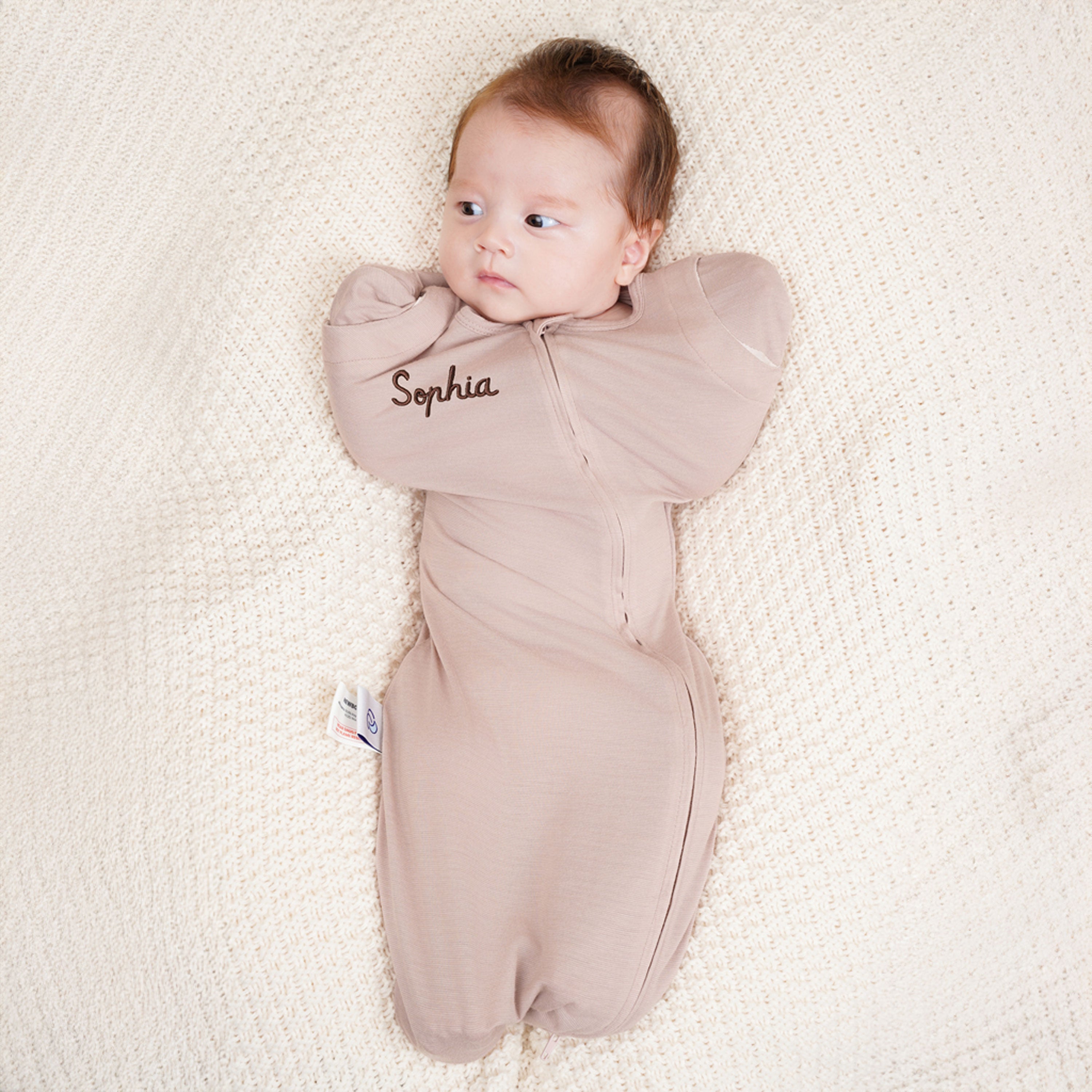
 The Dusty Pink swaddle, the checked variant
Sleep · Check #260
Kaiya Baby ClimaCuddle Swaddle 2-in-1 0.5 TOG
A well-designed transitional swaddle in a merino-bamboo knit with AAP-aligned transition guidance — but the “30% more breathable* / 2x faster drying*” numbers have no published test behind them, and its size chart runs to 12–18 months, past the rolling cutoff.
See current price ↗The pitch
Merino-bamboo transitional swaddle — arms in or out — that’s 30% more breathable and dries twice as fast as cotton
The catch
The asterisks lead nowhere — no test is published for either number — and the size chart runs to 12–18 months, long past the stop-at-rolling rule its own transition copy states
FSA/HSA
not eligible — swaddles are general infant clothing/sleepwear, not a qualified medical expense
What it is
A zip-up transitional swaddle in a single-layer, unfilled knit — 51% rayon made from bamboo / 49% merino wool — rated 0.5 TOG, the brand’s warm-weather weight. This is a new fabric line for the library: ClimaCuddle®, with no filling, so none of the camel-wool findings from checks #251–#253 transfer. The “2-in-1” is the sleeve design: SnoozySeal adjustable sleeves let it be worn arms-in (snug wrap, arms-up position supported) or arms-out through side openings, covering the newborn wrap stage and the first transition step before a sleep sack. Two-way zipper with a zipper guard, cotton-bound edges, and the line’s temperature-sensing sticker inside the chest. Only two sizes are actually sold: Newborn (7–13 lbs) and Small (14–18 lbs), in three colourways. Stock is patchy — Dusty Pink’s Newborn size was out of stock on the page read and Pea Green was marked sold out. Care is the strictest in the brand’s range: machine wash cold on a gentle or wool cycle, zipped, in a laundry bag, then lay flat to dry per the dedicated care guide. Optional embroidery is +$7.99 and final-sale. It is not weighted.
Claims vs. reality
“30% more breathable* / 2x faster drying time*” — the asterisks resolve to nothing. The full product page contains no footnote for either asterisk: no test method, no standard, no laboratory and no date found. Both figures trace only to the brand, unpublished and unverifiable — marketing numbers wearing a lab coat. The direction is plausible for a bamboo-rayon/merino knit versus cotton, but plausible is not “30%” and not “2x” — and the “2x faster drying” fabric is the one item the brand’s own care guide says must be laid flat to dry. The size chart runs to 12–18 months (31–33″, 25–27 lbs) — against the AAP rule, against the brand’s own transition copy (“once both arms are free, it is time to move into a sleep sack”), and against reality: only Newborn and Small sizes exist to buy, so its top rows describe babies who cannot be fitted and should not be swaddled arms-in. Follow the prose, not the table — and ignore the FAQ’s “sizing up often works wonders”: on a swaddle, snug is the safety spec. OEKO-TEX® covers the fabric, per the brand’s careful sources; one page block inflates it to the whole “lineup,” and no certificate or licence number is published to verify it. The 2-in-1 transition design itself verifies as designed — its printed trigger is developmental (“or sooner if rolling starts”), the opposite philosophy from its own chart. The sticker, to the brand’s credit, is sold here only as a comfort cue — the honest framing check #251’s finding allows.
Safety & recalls
No CPSC recall names Kaiya Baby or Kaiya Angel (searched Oct 29, 2026, under both names) — an absence, not a clearance; the brand is young, the ClimaCuddle line launched in 2025, and its US footprint is small. Not weighted — confirmed from the full materials list, which matters in this category: the AAP’s 2022 policy states weighted swaddles and clothing “are not safe and therefore not recommended,” and major retailers pulled weighted infant sleepwear in April 2024. The governing rule is the rolling cutoff, full stop: AAP 2022 — swaddling is no longer appropriate once an infant shows signs of attempting to roll (usually 3–4 months, may be earlier). Used arms-in inside that window, on the back, on a flat firm bare crib, a swaddle is within guidance; the AAP also notes there is no evidence swaddling reduces SIDS risk, so it is a comfort tool, not a safety device. Fit is the daily spec: snug at the chest with room at the hips and knees, neckline that cannot ride up. The brand states plainly its natural fabrics are not flame-resistant, and instructs retiring the swaddle if the zipper sticks or catches.
Real reviews — what owners say
The owner record is warm, small, and entirely brand-run. The Dusty Pink page displays 4.96/5 across 83 reviews — brand-collected, so treat as an upper bound, the same discount this library applies to checks #251–#253. Eighty-three reviews is a thin pool from which no complaint pattern — sizing, zipper, shrinkage after the strict wash regime — can yet emerge, and whether the pool is per-colourway or shared across the three colourway pages is NOT verified. Independent record: none found. No BabyGearLab or Mommyhood101 hands-on file and no editorial review of the swaddle surfaced; the coverage that exists is brand-issued PR, which describes the design but tests nothing. No Amazon listing for this swaddle was found, so there is no second, less-curated review pool to cross-check the brand store against — a real limitation for a $39 purchase decision, and stated as one. Demand signals, such as they are: Pea Green sold out and Dusty Pink’s Newborn size out of stock on the day of the check — consistent with a small production run selling through, not proof of anything either way.
Price & FSA/HSA
$39.00 at kaiyababy.com (read Oct 29, 2026; both buyable sizes the same price). Free shipping starts at US$89, so one swaddle ships at a cost the page does not state — and so does the realistic rotation: a flat-dry-only garment with a newborn’s laundry cadence means most families will want two, and 2 × $39 = $78 still lands under the free-shipping threshold; three clears it. Against the library shelf, $39 is mid-market for a branded transitional swaddle — above multi-pack cotton wraps (check #75’s Momcozy 2-pack, check #157’s KeaBabies 3-pack) and in line with the single-garment transitional designs (checks #92, #169, #176) — with the merino content as the honest reason for the premium and the strict care regime as its cost. The use window is the other price fact: bought in Newborn, this is a garment for roughly the first three to four months of life, and the Small extends it only until rolling says stop — whichever comes first. Returns are 45 days. FSA/HSA: not eligible — swaddles are general infant clothing/sleepwear, not qualified medical expenses.
A well-designed transitional swaddle in a merino-bamboo knit with AAP-aligned transition guidance — but the “30% more breathable* / 2x faster drying*” numbers have no published test behind them, and its size chart runs to 12–18 months, past the rolling cutoff. Worth It If…