
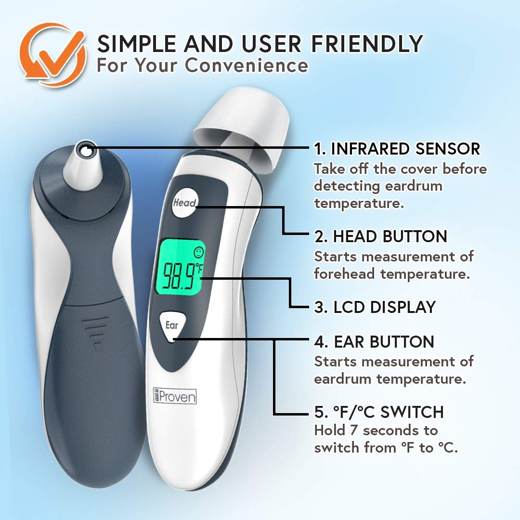
 iProven DMT-489 (dual-mode ear & forehead) — Amazon listing photo via manuals.plus ASIN record
Health & Home · Check #166 — Batch 12
iProven DMT-489 Thermometer
Worth It If…$27.99 at Amazon — DMT-489 dual-mode ear & forehead thermometer, White (ASIN B01H3MTVE8); Amazon refused a live price read, so the price rests on independent roundup records dated Oct 2026 — see Price note. Direct companion to the Braun ThermoScan 7 (check #125)
One-second ear + forehead readings in one $28 device with no probe-cover refills — but its own manual allows ±0.6°F clinical error, and hands-on testing and owners find readings wander when technique slips.
See current price ↗The pitch
ear + forehead readings in 1 second, clinically accurate, colour fever indicator, 20-reading memory — one thermometer for the whole family, newborn to adult
The catch
the manual itself requires a 30-minute room acclimatisation, a clean lens, 10 seconds between readings and correct ear-canal technique; ear mode is 6 months+, forehead aim changes the number, and independent hands-on testing found this model less consistent than the Braun and Kinsa ear thermometers it was tested against
FSA/HSA
Eligible — thermometers are a standard FSA/HSA medical expense, and this listing is sold as FSA/HSA eligible in independent records
What it is
The iProven DMT-489 (Amazon ASIN B01H3MTVE8 — ASIN pinned from BestAdvisor’s and Ubuy’s Amazon-mirror records and the manuals.plus ASIN manual page; Amazon pages refuse agent reads, so price and ratings here come from independent records). A dual-mode infrared thermometer, about 1.77 × 1.73 × 6.1 in and 3.99 oz, in White/Grey. With the cap on, the Head button takes a forehead (temporal) reading — press, swipe temple to temple, release; with the cap off, the Ear button takes a tympanic (eardrum) reading. The manual rates ear mode for children 6 months and older and adults; forehead mode is for all ages. Readings land in 1 second, on a backlit display with a colour fever indicator (green normal, orange elevated, red fever, with beeps on fever), a 20-reading memory, °F/°C switching and auto shut-off at about 10 seconds. It runs on 2 AAA batteries (included), rated for about 3,000 measurements, and comes with a soft pouch and a 2-year (730-day) warranty per the manual. No app, no Bluetooth, and — unlike the Braun ThermoScan line — no disposable lens filters to buy: the manual has you wipe the sensor lens with alcohol instead. It is the direct, cheaper companion to the ear-only Braun ThermoScan 7 already checked (#125).
Claims vs. reality
- “Clinically accurate” / ±0.5°F: read the manual’s own numbers. Its stated lab precision is ±0.2°C / ±0.4°F (ASTM E1965), and its clinical-test allowance is looser: a maximum allowable error of 0.3°C / 0.6°F for 95% of readings. Independent comparison tables split it the same way — about ±0.4°F in ear mode, ±0.6°F on the forehead. Around the 100.4°F fever line, a ±0.6°F band is the difference between “fever” and “no fever” — which is why this is a screening-and-confirming tool, not a single-swipe verdict, especially in young infants.
- “1-second readings”: verifies — the manual’s latency is 1 second in both modes. What the headline omits is everything around that second: the manual requires the thermometer to acclimatise to the room for at least 30 minutes if it has been somewhere colder or warmer, 10 seconds between readings, a clean lens (wipe with alcohol, then wait 5–10 minutes for it to evaporate), and not holding the unit in your hands longer than necessary, because it is heat-sensitive. Sweat, recent exertion and strong emotion are also named as accuracy risks in iProven’s own guidance. Fast per reading; not fast if you skip the setup and have to take five.
- Forehead mode: the technique-sensitive half. The reading is taken wherever the sensor is pointed during the swipe, so missing the temporal artery changes the number. In one hands-on test published against the Braun and Kinsa ear thermometers, forehead readings on the same tester ranged from 96.0 to 98.0°F depending on where it was pointed, while a comparison temporal unit held a much tighter band. Owner-review synthesis says the same in plain language: many find it fast and accurate, a persistent minority report readings inconsistent or off by several degrees. Swipe slowly, centre forehead to temple, dry skin, and repeat — then confirm a surprising number in ear mode (6 months+) or rectally.
- Ear mode: generally the tighter of the two when done right — pull the ear back (straight back for a child, up and back for an adult) to straighten the canal and aim at the eardrum. Done wrong, or with wax build-up or an ear infection, it reads low or scattered; that same hands-on test found ear readings less consistent than the Braun and Kinsa tested alongside it, despite following the manual and repeating the same placement. And it is simply unavailable for the youngest babies: the manual and paediatric guidance both put ear thermometers at 6 months and up, because younger ear canals are too small.
- “FDA approved”: iProven’s own product page uses that phrase; it overstates it. Thermometers of this type are a Class II device category that reaches the US market through FDA clearance / the ASTM infrared-thermometer standard the manual cites (ASTM E1965) — independent roundups describe the DMT-489 as FDA cleared, and “approved” is the stricter premarket term the FDA reserves for a different process. Either way, clearance speaks to the device meeting its stated lab specification; it is not a promise that a home forehead swipe equals a core temperature.
- “The only thermometer your family needs”: almost — with one deliberate gap. It covers forehead (any age) and ear (6 months+) for the whole household, with no per-use consumables. It does not do the one job paediatric guidance still assigns elsewhere: a rectal reading for a baby under 3 months (and to confirm borderline readings under 3 years). A basic digital rectal thermometer costs a few dollars; keep one alongside this, and the claim becomes true.
🛡 Safety & recalls
No CPSC recall for the iProven DMT-489 was found on Oct 23, 2026. The safety story here is measurement risk, not hardware risk. Children’s Hospital Colorado’s AAP-based fever guidance: rectal temperatures are the most accurate, forehead are the next most accurate, and ear temperatures are accurate only if done properly — and not accurate before 6 months of age; a fever is 100.4°F (38°C) or higher by rectal, forehead or ear. For a baby under 3 months, any fever at that level means medical care now, and the reading that decision rests on should be rectal — a forehead number that reads 99.8°F on a device with a ±0.6°F clinical allowance cannot rule a fever out at that age. The manual echoes the same call-the-doctor thresholds (under 3 months at 100.4°F; 3–6 months at 102°F; 6–24 months over 102°F lasting more than a day). Use the same mode, same site, when you re-check, so trends mean something; clean the lens before and after ear use; never immerse the unit (it is not waterproof). Information only, not medical advice — when in doubt, call the paediatrician, not the thermometer.
Real reviews
4.2/5 across 17,467 Amazon reviews in the Oct 2026 BestRatedDocs roundup records (the candidates file’s figure, corroborated across its thermometer roundups) — the largest dual-mode thermometer file on Amazon, and a middling score for it, which matches the split in the text. iProven’s own site shows 4.76/5 from its direct buyers; treat the Amazon figure as the harder test. It carries real editorial history: the New York Times / Wirecutter line iProven quotes — “if you’re looking for an ear or forehead thermometer, we recommend the dual-function iProven DMT-489” — and The Bump named it a best baby thermometer for the 1-second read, backlit display and two-mode coverage of younger and older babies. The praise pattern: genuinely fast, dead simple two-button operation, readable in the dark, one device from newborn forehead checks to adult ear checks, no probe-cover refills. The complaint pattern, in order: (1) inconsistency — back-to-back readings that differ, ear-to-ear differences, numbers that disagree with a rectal or Braun reading (the manual’s own troubleshooting page leads with exactly this, and names the causes: dirty lens, poor technique, rapid repeats, no acclimatisation); (2) forehead aim sensitivity (see Claims); (3) the snap-on/off cap that swaps modes can be stiff, and losing it degrades forehead use; (4) the fever beeps are loud, with no true silent mode in owner reports, for a device marketed for sleeping-baby checks. Hands-on testers land where the owners do: the concept and speed are right; consistency, not features, is what separates it from the Braun in the drawer next to it.
Price & FSA/HSA
$27.99 at Amazon in the Oct 2026 independent roundup records (4.2/5, 17,467 reviews; BestRatedDocs, Oct 2026) — Amazon refused a live price read, so this rests on those records, and iProven’s own store corroborates the tier at $29.97 direct. Against the checked alternative, the ear-only Braun ThermoScan 7 (#125) at roughly $45–$60 plus ongoing lens-filter costs, the DMT-489 is the value play: dual mode, no consumables, running costs limited to AAA batteries every ~3,000 readings and the alcohol swabs you already own. That math only holds if its readings settle for your family — do the first-week test (same person, both modes, back-to-back, against any thermometer you already trust) inside the return window. FSA/HSA: eligible — thermometers are a standard eligible medical expense, and this model is listed as FSA/HSA eligible in independent retail and roundup records (Ubuy’s Amazon-mirror listing and NBC’s FSA shopping roundup both name the DMT-489 specifically).
Worth It If… you want one inexpensive thermometer that screens on the forehead at any age and confirms in the ear from 6 months, and you will use it the way its own manual demands — because the 1-second, dual-mode design verifies, but the accuracy number is a lab figure (±0.4°F, with a ±0.6°F clinical allowance) and hands-on testing and owners both find forehead and ear readings wander when technique slips. For a baby under 3 months, or any borderline reading, a rectal thermometer is still the decision-grade check.