
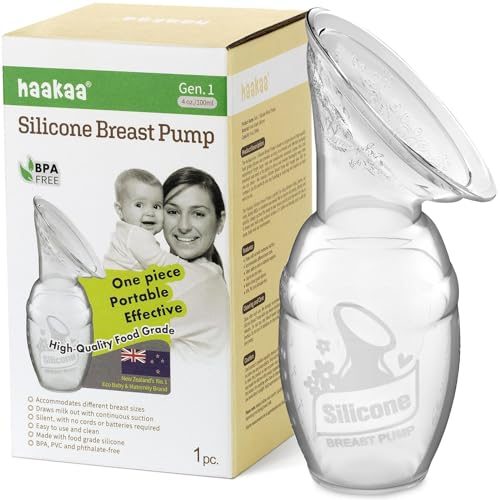
 haakaa Gen 1 — Amazon listing photo
Feeding & Pumping · Check #124 — Batch 9
haakaa Silicone Breast Pump, Gen 1 (4 oz / 100 ml)
Worth It If…$12.94 at Amazon — Target sells the Gen 1 only bundled with the flower stopper, at $21.99; the Gen 2 with suction base runs ~$20–$28 (the ASIN is verified; Amazon refused a live price read — see Price note)
A $12.94 let-down collector wearing a pump's name — it banks the other breast's let-down a pad would waste, but BabyGearLab ranks it last of 9 as a pump and the brand's own fine print says wait 2–3 weeks.
See current price ↗The pitch
one piece of silicone that suctions on and “pumps” hands-free — catch the other breast’s let-down while you nurse and build a freezer stash with no cords, parts or noise
The catch
it’s a collector with a draw, not a pump — BabyGearLab ranks it last of 9 as a pump (Efficiency 3.0) — its steady suction is a demand signal, and the baseless, lidless Gen 1 tips its catch away
FSA/HSA
Eligible — breast pumps & lactation supplies (IRS Pub 502); verify with your plan
What it is
A single piece of food-grade silicone — a flange on a bulbous 4 oz / 100 ml cup, 1.91″ × 1.91″ × 6.95″, 3.2 oz, with no motor, valve, tubing or second part. Squeeze the base, centre the flange over the nipple, release: the silicone’s rebound holds a constant static suction, set once by how much air you squeeze out — it cannot be adjusted while attached, and there is one flange size. Standard use: the breast the baby isn’t feeding from, catching the let-down a nursing pad would waste. Listing material claims: BPA-, PVC- and phthalate-free. Care: boil 2–3 minutes or steam-sterilise; no bleach, no UV. The Gen 1 box holds the pump only — no suction base, no lid, no stopper; the flat suction base is the Gen 2’s defining upgrade, and the detachable bottle is the Gen 3’s. Neither is this product.
Claims vs. reality
- The name, “Breast Pump”: as a pump, it ranks last in the only bench programme that tested it — BabyGearLab: 50/100, #9 of 9; Efficiency 3.0, Comfort 2.2, Ease of Use 7.4, Portability 10.0, Hygiene 8.0 — “the initial suction is the only pull,” and the marked 4 oz “holds less due to potential spillage.” The brand disputes “just a collector” in terms (its myths page: “Absolutely not! It very much is an active pump”) — and with suction it does draw beyond drip-catching. But there is no cycle, no sizing and no emptying power: buy the verified job — hands-free let-down capture — not the name.
- The oversupply question: the mechanism is real and the brand concedes it — milk removed beyond the baby’s take signals more production, and “pumping too often can result in the dreaded oversupply.” Lactation-counsellor sources advise stopping the Haakaa when managing oversupply and prescribe once-or-twice-a-day, lightest-suction use. The brand’s own listing carries the governing fine print: “Recommended for established milk supply (typically 2–3 weeks postpartum)” — with a consult-a-lactation-specialist note for the first week or low supply. An owner in the listing’s own pool attributes her first-baby oversupply to using it at every feed for months, and changed her pattern with her second.
- “One size fits all” + “adjustable suction”: half verified. Suction varies — by squeeze, before applying only; an over-strong application is a remove-and-redo, and the listing FAQ leads with the pain case. One flange geometry for every breast is what the lab’s Comfort 2.2 prices: a stiff rim that punishes a shape mismatch, with no other size to exchange into.
🛡 Safety & recalls
No CPSC recall for the haakaa Silicone Breast Pump — or any haakaa product — was found (checked Oct 23, 2026); no incident or injury pattern for it surfaced in any source read. The operative file is use discipline: sterilise before first use, clean after every use (boil 2–3 minutes or steam; never bleach or UV — both damage the silicone); it should not hurt — pain means the suction is too strong or the nipple is touching the flange wall, so release, reposition, squeeze lighter; respect the established-supply window and the oversupply disciplines in the full check; and treat collected milk as a storage clock (fresh milk: up to 4 hours at room temperature, 4 days refrigerated — check #115’s CDC record). Information only, not medical advice — persistent engorgement, pain or supply problems are a lactation consultant’s territory, as the brand itself says.
Real reviews
Pools kept separate, never added. Amazon (ASIN B07CWK4S5W, via mirror records): 4.6/5 across 96,252 ratings — the same pool renders 9.2/10 across 96,173 in the price tracker’s record; #2 in Manual Breast Pumps. Target sells no bare Gen 1: its Gen 1 + flower-stopper bundle is 4.6/5 across 225 at $21.99; the suction-base bundle’s 4.4/5 across 877 is the Gen 2’s pool, kept separate. Praise: milk that would be wasted, banked (top reviews collect up to 4 oz a feed; one owner froze 100+ oz in the newborn months without touching her electric pump), engorgement relief, one-piece cleaning, silence and price. Complaints, in order: (1) spills — no base, no lid, a baby’s foot breaks the seal: “cried over spilled milk,” “lost so many ounces”; (2) suction pain / fit — “VERY strong,” nipple-centring fiddle; (3) oversupply with every-feed use; (4) it doesn’t empty — little yield for non-leakers; (5) silicone clouding over months of daily use, ending in replacement.
Price & FSA/HSA
$12.94 at Amazon is the anchor on a flat record: average $12.21 across 3,074 tracked days, high $15.99, low $6.59, recurring dips to $10.99–$11.65 — $12.94 is the fair everyday price and anything above ~$16 is a markup. The honest comparison is in-brand: Target’s Gen 1 + stopper bundle at $21.99 prices the spill fix at ~$9, and the Gen 2 (base + cap in the box) runs ~$20–$28. Running costs: the optional stopper/cap, and eventual silicone replacement on the owner file’s clouding pattern. Price-line note: the Amazon link carries ASIN B07CWK4S5W, pinned from two agreeing fallback records; Amazon refused a live read, so no live buy-box price or seller is asserted. FSA/HSA: eligible — breast pumps and supplies that assist lactation are an IRS Publication 502 expense (check #115’s basis); the brand’s US store sells the line as FSA/HSA eligible and the comparable Lansinoh silicone collector carries the flag at Babylist. Your plan administrator makes the final call — keep the receipt.
Worth It If… you buy it as what it is — a $12.94 let-down collector, not a pump — you start once supply is established (the brand’s own fine print: typically 2–3 weeks), use the lightest suction that catches, and budget for the baseless Gen 1’s spill tax, or pay up for the Gen 2’s suction base.