
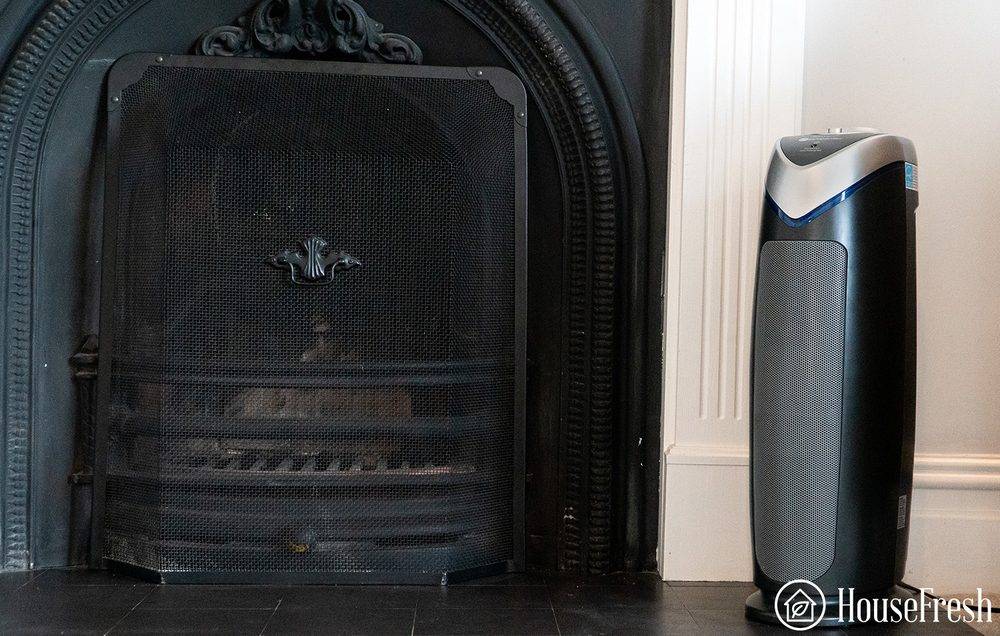
 GermGuardian AC4825E (22″ tower) — HouseFresh review photo
Health & Home · Check #159 — Batch 12
GermGuardian AC4825E Air Purifier
Worth It If…$80.74 at Amazon — single unit record (ASIN B004VGIGVY, via IndoorBreathing’s Oct 10, 2026 record; the white AC4825W and the 2-pack are separate listings that share this review pool); Amazon refused a live price read — see Price note
Genuine True HEPA and AHAM-verified CADR at a budget price — but the 743 sq ft headline is 1 air change an hour (153 sq ft at the recommended 4.8), the UV-C stage showed no measurable effect in hands-on testing, and filters plus bulbs cost more than the unit over time.
See current price ↗The pitch
True HEPA captures 99.97% of allergens as small as 0.1 microns*, UV-C light reduces germs and viruses**, cleans rooms up to 743 sq ft, charcoal layer cuts odors
The catch
both asterisks narrow the claims hard (see below), AHAM CADR (smoke 99 / dust 118 / pollen 125) supports only ~153 sq ft at the recommended 4.8 air changes an hour, and independent testing found no measurable difference with UV-C on or off
FSA/HSA
Not eligible as a standard purchase — air purifiers are dual-purpose and generally need a Letter of Medical Necessity for a diagnosed condition (e.g. asthma, severe allergies); plan decides
What it is
The GermGuardian AC4825E (Guardian Technologies): a 22″ tower purifier, 10.25 × 6.75 × 21.5–22 in, 8.55 lb, 55 W, with a simple rotary dial (3 speeds) plus a separate UV-C on/off button — no sensor, no auto mode, no app. Filtration is a combination filter: pre-filter / activated-charcoal layer + True HEPA (Filter B, FLT4825), plus a 5 W UV-C bulb (LB4000) behind the filter. AHAM/ENERGY STAR CADR: smoke 99, dust 118, pollen 125 cfm. CARB certified, ETL listed, Zero Ozone Verified per the listing; 3-year limited warranty. NOT the white AC4825W (button controls), NOT the taller AC5000/AC5350 models, NOT the 2-pack listing that shares this review pool.
Claims vs. reality
- “Captures 99.97% of dust and allergens as small as 0.1 microns*”: the HEPA part is real — this is a genuine True HEPA (H13) filter — but read the asterisk: “*Initial efficiency value. As small as 0.1 microns from air passing through the filter media.” That is a through-the-media, when-new figure; the standard HEPA test size is 0.3 microns, and what matters in a room is how much air actually passes through — which is the CADR story below.
- “Cleans rooms up to 743 sq ft”: true only at about 1 air change per hour. At the AHAM-recommended 4.8 air changes per hour, the smoke CADR of 99 supports 153 sq ft (the unit’s ENERGY STAR room size; HouseFresh’s 4.8-ACH figure is 167 sq ft on dust CADR) — and the brand’s own listing says the same in its fine print: 153 sq ft every 12.5 minutes, 743 sq ft about once an hour. A typical nursery fits; a living room or open plan does not.
- “UV-C reduces airborne germs, bacteria, mold spores and viruses**”: the second asterisk: “**Tested with Staphylococcus albus, E. coli, Aspergillus niger, and Phi-X174” — four lab test organisms, one of them a model virus, under test conditions. In a portable unit the air flashes past a small 5 W bulb in a fraction of a second, and HouseFresh’s hands-on testing saw no difference with UV-C switched on or off; independent reviewers consistently call the UV-C the least useful stage. The HEPA filter already traps the particles those organisms ride on — do not pay extra for the bulb, and do not count it as sanitising a room.
- “Charcoal layer reduces odors”: the weakest filter stage. The carbon is a thin charcoal-treated layer, not pellets of activated carbon (Vacuum Wars, HouseFresh) — fine for mild, fresh odors, poor on strong cooking/pet smells and VOCs, and it saturates fast. Owners who bought it mainly for odor control are the disappointed ones.
- “Whisper-quiet”: only on low. HouseFresh measured ~40 dB on speed 1 but ~52–56 dB on the top speeds at 3 ft (maker’s max: 55 dB). In a nursery, low across the room is reasonable; high belongs to daytime or an empty room — and low is also the slowest cleaning speed, the standing trade-off of this class.
- Speed in practice: HouseFresh’s 728 cu ft test room took 1 hour 44 minutes to clear at top speed — slow for its CADR class, and Vacuum Wars’ head-to-head scored the Levoit Core 300 88–45 over this unit on performance, filters and features. This is a patient, small-room cleaner, not a fast one.
🛡 Safety & recalls
No CPSC recall for the AC4825 series was found on Oct 23, 2026. The certifications check out and matter for a nursery pick: CARB certified, ETL listed, and independently Zero Ozone Verified; the manual states an 8-hour ozone average of 0.001 ppmv, well under the 0.050 ppmv maximum. Three manual warnings to keep: (1) the UV-C lamp contains mercury — if a bulb breaks, follow the EPA cleanup/disposal guidance printed in the manual, never handle a lit bulb or run the unit open, and always unplug before changing bulb or filter; (2) a California Prop 65 lead warning applies to the cord — wash hands after handling it and route the cord where a toddler cannot chew or pull it; (3) close supervision around children, unit on a firm, level surface out of reach. Standing EPA guidance also applies: a purifier supplements ventilation and source control, it does not replace them, and it does not make a smoky or mouldy room safe — fix the source. Information only, not medical advice.
Real reviews
Amazon: 4.6/5 across 63,604 ratings for the single unit (IndoorBreathing record, checked Oct 10, 2026; pricehistory.app’s shared listing pool shows 9.2/10 across 63,612 reviews — one pool, cited once, and it is shared with the 2-pack). Praise, consistent across the owner file and long-term reviews: allergy and dust relief in bedrooms, dead-simple dial, small footprint, quiet-enough low speed as background noise, and units that run for years. Complaints, in order: (1) it does not move the needle in larger rooms — the 743 sq ft expectation gap; (2) weak odor/VOC performance from the thin carbon layer; (3) noise and some vibration on high; (4) running costs and filter quality variation in recent replacement filters (HouseFresh notes a filter-maker change); (5) dated design, no sensor or auto mode. HouseFresh’s bottom line was blunt — 1 star, buy a modern budget rival instead — which is why this is a conditional, small-room verdict and not a blanket one.
Price & FSA/HSA
$80.74 at Amazon for the single AC4825E (ASIN B004VGIGVY; IndoorBreathing record, Oct 10, 2026) — a genuinely low entry price for AHAM-verified True HEPA. The real price is the running cost: genuine Filter B (FLT4825) is $19.89 at Target and roughly $25–$30 in most records, replaced every 6–8 months (do not wash it; the manual says replace when it turns grey/black), carbon pre-filters (FLT22CB4) are a separate consumable, and the UV-C bulb (LB4000, ~$15–$20) needs replacing every 10–12 months if you use it. HouseFresh’s measured all-in running estimate is $121.49 per year (electricity + official filters, heavy use) — over three years the consumables pass the purchase price several times over. Comparison in this library: the Levoit Core 300S (check #147) costs more up front with a higher CADR and a proper carbon filter; this unit wins only on entry price and simplicity. FSA/HSA: not eligible as a standard purchase — air purifiers and HEPA filters are dual-purpose items that the federal FSA program lists as eligible only with a Letter of Medical Necessity documenting a diagnosed condition such as asthma or severe allergies, and your plan administrator makes the final call.
Worth It If… it is for one small nursery or bedroom (about 153 sq ft or less, door closed), you want genuine True HEPA on a budget, and you budget for filters — because the “743 sq ft” headline is one slow air change an hour, the UV-C germ claim is the weakest part of the box, and the $81 unit costs more than its price again to run over a few years.