
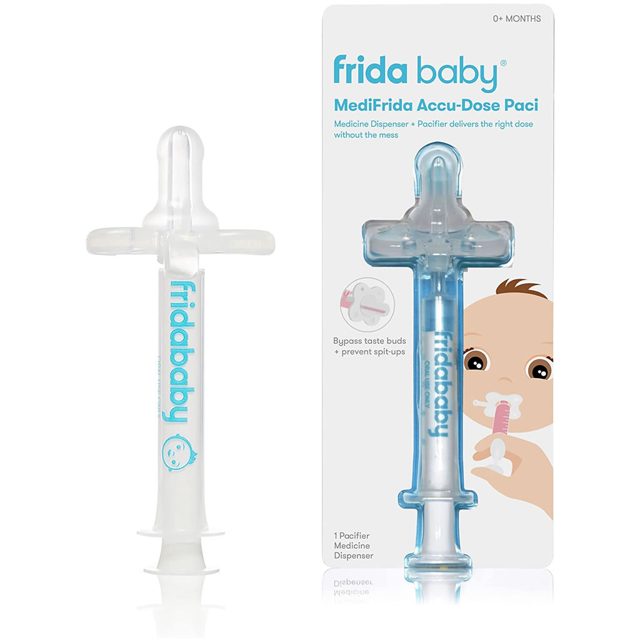
 MediFrida Accu-Dose Pacifier — Amazon listing photo (ASIN B073XVXQ6R) via independent record
Health & Home · Check #183 — Batch 14
Frida Baby MediFrida Accu-Dose Pacifier Medicine Dispenser
Worth It If…$11.49 at Amazon — ASIN B073XVXQ6R, list $12.99 (CamelCamelCamel record, Amazon-price average $11.85, still tracked Oct 2026); $10.39 at Target and $12.99 at Babylist/Optum — the $24.98 figure on Amazon-mirror pages is a marked-up third-party price, not Amazon’s own — see Price note
A paci that delivers liquid medicine to the cheek pocket — the AAP-taught technique, in a shape a sucking baby accepts — whose 'right dose, every time' headline is undercut by ~0.2 mL of dead volume an FDA report documents staying in its tube, and whose 'CPSC-approved' badge names an approval the CPSC does not issue.
See current price ↗The pitch
a paci that sends the full dose to the side of the cheek, “as recommended by doctors,” bypassing taste buds to prevent spit-ups — the only paci-style dispenser “CPSC-approved” for use as a real pacifier
The catch
~0.2 mL of every dose stays in the tube (FDA MAUDE report), so tiny doses come up short; the CPSC sets pacifier rules but approves nothing; and the flow is your thumb — push too fast and the owner file’s rare complaints are choking scares
FSA/HSA
Eligible — flagged by Babylist, listed as “guaranteed HSA eligible” at HSA Store and sold by Optum’s FSA/HSA store; your plan administrator’s rules govern
What it is
A pacifier-shaped medicine dispenser (Frida Baby LLC, model 019, UPC 851877006110): an oral syringe twists into the back of the paci shield and liquid medicine travels through a thin tube inside the nipple, exiting at the tip toward the side of the cheek as the baby sucks. The box holds one dispenser plus one included oral syringe marked for common medicine doses (up to 5 mL per the brand’s own Amazon Q&A), and the hub accepts any standard oral syringe. Twist the syringe out, close the pacifier tab, and the brand sells it as a real pacifier for soothing between doses. Brand-rated 0+ months. Both parts are BPA-free and dishwasher safe; the manual directs warm soapy washing and allows boiling/steam sterilization. Reusable, with no consumables and no subscription.
Claims vs. reality
- “Delivers the full dose — RIGHT DOSE: accurate dosing, every time, by bypassing taste buds”: the cheek-delivery half verifies; the “full dose, every time” half does not. Squirting liquid medicine gently into the cheek pocket is exactly the AAP’s taught technique (“Don’t put the medicine in the back of the throat… squirt it gently between your child’s tongue and the side of the mouth”), and owners confirm far less spit-out. But an FDA MAUDE adverse-event report (March 31, 2022) documents that the tube traps ~0.2 mL that never dispenses once the plunger bottoms out — and at the 0.3 mL dose the brand’s own Amazon Q&A called measurable, the baby would get ~0.1 mL, a third of the dose. Dead volume is a rounding error at 5 mL and a real under-dose under 1 mL. The taste-bud bypass is also partial — medicine is sucked and swallowed across the tongue, and owners note babies still taste it. A MAUDE report is a single unverified submission, not an FDA finding; it is carried as a documented accuracy flag the brand’s copy never answers.
- “CPSC-APPROVED — the only paci-style dispenser CPSC-approved for use as a pacifier”: the framing misstates the system. The CPSC does not approve or endorse products — there is no approval list for this pacifier to top. Pacifiers are governed by a mandatory standard, 16 CFR Part 1511 (the shield must not be drawable into the mouth, at least two ventilation holes, protrusions ≤0.63 in, structural-integrity pull tests after repeated boiling, no ribbons or cords, and the “do not tie pacifier around child’s neck” package warning), and makers self-certify compliance on a Children’s Product Certificate backed by CPSC-accepted lab tests. Note too that §1511.2(a) defines a pacifier as not designed to facilitate a baby’s obtaining fluid — so it is the pacifier mode (tab closed) that the pacifier rules govern. The “only” is brand copy repeated verbatim by retailers; Dr. Brown’s Pacidose, Munchkin’s Medicator and Nuby’s Medi-Nurser are other paci-style dispensers — MediFrida’s real distinction is the dual-use claim.
- “Sends medicine to the side of the cheek, as recommended by doctors”: the technique verifies; the attribution is generic. Cheek-pocket delivery, slowly, as the baby swallows, is the standard pediatric instruction. No named doctors, study or professional body is cited — and the same technique is free with the plain oral syringe that comes with the medicine.
- “Same familiar paci shape used in hospitals nationwide”: brand-only; no source found. Hospitals commonly use one-piece Soothie-style pacifiers; MediFrida’s cross-shield dispenser with a tube through the nipple is its own design. Carried as marketing, not fact.
- “Medicine markings — works with all standard oral syringes”: verifies, with the small-dose caveat. The included syringe is marked to 5 mL but has no 0.3 mL marking (brand Q&A); the twist hub does accept standard syringes, including the one that came with the medicine — the AAP’s preferred measuring tool — though its dose still travels through the same ~0.2 mL tube.
- “BPA free, dishwasher safe”: verifies as stated across brand and retailer copy, with boil/steam sterilization in the manual. The packaging also states: “This is not a toy — keep out of reach of children.”
🛡 Safety & recalls
No CPSC recall for the MediFrida was found on Oct 23, 2026. The one regulator record is the FDA MAUDE report above (event March 31, 2022; classified Serious Injury; health-effect code: no clinical signs, symptoms or conditions) — an under-dosing report, not an injury. The live safety variable is flow rate, which is entirely parent-powered: the plunger is the pump, and the AAP technique says gently. The owner file holds a small number of high-severity flow reports — most detailed, a Target 1-star review (Dec 17, 2024) describing medicine shooting toward the baby’s throat as he sucked, choking, and an EMT call (a single unverified owner account; a second mirrored review reports the same too-fast flow) — and no regulator action followed. The actionable reading is mechanical: push slowly, in small pulses, as the baby sucks and swallows, with the baby upright, and stop if the baby coughs — the paci shape does not meter flow for you. Pacifier-mode safety is ordinary pacifier safety plus hygiene: heed the federal package warning (never tie a pacifier around a child’s neck), inspect before use and discard at tears or stickiness, and wash after every dose — medicine residue sits in the tube between uses, which is why this is a medicine-time device first and a soother second. The dosing rule that outranks the gadget: for weight-based medicines at doses under ~1 mL, use the medicine’s own syringe slowly into the cheek, or ask the pharmacist about the ~0.2 mL the tube keeps — and if you are ever unsure how much of a dose went in, do not re-dose a full dose; call the pharmacist or pediatrician. Information only, not medical advice.
Real reviews
Files kept separate. Target: 4.6/5 across 728 ratings (258 reviews), $10.39, InStock. Babylist Shop: 4.6/5 across 155 reviews, $12.99, flagged FSA & HSA Eligible. HSA Store: 5/5 across 260 ratings, sold as “guaranteed HSA eligible.” TikTok Shop’s file is tiny (5 stars, 7 reviews). Amazon pool: CamelCamelCamel’s record for ASIN B073XVXQ6R (tracked since Aug 2017, still tracked Oct 2026) verifies the offer and price history only — no Amazon star rating or count is quoted from it; Snapklik’s Amazon-mirror page calls it a category “Top Seller” at a marked-up $24.98. Praise pattern: antibiotic and daily-medication courses actually finished — “spitting out half the dose each time… he takes the full dose like a champ now” (Target, Jan 2026) — far less mess than a bare syringe, ready acceptance by paci-habituated babies, and specific praise for the included syringe’s extra measurement markings. Complaints, in pattern order: (1) flow too fast / choking scares — small count, highest severity (see Safety); (2) dose accuracy at tiny volumes — the MAUDE dead-volume report and the 0.3 mL Q&A thread are the same complaint from two directions; (3) leaks and pop-offs when the syringe is not firmly twisted in — the brand’s own troubleshooting names insecure attachment as the leak cause, and an owner reports the connector popping off mid-struggle; (4) acceptance is conditional — the pacifier reads large for very small mouths in retailer synthesis, and a baby who doesn’t take a pacifier gains nothing; (5) middling nipple durability for the price in long-term reports.
Price & FSA/HSA
Price note: pinned from independent records, the standing method for this library. Amazon: $11.49, ASIN B073XVXQ6R (CamelCamelCamel: list $12.99, Amazon-price average $11.85, low $6.99 in Nov 2024) — the link above carries the Associates tag. That resolves the spread in the candidate records: $12.99 is the list price (and the Babylist/Optum retail price), and $24.98 is Snapklik’s marked-up Amazon-mirror figure — do not pay it. Cheapest verified channel is Target at $10.39. Running costs: none — reusable, and the oral syringes it hosts come free with liquid medicines; replace only if the nipple tears or the fit loosens. FSA/HSA: eligible — Babylist flags it “FSA & HSA Eligible,” HSA Store lists it as “guaranteed HSA eligible,” and Optum’s FSA/HSA store sells it at $12.99; your plan administrator’s rules govern any given purchase.
Worth It If… your baby already takes a pacifier and spits out bare-syringe doses — delivering medicine to the cheek pocket is the technique pediatric guidance teaches, and owners really do finish antibiotic courses with it — but not on the strength of its two headline claims: an FDA adverse-event report documents about 0.2 mL staying trapped in its tube (a third of a 0.3 mL dose), and “CPSC-approved” names an approval the CPSC does not issue to any product.