
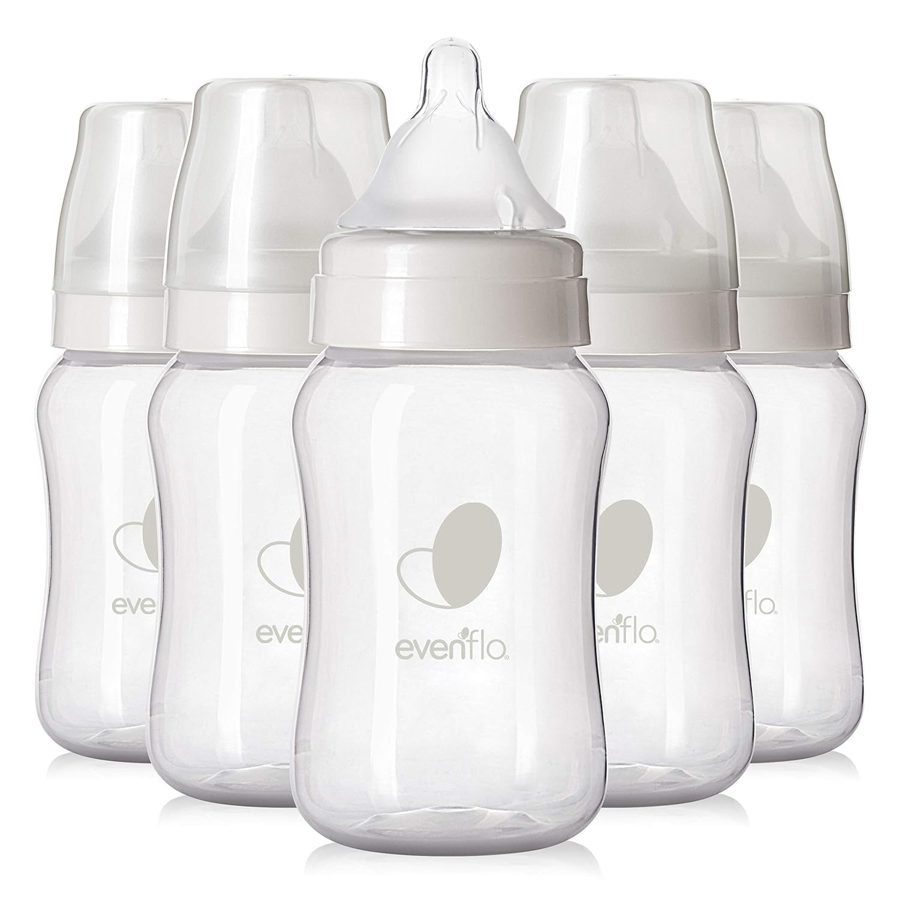
 The Balance+ Wide 9 oz 6-pack — three parts per bottle, a sloped nipple, and a vent you have to squeeze open before every feed
Feeding & Pumping · Check #201 — Batches 11–15
Evenflo Balance+ Wide-Neck Bottles, 9 oz 6-pack
The lactation world's budget bottle — The Bump's best budget-friendly pick for breastfed babies, with a gradual sloped nipple testers latched deeply 'almost instantly' and a genuine 1-piece Proflo vent in a 3-part bottle — held to Worth It If… by the step the marketing never headlines: squeeze the vent open before every feed or the nipple collapses (Evenflo's own standing reply across its review file), plus cap-ring…
See current price ↗The pitch
developed with pediatric feeding specialists; naturally sloped nipple promotes a healthy wide latch and decreases mouth fatigue; patented Proflo 1-piece venting reduces colic, gas and fussiness; slow, gulp-free flow; only 3 pieces; molded oz/ml markers that will not wash off; 100% free of BPA, polycarbonates, PVC and phthalates
The catch
the vent has to be squeezed open before every feed or the nipple collapses (Evenflo’s own standing reply to collapse complaints); cap-ring threading/leaks are complaint #2; owners report measurement numbers rubbing off within a month and white print that is hard to read at night, against the “will not wash off” claim; and the brand’s replacement cadence for nipples is every 1–2 months
FSA/HSA
not eligible — bottles for feeding a healthy baby are a general feeding expense, not medical care; no eligibility claim appears in any record checked
What it is
A 6-pack of 9 oz wide-neck plastic baby bottles from Evenflo Feeding’s Balance+ line — this check pins the plastic 9 oz 6-pack, model 1129611, ASIN B01MDOBN21 (UPC 849409002426), with slow-flow nipples included. Each bottle is just three parts — bottle, nipple and cap ring — plus a hood (manual, model 1129611: 6 bottles, 6 slow-flow nipples, 6 cap rings, 6 hoods). The bottle is polypropylene, the nipple soft silicone with the line’s signature gradual, naturally sloped shape on a wide (2 in) base; medium and fast-flow nipples are sold separately. Bottles measure about 6.75 in tall × 2.75 in at the base; the wide neck takes a bottle brush easily and the parts are dishwasher safe, top rack only; before first use the manual says wash, then boil 5 minutes or sterilize. Variants NOT covered here: the 5 oz 6-pack (model 1125611, ASIN B01MA5TUJH), the standard-neck Balance+ line, and the 6 oz glass Balance+ bottles (Target 4.2/5 across 257 ratings) — the glass and plastic files differ in exactly the places owners argue about, so this check borrows none of their numbers.
Claims vs. reality
“Developed with pediatric feeding specialists … the sloped nipple promotes a proper latch” — THE DESIGN CLAIM WITH THE STRONGEST INDEPENDENT FILE IN THIS CATEGORY. Evenflo’s on-staff IBCLC (Amy Peterson, author of Balancing Breast and Bottle) is named in independent coverage, and the latch mechanics are corroborated from three directions: The Bump’s hands-on parent testing (best budget-friendly bottle for breastfed babies; a twin mom: the babies “achieved a nice deep latch almost instantly”; a second tester: her 6-week-old “drank from this bottle as if she was breastfeeding”); IBCLC recommendation roundups, which keep the Balance line on the shortlist for gradual slope, deep latch and paced feeding; and Target’s 1,102-review file itself, where the praise pattern is breastfed babies switching back and forth without losing the latch. The honest limit, printed here because the brand does not: no source in this check — brand or independent — is a controlled clinical study of this bottle’s latch outcomes; “developed with specialists” is a design-provenance claim, and the corroboration is tester and clinician consensus, which for a $3.32 bottle is the right evidence tier. Two fit caveats from the file: a preemie parent found the wide nipple too large/firm for premature twins (the standard-neck sibling worked), and one newborn reviewer’s baby gasped and spit up on the included slow flow — Evenflo’s reply (latch onto the empty nipple first, then tip) is its own admission that “slow” still needs paced-feeding technique.
“Patented Proflo venting reduces colic, gas and fussiness” — THE MECHANISM IS REAL AND 1-PIECE; THE OUTCOME WORDS ARE THE BRAND’S. The vent is a slit in the nipple itself — the manual’s troubleshooting says keep it clear and unobstructed, and there are genuinely no separate vent parts to wash, assemble or lose, which owners confirm (“no extra pieces to wash every time” is the file’s most repeated praise after latch). Air-in-milk-out venting is a plausible, mechanically verifiable design; “reduces colic” is not something any source here measured, and colic in particular has no established bottle cure — read the claim as “designed to reduce swallowed air,” which is what the hardware does. The price of a 1-piece vent is the next paragraph.
The step the box does not headline: SQUEEZE THE VENT BEFORE EVERY FEED. Across Target’s nipple and bottle files, Evenflo’s support team gives the same reply to collapse complaint after collapse complaint (Aug 28, 2026; Sep 16, 2026; Apr 14, 2025, and more): “To allow milk to flow properly, it is important to squeeze the nipple vent prior to every feeding, right at feeding time. You should see the slit open.” Owners who skip it report the nipple “sucking into itself and blocking the milk,” bottles that “kept suctioning” until the ring is cracked open to let air back in, and collapse even from owners who knew (“they will collapse if you do not get the vent open or if the lid is on too tight”). A viral side-myth gets corrected by the brand in the same file: you do not need to line the cap-ring notch up with the vent — “that is a myth that someone started on social media.” This is a learnable 2-second habit, and parents who learn it mostly stop complaining — but a check that repeated “1-piece vent, no fuss” without it would be laundering the marketing.
“Molded measurement markers … will not wash off” — CONTESTED BY THE OWNER FILE. The listing copy is explicit: molded oz/ml markers “without the risk of the measurements washing off,” and the manual repeats “molded measurement markers.” Owners say otherwise in two registers: legibility (“I wish the text on the side of the bottle wasn’t white — so I could read it easier when filling them at night,” Jan 6, 2025; an independent review roundup lists “volume markings can be hard to read in low light” as the line’s known watch-out) and durability (“the numbers to measure the amount of liquid rubbed off within a month … I’m not sure how much milk I am pouring in there anymore,” Dec 14, 2024; an Amazon-file synthesis carried by Ubuy lists “measurements can fade slightly over time with frequent washing” among the cons). Whether the failing print is a printed overlay on some production runs or worn molding, the practical guidance is the same: check your set’s markings under kitchen light before the first night feed, and treat a bottle whose scale you cannot read as a measuring cup’s job, not a guessing game.
“Pump directly into your bottles” — ONLY WITH AN ADAPTER, AND NOT ON YOUR PUMP’S FLANGE. The listing’s own fine print says the Wide Neck Pump Adapters are sold separately and fit most standard-neck pumps. An exclusive pumper’s 1-star review (Jan 12, 2025) reports the bottle does not fit her Spectra flange and leaked pumped milk at 3 a.m.; Evenflo’s reply is the honest spec: “we do not manufacture our bottles to work with other brands of breast pumps — it is recommended to pump into the bottles that came with your pump and pour the milk into our bottles.” Pour-and-feed is the default workflow; the adapter is an add-on cost, not a feature in this box.
Materials — VERIFIED AS STATED. “100% free of BPA, polycarbonates, PVC and phthalates, FDA-approved food-grade materials” (manual spec table: polypropylene bottle, soft silicone nipple, BPA/polycarbonate/PVC/phthalate free). Context worth one line: the FDA has barred BPA in baby bottles and sippy cups since 2012, so BPA-free is the legal floor for this category, not a differentiator — the full four-item free-of list and the named polymers are the checkable part, and they check out.
Safety & recalls
No CPSC recall for the Evenflo Balance+ bottles was found on Oct 23, 2026 — dedicated searches surfaced Evenflo actions on car seats and other categories only; none touches the Balance+ feeding line. The governing safety text is the manual’s (model 1129611): test the liquid’s temperature before every feed; boil or sterilize all parts before first use; inspect nipples regularly for wear, tears or stickiness and replace immediately if damaged; do not store nipples in direct sunlight or heat. The brand’s own replacement cadence, stated in its reply to a durability complaint (Jun 27, 2025), is replace nipples routinely every 1–2 months — “standard in the industry,” and it matters doubly here because the fast-flow nipple is X-cut and, by Evenflo’s own admission in that reply, X-cut nipples wear faster. CDC infant-feeding hygiene is the standing frame for this whole category: wash and separate bottle parts after every feed and sanitize daily for babies under 2 months, premature babies, or babies with weakened immune systems. Two owner-file items are handled at their true weight: the leak pattern (cap rings that must be threaded exactly right; Evenflo attributes some cases to cap rings from two different manufacturing locations being mixed between sets, per its Dec 16, 2024 reply pointing to its “Balance Wide has a new bottle design” notice — keep each set’s rings with its bottles) is a wasted-milk and mess hazard, not an injury pattern; and a pocket inside the nipple that one reviewer found collects debris is a cleaning-flag — use a nipple brush, as the manual directs. Information only; WorthItMama does no hands-on testing.
Real reviews — what owners say
Target (6-pack 9 oz plastic, A-51793544): 4.4/5 across 1,659 ratings / 1,102 reviews, $19.89, InStock (page read in full Oct 23, 2026) — the candidate file’s own figures, confirmed at staging. Praise, in order: (1) latch and breast-to-bottle switching — “the only bottles that my breastfed baby liked” (Jan 21, 2025); “didn’t cause my son to develop a bottle preference or weaken his latch when I nursed him” (Jan 23, 2025); a lip/tongue-tie recovery parent: “the only bottle that has helped my 2 month old … he’s able to get a proper latch” (Feb 6, 2025). (2) three parts, easy washing — repeated across the file, including sterilizer/dryer durability (“held up great in our Brezza”). (3) genuinely slow flow when the vent is managed. Complaints, in order: (1) nipple collapse — the vent-squeeze file above, spanning the bottle listing and the replacement-nipple listings (Target’s own nipple-page summary: “several guests have reported issues with collapsing nipples, inconsistent flow rates”); one Aug 28, 2026 reviewer calls a faster-flow set’s valves “completely different … a quality control issue vs. a design change” — flow-step consistency between slow/medium/fast sets is the pattern to watch when you size up. (2) leaks and cap-ring threading — “lid is extremely tedious to screw correctly” (Jan 24, 2025); “you can have it screwed on just fine … and it just leaks everywhere” (Dec 16, 2024, with Evenflo’s mixed-rings explanation); the 1-star “Leak!!!” review (Feb 1, 2025) pairs leaks with collapse at 2 a.m. (3) measurement markings — fading within a month and white-on-clear night legibility (above). (4) pump fit — the Spectra-flange case (above). Independent corroboration: The Bump (parent-tested; best budget-friendly for breastfed babies; leak-on-transport noted by some parents; plastic scratching over time questioned by a tester — their own advice is that this is an early-days bottle, which for the 9 oz size reads as: expect to retire scratched plastic rather than hand it down); a feeding-specialist site prices it “6 for $19, $3.17 per bottle” and notes Pigeon nipples are compatible and offer an extra-slow option for babies the included slow flow still overwhelms; an RN-reviewed roundup prices the 6-pack at ~$25 and flags that it is “sometimes hard to find in stock — high demand outpaces supply.”
Price & FSA/HSA
Pinned: $19.89 at Target for the exact 9 oz 6-pack (JSON-LD offer, InStock, Oct 23, 2026) — $3.32 per bottle, the cheapest per-bottle figure among the library’s checked breastfed-baby bottles. Amazon: the same pack is ASIN B01MDOBN21 (verified via Ubuy’s Amazon-mirror record carrying the matching UPC 849409002426 and model family, manuals.plus’s ASIN manual record for model 1129611, and two independent Amazon share links to this exact dp) — Amazon refuses direct agent reads, so no Buy Box figure is claimed; independent editorial records bracket the Amazon price at $19 (feeding-specialist roundup, “6 for $19”) to ~$25 (RN-reviewed roundup), i.e. the same shelf as Target, and the card links the verified ASIN with the Associates tag. The 3-pack at Target is $14.99 — a worse per-bottle rate ($5.00); buy the 6-pack. Running costs are the honest asterisk: replacement nipples on the brand’s own 1–2-month cadence run $7.89 (medium) / $8.59 (fast) per 6-pack at Target — over a 6-month bottle run that is roughly $24–$52 in nipples, which still leaves the system cheaper than premium silicone bottles, but erases the “$19.89 and done” reading; the pump adapter, if wanted, is a further separate purchase whose price was not verified. FSA/HSA: not eligible — bottles for feeding a healthy baby are a general personal/feeding expense, not medical care, and no FSA/HSA eligibility claim appears in any record checked (contrast the library’s breast-pump checks, where the pump itself is the eligible item; its bottles-as-accessories are not claimed here).
The bottle the lactation world actually recommends, at the lowest per-bottle price on the shelf — with one operating step the marketing never mentions. The naturally sloped nipple and wide base are the real thing: The Bump’s parent testing named this the best budget-friendly bottle for breastfed babies (“a little over $3 a bottle”), testers got a wide, deep latch almost instantly, and IBCLC roundups keep it on their shortlists because the gradual slope supports paced, gulp-free feeding. The patented Proflo vent is genuinely 1-piece — three parts total, nothing extra to wash or lose. The condition is in Evenflo’s own replies to unhappy owners, repeated across its review file: you must squeeze the nipple vent open right before every feeding, or the nipple collapses — the single biggest complaint pattern behind Target’s 4.4/5 across 1,659 ratings, ahead of cap-ring leaks and measurement markings owners say fade or read badly at 3 a.m. despite the brand’s “molded, will not wash off” promise. Learn the squeeze, keep spare nipples in the budget (the brand’s own replacement cadence is every 1–2 months), and this is the best-value breast-to-bottle buy in the library: Worth It If…. Skip it if any per-feed ritual will fail in your house at night, or if you need to pump straight into the bottle on a Spectra — that takes an adapter sold separately, and Evenflo itself tells owners it does not make these bottles to fit other brands’ pumps.