
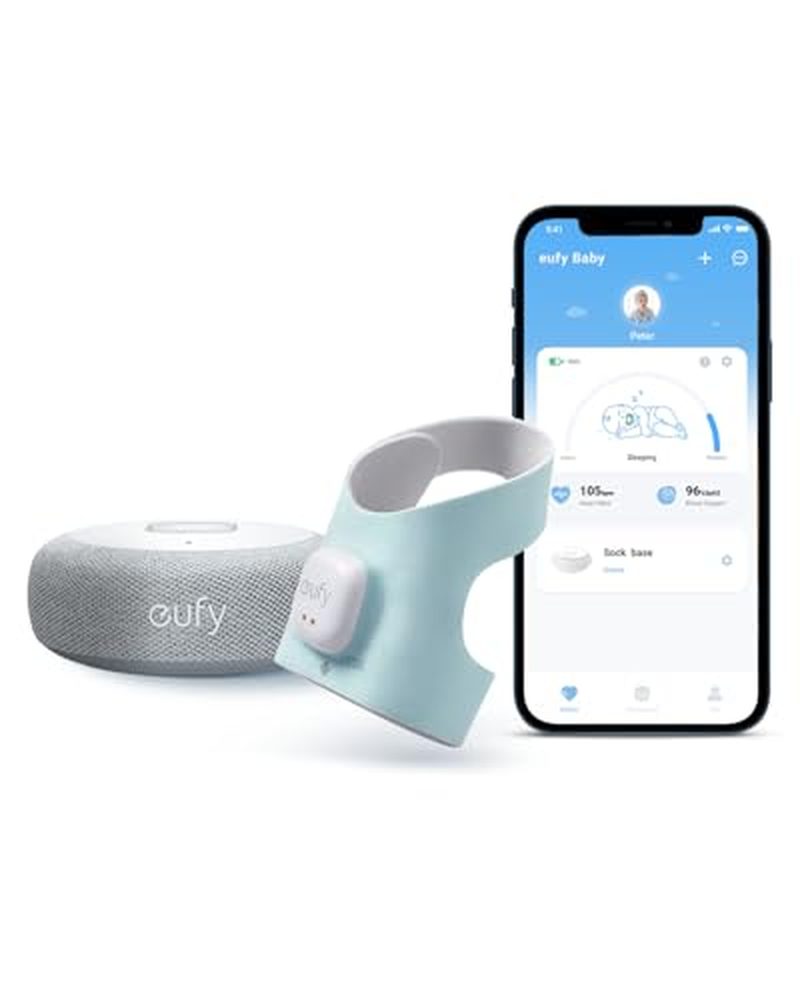
 The S320 sock-only kit — a PPG sensor on a washable wrap, three sizes in the box, and a base that is charger, status light and alert speaker in one
Smart sleep sock · Check #83 — Batch 6
eufy Smart Sock S320
A comfortable, fee-free heart-rate and oxygen sleep sock with genuinely useful sleep reports — worth it if you buy it as the wellness tracker eufy itself says it is; it is not the cleared Owlet at half price, its tested alerts are its weakest part, and eufy says the line was discontinued in June 2026.
See current price ↗The pitch
real-time heart rate, blood oxygen and sleep tracking for 0–18 months, three sock sizes in the box, up to 24 hours per charge — and no monthly fee
The catch
not a medical device by eufy’s own disclaimer; no FDA clearance or published accuracy figure; tested alerts repeat only about every 10 minutes; a discontinued line (brand blog, Jun 2026) — the app and warranty continue, per eufy
FSA/HSA
flagged eligible — the flag appears on the Amazon listing and on eufy’s own product page; verify against your plan
What it is
A wearable wellness sock for babies 0–18 months / up to 30 lbs: a photoplethysmography (PPG) sensor (42 × 38 × 13.5 mm, 8 g) sits on a soft, washable fabric wrap — three sizes in the box, wearable on either foot — and reads heart rate, blood oxygen (SpO2) and movement, which the eufy Baby app turns into sleep state, sleep time and daily sleep reports. The sensor talks to the base over Bluetooth Low Energy; the base reaches your phone over 2.4 GHz Wi-Fi only and doubles as the magnetic charging dock and the glanceable status light (green = fine; red light plus sound = check the baby). Battery is up to 24 hours per charge, about 2 hours to recharge. Alerts fire when vitals change or the sock detaches, and are customizable. There is no camera and no audio in the S320 — this is the sock-only kit (model T8352), not the S340 bundle ($279.99–$329.99), which adds a 2K camera around the same sock. Warranty: 12 months (the S320 user guide).
Claims vs. reality
“The same thing as Owlet, only cheaper” — false on the point that matters. Same shape, yes: a foot-worn sensor reporting heart rate, oxygen and sleep. But eufy states in its own fine print that the Smart Sock “is not a medical device” and “cannot be used to diagnose, treat, cure, or prevent any disease or condition, including… sudden infant death syndrome (SIDS).” The Owlet Dream Sock (check #12) holds an FDA De Novo clearance as an over-the-counter pulse oximeter with a published ±3% clinical accuracy citation. eufy publishes no accuracy figure at all — its claim is a mechanism (“a Fresnel lens” refracting infrared light), not a measurement. Neither sock prevents SIDS, and safe sleep does the real work for both — but only one has had its numbers vetted by a regulator.
“No monthly fee” — true, and the cleanest win here. eufy’s own FAQ: sleep data, history and reports are accessible “at zero cost,” no subscription or contract. The Owlet’s live readings are free too, but its trend reports sit behind Owlet360 at $9.99/mo. Budget the eufy as its sticker price, full stop.
“Real-time” alerts — the tested seams. BabyGearLab tested the S340 — the same sock, sensor and base with a camera added — and scored it below average for expected reliability: reports of inaccurate readings, and readings and alerts “when the sock is not being used” — in their own testing, the sock sent blood-oxygen and heart-rate notifications while sitting on a desk. Push notifications for out-of-range vitals are not persistent and repeat only about every ten minutes, and the base alarm they measured topped out at 66 dBa and can be snoozed without checking the baby. eufy’s own support file adds that sleep data is “slightly delayed” while the baby sleeps. As trends, the numbers are useful; as an alarm, this is weaker than the marketing tense claims.
Battery and comfort — the claim holds, with an asterisk. The 24-hour battery is corroborated by eufy support and owners, and drop-on magnetic charging makes the daily top-up easy. But BabyGearLab notes the sensor is larger than rivals’ and collects owner reports of skin irritation where it sits — and eufy’s own listing FAQ acknowledges red marks, imprints and even blisters from prolonged wear in heat or humidity or from kick friction. Correct size, clean dry feet and skin checks are operating requirements, not fine print.
The finding no listing page mentions: eufy says it discontinued the sock. A post on eufy’s own blog (Jun 5, 2026) states the Smart Sock “has been discontinued, and eufy no longer sells it new,” as the brand pivots to camera monitors that don’t track vitals at all. The same post promises existing socks keep working in the app, with support and warranty continuing and replacement socks available while stock lasts. Flagged contradiction: eufy’s product page still offered the S320 at $169.99 when this check ran, and Amazon still stocked it — a wind-down, not a switch-off. Buy knowing the app and accessories now run on a discontinued line’s clock.
Safety & recalls
No CPSC recall was found for the eufy Smart Sock (checked Oct 21, 2026). The rules that matter: it is not a medical device — eufy’s own disclaimer says it cannot diagnose, treat, cure or prevent any condition including SIDS and must not substitute for adult oversight or medical advice; treat its numbers as wellness information, never a clinical reading. Safe sleep does the real work — no consumer monitor prevents SIDS, and the AAP does not recommend home monitors as a SIDS-reduction strategy: back to sleep, flat firm surface, bare crib. Alert limits are a safety fact — phantom off-body readings, a roughly ten-minute push cadence and a quiet, snoozable base alarm (BabyGearLab, on the identical sock platform) mean this sock must never be the only thing standing between a baby and a checked-on night. Skin: correct size, clean dry feet, never over an open wound, and check the skin under the sensor — the red-mark and blister file is the brand’s own FAQ. Keep the sensor away from the baby’s mouth. Information only, not medical advice.
Real reviews — what owners say
Owners like the product they got; testers question the readings it gives. Amazon’s record for this listing aggregates to about 4.3/5 across 899 reviews (pricehistory.app, Oct 2026), independently matched by ExpertBeacon’s record (4.3 across 845). eufy’s own store pool is rosier (4.79 across 152, brand-hosted); Best Buy’s is tiny (4.7 across 15, syndicated from anker.com and largely promotion-collected). The praise repeats in one voice: peace of mind and sleeping better, heart rate and oxygen together in one app, easy setup and an easy on/off sock, no subscription ever, and Owlet-shaped reassurance at roughly half the street price. The complaint spine: reading trust — vitals that are slow to appear or hard to believe (the pattern BabyGearLab’s below-average reliability score documents at platform level); connectivity — dropouts and “glitchy” reports, on a 2.4 GHz-only Wi-Fi link plus a Bluetooth sock-to-base link whose range depends on your walls; fit and skin — digging in on skinny ankles, red marks in heat; and the 24-hour battery ceiling — a forgotten charge is a blind night. Notably absent: any dead-unit pattern or a paywall ambush — the no-fee promise holds in the owner file.
Price & FSA/HSA
$139.99 at Amazon is the verified anchor for this listing (tracked Oct 21, 2026; the tracked range runs $115.33–$319.99, oscillating between $118.99 and $169.99 through 2025–26 — never pay above $169.99, and $118.99–$139.99 is the recurring sale band). eufy.com lists the same kit at $169.99 (its table still shows the $199.99 list) — Amazon is the cheaper channel, and the discontinuation wind-down argues for buying where returns are easiest. No running costs: no subscription, three sock sizes in the box; the tail costs are replacement wraps (brand-priced, while stock lasts) and battery wear past the 12-month warranty. The framing comparison: the Owlet Dream Sock (check #12) is $299.99 list with FDA clearance and an optional $99.99/yr trend tier; the S340 camera bundle at $279.99–$329.99 buys this same sock at Owlet money with none of the clearance — it is not the shortcut it looks like.
FSA/HSA: flagged eligible — the flag appears in this listing’s Amazon feature set and on eufy’s own product page. No FSA Store / HSA Store listing was found in this check, so verify against your own plan before checkout and keep the receipt — doubly so for a product whose maker states it is not a medical device.
The verdict
WORTH IT IF… you want what this product actually is: a comfortable, fee-free wellness sock whose sleep reports and heart-rate/oxygen trends help you understand your baby’s nights, bought at the $118.99–$139.99 sale band with an 18-month window all you need. Then the file supports it: three sizes in the box, 24-hour battery with drop-on charging, a consistent ~4.3/5 owner file, low measured EMF, no recall, and honest pricing with no subscription tail. The conditions: you accept — in eufy’s own words — that it is not a medical device, with no FDA clearance and no published accuracy figure; you accept the tested alert limits (phantom readings, ten-minute push cadence, a quiet base) and keep safe sleep as the actual safety system; you run the fit and skin discipline; and you buy it as a discontinued line, eyes open, from a channel with easy returns. Not worth it if a clinician has asked you to watch your baby’s oxygen, or the numbers are the point — check #12’s cleared Owlet is that product, and this is not a substitute for it at any discount — or if alert reliability is the whole purchase, or you were about to pay S340 money for the same sock plus a camera.
Sources: Batch 6 queue and batch-6-candidates.md (Joe-approved Oct 21, 2026; the Facebook-group “same thing as Owlet, only cheaper” demand line; the S320 pin); amazon.com listing index for ASIN B099RYB9RR (title, box contents — sensor, socks × 3, base, adapter, cable, guide; the not-a-medical-device disclaimer in the listing Notes; the red-marks/blisters FAQ; BLE 5.0 and RF statements); pricehistory.app ASIN record (Amazon $139.99 on Oct 21, 2026, InStock; tracked low $115.33 / average $186.31 / high $319.99; rating 8.6/10 across 899 reviews; model T8352; the listing’s “HSA/FSA Eligible” feature); expertbeacon.com ASIN record (4.3 across 845 reviews); eufy.com S320 product page (price $169.99, $199.99 table list; heart-rate, oxygen and sleep tracking; daily reports and 48-hour history; the Fresnel-lens mechanism claim; base status light; up-to-24-hour battery; three sizes 0–18 months; HSA/FSA flag; 4.79 across 152 brand-hosted reviews; the disclaimer) and eufy specs (sensor 42 × 38 × 13.5 mm / 8 g; base 80 × 80 × 32 mm / 123 g; 80 mAh sensor battery); eufy.com S340 FAQ (“no monthly subscription fee… at zero cost”; three sizes to 30 lb); service.eufy.com Smart Sock FAQ (~24 hours per charge, ~2 hours to recharge; cold-wash/air-dry wrap care, sensor IP65 do-not-submerge; sleep data slightly delayed while asleep); eufy.com blog, “eufy Smart Sock Discontinued — Alternatives Guide” (published Jun 5, 2026 — the line discontinued, eufy no longer sells it new, pivot to camera-only E20/E21; existing socks keep working, support and warranty continue, replacement socks while stock lasts); babygearlab.com Eufy Smart Sock S340 tested review (the SAME sock/sensor/base as the S320 — used only for the shared platform: below-average expected reliability; inaccurate and phantom off-body readings, including notifications for a sock on a desk; push notifications not persistent, repeating about every 10 minutes; base alarm max 66 dBa and phone prompt about 68 dBa; snoozable alert; larger sensor with owner skin-irritation reports; easy to put on; intuitive app; EMF 0.244 V/m among the group’s lowest; claimed 300 ft Bluetooth sock-to-base range; 2.4 GHz Wi-Fi setup requirement; the editors’ Owlet alternative note); cybernews.com S320/S340 breakdown (pricing; 12-month non-washable / 3-month washable warranty split; no temperature sensing; no camera on the S320); manuals.plus S320 User Guide (12-month limited warranty); bestbuy.ugc.bazaarvoice.com anker.com-syndicated S320 pool (4.7 across 15, largely promotion-collected — the peace-of-mind, 24-hour-battery and skinny-ankle fit accounts); target.com individual reviews via search (a Jun 19, 2026 one-star connectivity complaint; a Feb 27, 2026 five-star verified purchase — the Target pool aggregate could not be read); site:cpsc.gov searches (no eufy Smart Sock recall found, Oct 21, 2026); report.md check #12 (Owlet Dream Sock — FDA De Novo clearance, ±3% citation, $299.99 list, Owlet360 $9.99/mo or $99.99/yr, the AAP position on home monitors). NOT verified: Amazon’s live buy-box read (Amazon blocks automated reads; price and rating rest on the pricehistory.app ASIN record, corroborated by ExpertBeacon and eufy.com); any independent laboratory accuracy measurement for the S320 sensor (none exists — eufy publishes no accuracy figure; BabyGearLab’s findings are hands-on observations on the S340 kit’s identical sock platform, flagged as such); the S320 base’s own decibel level (the 66 dBa figure is the S340 kit’s base); Target’s aggregate pool (the listing page 404’d and a live-browser recovery read found the listing unavailable at that URL — only individual reviews are used); how long eufy.com keeps selling the S320 direct (its blog says discontinued while its product page still sold it at check time); the 3-month washable-parts warranty split (Cybernews only; the user guide states 12 months without the split); any specific plan’s FSA/HSA adjudication for this ASIN (the flag rests on the listing and brand page; no FSA/HSA Store listing found).
A comfortable heart-rate and blood-oxygen sleep sock with genuinely useful sleep reports and no monthly fee — worth it if you buy it as the wellness tracker eufy itself says it is, because it is not “the same thing as Owlet, only cheaper”: it has no FDA clearance and no published accuracy figure, BabyGearLab scored its sensor platform below average for reliability after it reported vitals for a sock sitting on a desk, and eufy’s own blog says the line was discontinued in June 2026.