
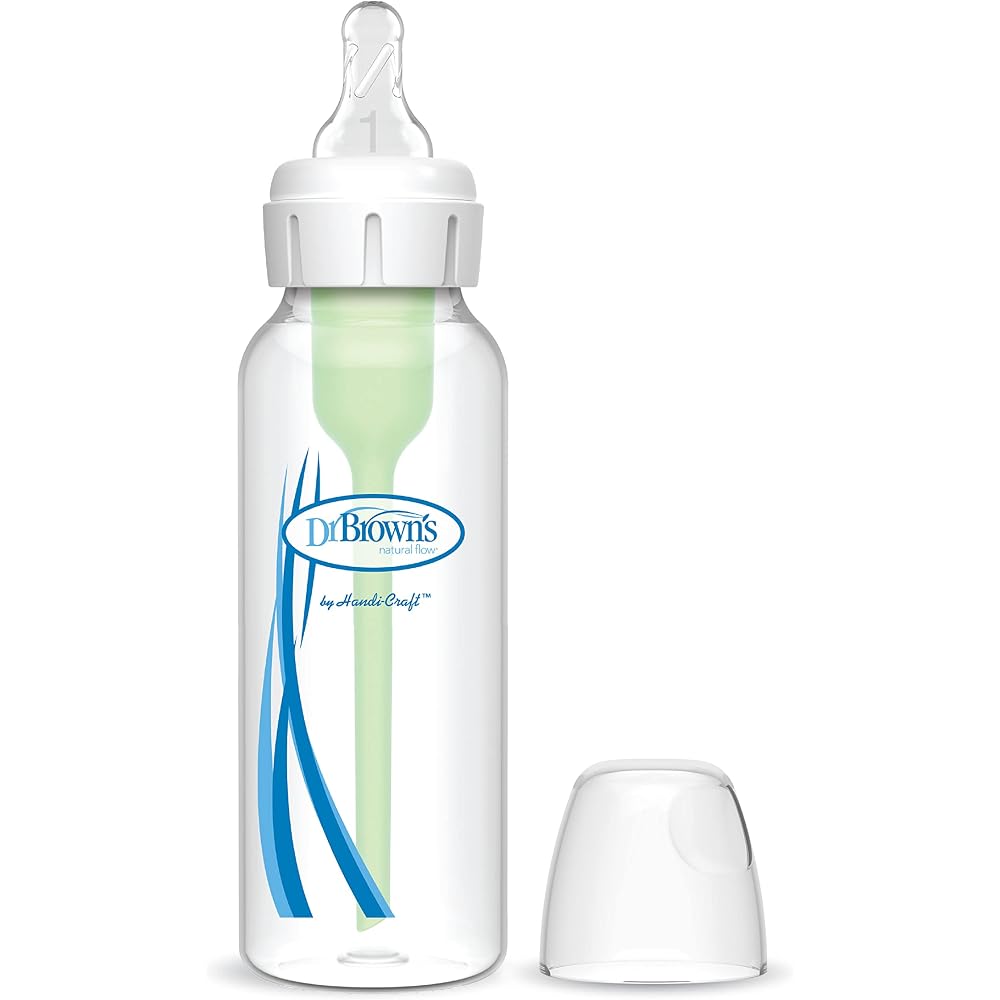
 The 8 oz Narrow with the green internal vent — the vent insert and reservoir tube route air behind the milk; the vent removes as baby grows
Anti-colic bottles · Check #34 — from the overnight review list
Dr. Brown’s Natural Flow Anti-Colic Options+ Bottles
Worth It If… your baby is gassy, reflux-y, preemie/early-feeding or came home from the NICU on Dr. Brown’s — the vent mechanism is real (air bypasses the milk, no vacuum, consistent flow) and it’s the only anti-colic vent with a clinical trial behind it, but every bottle is 5–6 parts per wash and leaks are the #1 owner complaint.
See current price ↗The pitch
the fully vented bottle the NICUs stock — air bypasses the milk, no vacuum, consistent flow, and a nipple ladder down to Ultra-Preemie
The catch
5–6 parts per bottle through every wash, and leaks are the #1 owner complaint — some units never seal right
FSA/HSA
not eligible — baby bottles are personal feeding items, not qualified medical expenses
What it is — the vented bottle the NICUs stock
The most widely used anti-colic bottle system in the US — brand copy, sourced to an IQVIA Health ProVoice Survey 2025, calls it the #1 Pediatrician Recommended Baby Bottle in the US, and it is the bottle hospitals and NICUs most visibly stock. The design is a fully vented bottle: a green internal vent insert plus a reservoir tube (“straw”) channels air that enters through the collar to the back of the bottle, above the milk, so air does not mix into the feed and no vacuum builds as the baby drinks. Silicone nipples are sold in an unusually deep flow ladder — Preemie, Ultra-Preemie, Transitional Newborn, Levels 1–4 and Y-Cut — which is a large part of why feeding therapists and NICUs default to it. Each assembled bottle is five to six parts: bottle, vent insert, reservoir tube, collar, nipple, cap. The vent is removable — that is the “Options+” part — so the bottle later converts to a nipple-vented bottle like most rivals. All parts are top-rack dishwasher, sterilizer and boiling safe; BPA-free polypropylene. This check covers the core polypropylene Options+ system (Narrow and Wide-Neck, 4 oz/120 mL and 8–9 oz, Level 1 nipple included); the glass, PPSU and newer silicone versions share the same vent idea and are priced only where the comparison decides the buy.
Claim check — “clinically proven to reduce colic”
“Clinically proven to reduce colic”
There is a real study behind the phrase — and it is much thinner than the phrase sounds. The citation on the packaging is Ellett, Gastroenterology Nursing, May/June 2006: a randomized, placebo-controlled trial run over the internet with 36 parents of colicky infants, who kept 3-day baseline arousal diaries on their usual bottles, then 2-week diaries on study bottles; babies on Dr. Brown’s spent significantly less time crying (p=.010) and fussing (p=.002) than babies on placebo bottles. That is a genuine RCT signal — and it is one small, short, parent-diary study from 2006, of the pre-Options+ Natural Flow design. The second leg of the brand’s evidence is a UK survey: in research commissioned in 2010 by Handi-Craft and its UK distributor, 75% of mothers who switched to Dr. Brown’s reported improvement in colic symptoms, 53% within three feeds — a commissioned switcher survey, not a controlled trial, and switching at peak misery is exactly when symptoms regress on their own. The independent literature is cooler: a systematic review of vented bottle/nipple systems notes the studies are limited, the assessments subjective, the aerophagia-causes-colic hypothesis itself unproven, and the evidence for vented systems on colic “very low” — and BabyGearLab’s hands-on test of the glass Natural Flow version could not tell whether its vent beat rival vents. Honest translation: the vent demonstrably does the mechanical job — air bypasses the milk, there is no vacuum, flow stays consistent and nipples don’t collapse, which owners and NICU staff verify daily. Whether that mechanical job cures colic is supported by one small old trial and a brand survey, and colic itself resolves with time. Buy it as the best-engineered anti-air bottle, not as a proven colic treatment — this check makes no medical claim either way.
“Preserves nutrients / aids digestion for a better night’s sleep”: the nutrient claim follows the same mechanism — less air mixed into milk means less oxidation of vitamins A, C and E — and it traces to the brand’s own materials and the same small evidence base; no independent measurement of nutrient retention in this bottle surfaced in this check. Treat it as plausible mechanism, brand-asserted as a benefit. “Better night’s sleep” is downstream marketing of the colic claim and gets the same discount.
“93% acceptance / breast-like nipple”: the 93% figure is from a brand-cited study of 884 babies accepting the Options+ Wide-Neck nipple. The Narrow nipple — the one most NICUs use — is a traditional, narrower shape, not a wide breast-like one; the acceptance story differs by line, and listings blur them. What is independently consistent is flow consistency: Dr. Brown’s nipples are repeatedly noted by feeding specialists and MommyHood101 for delivering the labeled flow reliably, and the Preemie/Ultra-Preemie flows are slower than almost any rival’s slowest — the concrete reason preemie and reflux-feeding programs stock this brand.
Safety & recalls — no recall of the bottles; the live file item is a lawsuit, not a recall
No CPSC recall of Dr. Brown’s bottles themselves found (checked Oct 17, 2026). The brand’s recalls are adjacent products and must not be conflated: the Lovey Pacifier & Teether Holders (CPSC, 2018, ~590,000 US units, snap detachment / choking hazard) and the Natural Bottle & Dish Soap (2017, ~23,000 units, bacterial contamination) — neither is a bottle. The live safety-file item for THIS product is a lawsuit, not a recall: on June 25, 2024, proposed class actions in California federal court (Case 3:24-cv-03782 against Handi-Craft, with a parallel case against Philips Avent) alleged the polypropylene bottles release microplastics when heated as directed (sterilizing, warming) and that the “BPA FREE” label misleads by omission. Those are allegations only — no finding, no recall — and the same material question applies to every polypropylene bottle in this category. A parent who wants out of the plastic question entirely has an in-brand exit: Dr. Brown’s sells the same vent system in borosilicate glass Options+ bottles (the vent parts inside remain plastic, sitting in the milk — glass removes the bottle-wall plastic, not all plastic contact) and in PPSU. Category rules otherwise: replace nipples at signs of wear, follow the brand’s fill and assembly guidance (overfilling and warming with the vent in are the brand’s own named causes of leaks), and do not heat milk in the bottle in a microwave (uneven heating; brand guidance is to warm without the vent assembled).
What parents say — the vent works; the parts and leaks tax you
The owner pool is enormous and split along one fault line. Target’s main Narrow 8 oz listings run 4.3/5 across ~1,689 ratings (single) and 4.5/5 across ~946–998 ratings (4-pack and 6-pack), with Babylist’s glass gift set at 4.6/5 across 482 ratings. MommyHood101’s best-bottles testing calls the anti-colic system “second to none,” found “superior colic and gas prevention” and minimal leaking except when vigorously shaking to mix formula, and lists exactly two cons: the extra vent part to clean, and glass weight on the glass version. Editorial praise clusters on: less gas/spit-up after switching (the most repeated owner story in every pool), the deep slow-flow ladder for preemies and paced feeding, consistent flow nipple-to-nipple, and NICU familiarity — a baby discharged on Dr. Brown’s can keep the same system at home. The complaint pattern is equally consistent across Target, Babylist and brand-site pools: (1) leaks — the dominant negative by a wide margin; “leaked everywhere, every time,” units that sealed for weeks then started leaking, milk wasted and babies soaked at night feeds, with owners reporting the brand’s fixes (don’t overfill, don’t overtighten, align the vent, remove the vent for warming) working for some and not others; (2) parts count — five to six pieces per bottle, a tiny vent brush required, and a full day of exclusive bottle feeding meaning dozens of small parts through the wash — owners either routinize it or quit the system over it, and twins/exclusive-pumping households feel it most; (3) narrow-neck measuring and pouring friction, and formula powder clogging the vent tube if powder is mixed in the bottle (the standard owner workaround is pre-mixing in a pitcher); (4) a measurement-accuracy grumble in a minority of reviews (ounces not matching a Pyrex measure). Counter-signal: the system’s defenders are unusually loyal — babies who refuse rival bottles after starting on Dr. Brown’s are a recurring story, including in the Babylist pool (“Babies prefer them… He does much better with these bottles”).
Price & FSA/HSA
This is commodity pricing, and the per-bottle math is the story. Target: single 8 oz Narrow $7.99; 3-pack 8 oz $16.99 (~$5.66/bottle); 4-pack $23.99; 6-pack $29.99 (~$5/bottle); the Newborn Gift Set (three 8 oz + two 4 oz, extra Level 2 nipples, caps) is $32.99 at Babylist. Dr. Brown’s own store lists a single 8 oz glass at $9.99 — retail undercuts the brand store. Glass runs roughly double: glass gift set $46.99 at Babylist, single glass 8 oz ~$10.49 at Meijer. A realistic full setup — six to eight 8 oz bottles plus a couple of 4 oz — lands around $30–$45 in plastic, less than one premium wearable-pump accessory in this library, and replacement nipples/vents are cheap and sold everywhere. The running cost is time (parts washing), not consumables: no proprietary tablets, filters or pods.
FSA/HSA: not eligible as a standard purchase. Baby bottles are personal feeding items, not qualified medical expenses — Lively’s eligibility list and Flex’s baby-items guide both state baby bottles are not HSA/FSA eligible. The narrow exceptions are specialized feeders for a medical condition with a Letter of Medical Necessity — a documentation route for a clinician-directed feeder, not checkout eligibility for Options+. Budget it as a regular purchase.
Sources: drbrownsbaby.com Options+ product pages (internal vent system description, “clinically proven to reduce colic” with the Ellett 2006 citation, #1 Pediatrician Recommended sourced to IQVIA Health ProVoice Survey 2025, 93% acceptance in 884 babies for the Wide-Neck nipple, removable-vent Options+ design, dishwasher/sterilizer/boiling safe, BPA-free) and brand colic article (UK study: 75% improved, 53% within three feeds, 36% after one feed) · drbrowns.co.uk Colic Report (2010 research commissioned by Handi-Craft and Central Medical Supplies — commissioned status stated in the report itself) · Ellett 2006, Gastroenterology Nursing, via ResearchGate abstract (randomized placebo-controlled internet trial, 36 parents, baseline 3-day and 2-week diaries, crying p=.010 and fussing p=.002 favoring Dr. Brown’s) · systematic review of vented bottle/nipple systems via ResearchGate (studies limited, subjective assessments, aerophagia hypothesis unproven, evidence for colic reduction “very low”) · mommyhood101.com best baby bottles (anti-colic system “second to none,” superior colic/gas prevention, minimal leaking except vigorous formula shaking, extra vent part to clean) · babygearlab.com Dr. Brown’s Natural Flow Glass review (borosilicate glass, vent harder to assemble/clean, testers unable to tell if its vent beat rivals, babies not gassier, plastic vent components immersed in milk) · target.com Options+ Narrow listings (single 8 oz $7.99, 4.3/5 across 1,689 ratings; 3-pack $16.99; 4-pack $23.99, 4.5/5 across 946; 6-pack $29.99, 4.5/5 across 998; owner reviews — leaks as dominant complaint, six-parts-to-wash note) · babylist.com listings (Newborn Gift Set $32.99, polypropylene BPA-free; Glass Gift Set $46.99, 4.6/5 across 482 ratings) · meijer.com glass single ($10.49) · classaction.org and greenmatters.com on the June 25, 2024 California class actions (Handi-Craft / Dr. Brown’s and Philips Avent, Case 3:24-cv-03782 — polypropylene microplastic release when heated, “BPA FREE” omission theory, allegations only) with the complaint itself via Thomson Reuters legal docs · cpsc.gov recall notice for Dr. Brown’s Lovey Pacifier & Teether Holders (2018, Handi-Craft — a different product, flagged as such) and happi.com / legalreader.com on the 2017 Natural Bottle & Dish Soap recall (~23,000 units, bacterial contamination — also not a bottle) · livelyme.com baby-bottles eligibility page and withflex.com HSA/FSA baby-items guide (baby bottles not eligible) and legalclarity.org (specialized feeders eligible only with an LMN). No Amazon ASIN was verified for the mainline plastic Options+ pack in this check, so the click-through uses the brand’s bottles page rather than an Amazon link. Check #34 — from the overnight review list, checked October 17, 2026. Some links on this page may earn WorthItMama an affiliate commission — it never changes the answer.
Worth It If… your baby is gassy, reflux-y, preemie/early-feeding or came home from the NICU on Dr. Brown’s, and you’ll accept 5–6 parts per wash and a real leak risk for the deepest slow-flow nipple ladder and the only vent with any clinical trial behind it. Not worth it if a simpler 3-part nipple-vented bottle already works for your baby.