
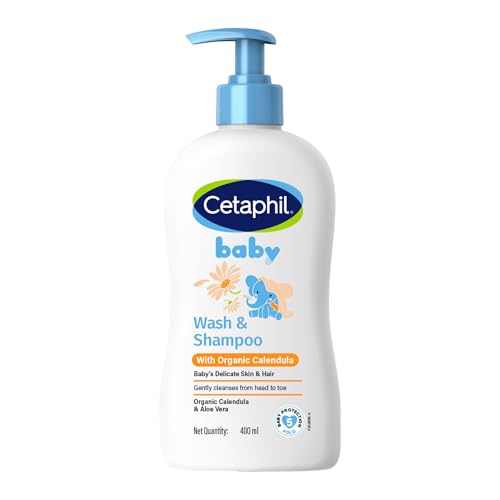
 Cetaphil Baby Wash & Shampoo (13.5 fl oz) — Amazon listing photo
Bath & Changing · Check #180 — Batch 14
Cetaphil Baby Wash & Shampoo
Worth It If…$8.97 at Amazon — ASIN B07VHR8NDF, single 13.5 fl oz bottle (pricehistory.app Amazon record, Oct 23, 2026; Target $9.39) — pinned single bottle: the 2-pack is a different listing (B09MVMNW5M, $17.49), and Amazon refused a live price read, see Price note
A rich-lathering, well-loved $9 2-in-1 whose US formula is fragranced and built on Sodium Laureth Sulfate — despite roundups calling it fragrance-free and sulfate-free, an unregulated 'hypoallergenic' label, and no published study behind 'clinically proven gentle.'
See current price ↗The pitch
tear-free, hypoallergenic 2-in-1 wash & shampoo with natural calendula, “dermatologist tested and clinically proven to be gentle on sensitive skin,” free from parabens, colorants and mineral oil
The catch
the US formula is fragranced (Fragrance 12th of 22, plus Heliotropine) and built on Sodium Laureth Sulfate (2nd ingredient) despite roundups calling it fragrance-free and sulfate-free; “hypoallergenic” has no FDA definition and “clinically proven” arrives with no published study
FSA/HSA
Not eligible — a general cosmetic cleanser for everyday hygiene, not treatment of a medical condition
What it is
A 2-in-1 head-to-toe baby wash and shampoo from Galderma: wet hair and skin, massage into a lather, rinse. The pinned bottle is the US single 13.5 fl oz / 399 mL bottle, $8.97 (model 302993936374 on the Amazon record) — NOT the 2-pack (ASIN B09MVMNW5M, $17.49) and NOT the wash-plus-lotion kit, which are separate listings with separate review pools. Bigger trap: it is also not the international “Cetaphil Baby Gentle Wash & Shampoo” (400 mL pump sold outside the US), whose formula is sulfate-free. The US formula’s main cleanser is Sodium Laureth Sulfate, 2nd of 22 ingredients. Full US ingredient list, from cetaphil.com: Water, Sodium Laureth Sulfate, Disodium Laureth Sulfosuccinate, Cocamidopropyl Betaine, Glycerin, Panthenol (Vitamin B5), PEG-120 Methyl Glucose Dioleate, Glycol Distearate, Hydrolyzed Wheat Protein, Calendula Officinalis Flower Extract (10th), Aloe Barbadensis Leaf Juice Powder (11th), Fragrance (12th), Citric Acid, Sodium Benzoate, Phenoxyethanol, Sodium Citrate, Laureth-4, Heliotropine (a second fragrance component), Polyquaternium-10, Sodium Chloride, Sodium Hydroxide, Tocopherol (Vitamin E). The moisturizers doing the heavy lifting are the plain ones high on the list — glycerin (5th) and panthenol (6th) — while the marketed botanicals sit mid-list in undisclosed amounts. Note for wheat-sensitive households: it contains hydrolyzed wheat protein, and retailer Q&A confirms the product is not gluten-free.
Claims vs. reality
- “Tear free”: an unregulated term — there is no FDA definition or standard test for “tear-free” in cosmetics. What stands behind it here is formulation, not certification: a diluted blend in which the stronger cleanser (Sodium Laureth Sulfate) is tempered by two milder co-surfactants, and the harsher Sodium Lauryl Sulfate is absent. Owners largely corroborate the result — gentle face-washing, no-sting reports, a NICU parent’s account of adequate cleaning “without hurting her eyes” — so read the claim as formulated to sting less, and usually doesn’t, not as a guarantee; the brand’s own caution on sibling listings is still to rinse eyes with water on contact.
- “Hypoallergenic”: the FDA’s own words: “There are no Federal standards or definitions that govern the use of the term ‘hypoallergenic.’ The term means whatever a particular company wants it to mean” — and manufacturers are not required to submit substantiation of the claim to FDA. In this bottle the word sits on a formula containing added Fragrance plus Heliotropine, and fragrance is the ingredient class EWG rates HIGH for allergies and immunotoxicity. A fragranced wash can be hypoallergenic in the seller’s private definition; it cannot be what most parents picture when they read the word.
- “Dermatologist tested and clinically proven to be gentle on sensitive skin”: brand language with no published study in the sources checked — no sample size, method or measured endpoint accompanies “clinically proven” on the brand page, and “dermatologist tested” (like the “pediatrician recommended” framing in retailer copy) has no standard definition either. The dermatologist quotation on the brand page is testimonial copy, not a trial report. The claim may rest on real internal testing; a buyer cannot verify any of it from what is published.
- “Free from parabens, colorants and mineral oil”: verifies true — none of the three appears anywhere in the 22-ingredient US list. This is the cleanest claim on the bottle, and the one the check can endorse without qualification.
- “Natural calendula helps soothe, moisturize and soften” + the fragrance-free/sulfate-free roundup halo: calendula and aloe sit 10th and 11th of 22, behind every cleanser, in undisclosed amounts — present, not dosed. Meanwhile the brand itself sells the scent: the wash leaves skin and hair “with a soft, fresh fragrance.” Against that label, the secondary literature is unreliable in a specific direction: at least one 2026 roundup describes this US bottle as a “fragrance-free formula” and others call it sulfate-free — both false for the US bottle (Fragrance is on the label; Sodium Laureth Sulfate is its 2nd ingredient). Those descriptions fit the international Gentle formula or the sibling CeraVe, not this product.
- The sulfate / 1,4-dioxane file, kept in proportion: EWG Skin Deep scores this product 3, with Allergies & Immunotoxicity HIGH (driven by Fragrance), Use Restrictions HIGH and Developmental/Reproductive Toxicity MODERATE. EWG flags the ethoxylated ingredients (Sodium Laureth Sulfate, Disodium Laureth Sulfosuccinate, Laureth-4, PEG-120 Methyl Glucose Dioleate) for ethylene oxide and 1,4-dioxane contamination concerns — trace manufacturing byproducts, purified down in finished cosmetics and monitored by FDA, not ingredients anyone adds. A 2026 synthesis of New York DEC waiver filings lists Cetaphil Baby Wash at 1.1 ppm 1,4-dioxane, marginally over New York’s 1 ppm personal-care limit and sold under that waiver system — cited as sourced, a trace-level regulatory footnote, not a finding of harm from a rinse-off wash. SLES itself is a mainstream surfactant with CIR safety reviews behind its cosmetic use. The honest objection is not “this will harm your baby”; it is that parents specifically shopping sulfate-free are not getting it here, whatever the roundups say.
🛡 Safety & recalls
No CPSC recall and no FDA safety action for Cetaphil Baby Wash & Shampoo found Oct 23, 2026 — it is a cosmetic, and cosmetics get no FDA pre-market approval, so “dermatologist tested / clinically proven” is the brand’s own testing language, not a regulator’s clearance. One credential to keep straight: no National Eczema Association Seal of Acceptance was found for this wash in the sources checked. The NEA-accepted Cetaphil baby products are its eczema siblings (the Eczema Soothing Lotion and Eczema Calming Wash); at least one review site transfers that acceptance to this bottle in error — do not buy this wash on an eczema credential it does not carry. The governing guidance is AAP/AAD-aligned newborn care: mild, fragrance-free cleansers, warm water for most cleaning, sponge baths until the cord stump falls off, and only about two to three baths a week for newborns because over-bathing dries developing skin — a frame in which an added-fragrance daily wash is a preference, not the paediatric default. Practical rules: patch-test a small area first and discontinue if redness or a rash appears (the minority owner file below is exactly that signal); remember the hydrolyzed wheat protein if your household avoids wheat; rinse eyes with water on contact. Information only, not medical advice.
Real reviews
Two files, kept separate. Amazon pool via pricehistory.app: 9.6/10 across 22,938 reviews — pricehistory.app’s own /10 scale for ASIN B07VHR8NDF, cited as sourced, not converted to stars. Target: 4.7/5 across 1,649 ratings. Praise, consistent everywhere: rich lather from a small amount, easy rinsing, soft clean skin and hair, and — for fans — the scent (“smells amazing,” “the scent is definitely a plus”), plus real sensitive-skin successes: “the only shampoo my sensitive skin babies can use” (5 stars, Target verified purchase, Oct 19, 2026) and a NICU parent who found it foamed and cleaned gently without eye irritation. Complaints, in order: (1) the fragrance surprise — “Beware not fragrance free. How is this hypoallergenic but still had added fragrance??? Expected more from a brand like Cetaphil!!” (3 stars, Target verified purchase, Sep 30, 2026); “Strong fragrance, not for sensitive skin as advertised… The packaging is misleading” (1 star, gift-set listing, Aug 2025); repeated “wish they would remove fragrance” notes; and Target’s own AI review summary concedes guests report “issues with irritation and strong fragrance.” (2) Irritation in a minority — including a brand-site 1-star report of a breakout in a 3-month-old (with the same reaction in a 5-month-old cousin) that cleared once use stopped. (3) Value niggles — some owners use more product than expected, and a brand-site reviewer wishes for a bigger bottle. Caveat on the Target file: many of its reviews are syndicated from Influenster or promotion-collected; the 22,938-review Amazon pool is the deeper file, and it points the same way — a well-liked wash whose one structural complaint is its scent.
Price & FSA/HSA
$8.97 at Amazon for the single 13.5 fl oz (pricehistory.app Amazon record, Oct 23, 2026, InStock) — $0.66/fl oz, and a genuinely fair buy: the record’s average is $10.20 over 2,573 tracked days. Ignore its extremes (a $22.19 spike in Aug 2025 and a $1.99 low in 2021 are stale marketplace noise). Target charges $9.39 ($0.70/fl oz) and Publix lists $10.99, so Amazon is the cheap route. The 2-pack at $17.49 works out to $8.75 a bottle — a saving of about 22 cents a bottle, no bulk game worth playing. The comparison that actually matters is formula, not price: CeraVe Baby Wash & Shampoo (check #198) is the bottle built to the brief this one’s marketing implies — fragrance-free, sulfate-free, dye-, phthalate- and paraben-free, with 3 ceramides and hyaluronic acid, and National Eczema Association acceptance — in a smaller 8 fl oz bottle at a similar shelf price. Cetaphil wins on cost per ounce, lather and scent; CeraVe wins the sensitive-skin spec sheet outright. No refills, subscriptions or system costs either way. FSA/HSA: not eligible — a general cosmetic cleanser for everyday hygiene, not the treatment of a diagnosed condition; no eligibility claim appears in the Amazon or brand records checked.
Worth It If… you want a rich-lathering, good-smelling 2-in-1 that cleans well for $0.66 an ounce and your baby’s skin tolerates fragrance, as most owners’ babies do. If you are buying it because “hypoallergenic / for sensitive skin” sounded like fragrance-free and sulfate-free, this US bottle is neither — that brief is CeraVe Baby (check #198).