
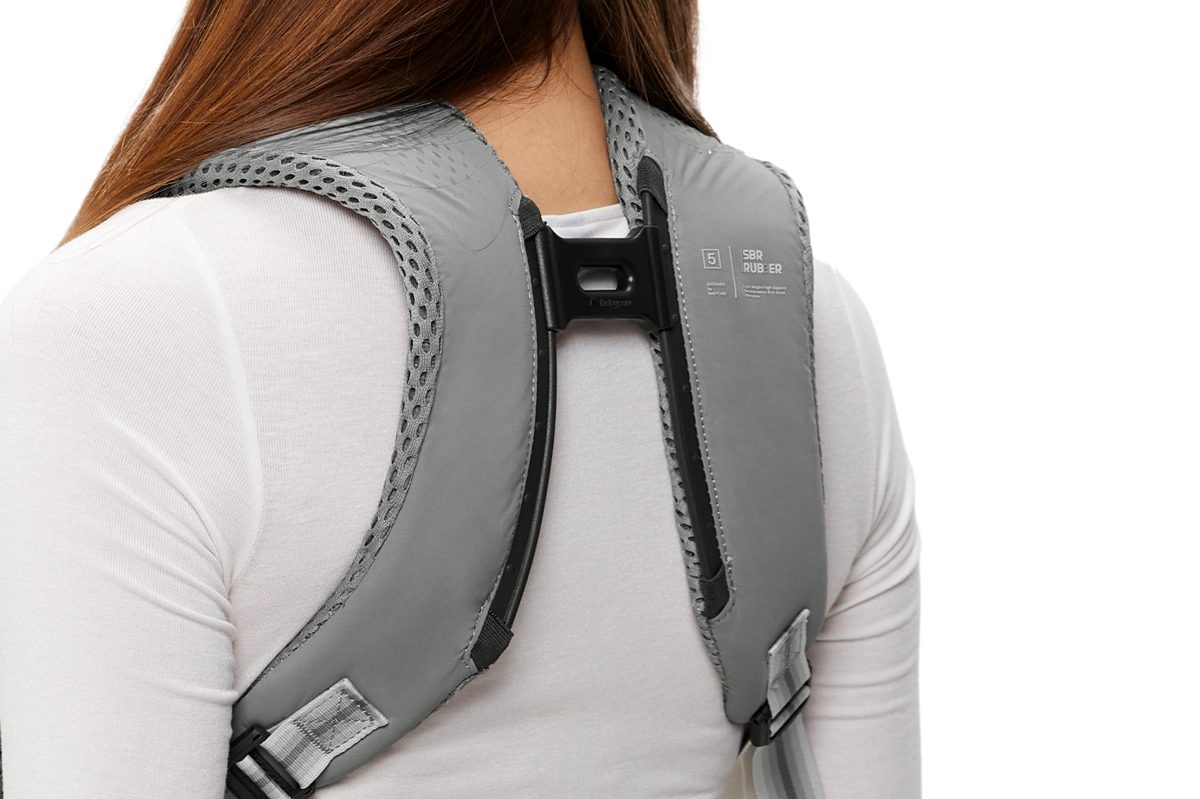
 The Hexa’s magnetic shoulder buckle — its one-hand on/off mechanism (brand close-up)
Travel & On the Go · Check #272
BC Babycare Hexa Effortless Carrier
Real effort-saving hardware — magnetic buckle, knob-tightened waistband, detachable hip seat — but ignore the “newborn cradle” pitch: the brand's own spec floors it at 6 months, sitting unassisted.
See current price ↗The pitch
Magnetic-buckle hip-seat hybrid with a knob-adjusted waistband that owners say genuinely spreads the load
The catch
Marketed “from a newborn cradle,” but the brand’s own spec floor is 6 months / sitting unassisted — and “hip-healthy” has no IHDI listing behind it
FSA/HSA
not eligible — baby carriers are general parenting gear, not a qualified medical expense
What it is
A 2-in-1 front carrier built around a structured hip seat: a padded waist belt with a seat pod (polypropylene core, per the brand spec block) that the baby sits on, plus a detachable upper panel with shoulder straps that converts the seat into a full carrier; the waist seat detaches and can be used on its own for supported sitting. Front carry only — no back-carry position appears in any brand material. The adjustment hardware is the product’s real identity: a magnetic shoulder buckle (one-hand baby in/out without rethreading straps), a rotary knob that tensions the waistband, a sliding back adjuster (stated wearer-height range 4′11″–6′3″), and extension straps (waist 23.6″–47.2″). Claimed weight window: 8–33 lbs in the page title, 13.2–33 lbs in the brand’s own spec block — the split is the headline claim check below, because it decides who this carrier is actually for. Materials: nylon/polyester straps and panel; machine washable after removing the waist-seat hardware. Checked in Stone Grey.
Claims vs. reality
The weight window and the “newborn cradle”: the headline marketing contradicts the brand’s own floor. The page hero sells “5 carry positions — from a newborn cradle to a toddler hip seat,” the page title rates it 8–33 lbs, and the FAQ’s first carrying mode is literally “Newborn: horizontal cradle hold.” Against all of that, the brand’s stricter documents say the opposite: the same page’s FAQ opens “Ideal for babies 6 months and older,” the spec block rates it 13.2–33 lbs and “perfect from 6 months when sitting unassisted,” the brand’s own Hexa blog says 6 to 36 months, and Amazon’s technical-details table gives Age Range “Toddler (6–36 months).” There is no infant insert anywhere to bridge the gap — the seat is a fixed 30° upward-tilted hip seat, a shape a newborn cannot sit on — and a horizontal, curled “cradle” is precisely the position class federal sling guidance treats with the most caution for young infants. This check pins the floor at 6 months / sitting unassisted / 13.2 lbs. “Effortless”: the mechanisms are real — the magnetic buckle, rotary knob, sliding adjuster and seat-alone conversion all verify as described, and owners corroborate them — but the same owner pool’s recurring complaint is that the upper straps are hard to adjust with a larger baby in the carrier, “a two-person job at times”: read “effortless” as easier than a standard buckle carrier for the first year, not for the whole 33 lbs. “33% Less Strain” / “scientifically proven” / “patented”: a precise number with no published source — no test, lab, study, methodology or patent number appears anywhere; the underlying design moves are the established ones for this class and owners do praise weight distribution, so “more comfortable than a basic carrier” is corroborated while “33%” is not. “Hip-Healthy Design” / IHDI: the institution’s name, without the institution’s listing. IHDI’s own Industry Partners page (fetched Oct 29, 2026) lists exactly BabyBjörn, Bvya, Little Hippy Co., Momcozy and Ergobaby — BC Babycare appears nowhere on it, and IHDI states it is not a certifying body, has never safety-tested products, and certifies or endorses nothing. A wide seat that allows the spread-squat M-position is consistent with IHDI’s general guidance — true of the whole hip-seat class (check #95) — but it confers no product-level acknowledgment on this carrier. Positions: the brand gives three counts (5 in the hero, 4 modes in the FAQ, “5 under 3 modes” in the blog); facing-out carries no published age, weight or head-control gate of its own; and the detachable seat used alone leaves the baby not strapped in at all — an adult arm stays on the baby at all times, in every direction.
Safety & recalls
No CPSC recall naming BC Babycare — this carrier or any other product — was found (searched Oct 29, 2026) — an absence, not a clearance. The documentation file, however, is the thinnest in this library’s recent carrier checks: (1) No instruction manual for the Hexa could be located — not on the brand site, not on the manual aggregators that carry BabyBjörn’s, Momcozy’s and Koala’s manuals (checks #247–#250). For a carrier the manual is the safety document — position gates, fall/suffocation warnings, inspection rules — and a buyer cannot read any of it before purchase. (2) ASTM F2236 documentation: none found for this model — no F2236 statement, no CPC, no JPMA / Baby Safety Alliance listing. Framed carriers sold in the US are legally required to comply with F2236 (16 CFR 1226), so compliance is a legal obligation — but the brand publishes nothing a buyer can check, unlike the published compliance statement check #248’s Mini carries. Category context applies with full force: the standard fall hazard (keep a hand on the baby in seat-alone mode, bend at the knees, walking only) and the suffocation cautions for any horizontal/cradle positioning of a young infant — which is why this check pins the 6-month floor as the operative rule regardless of the “newborn” copy. Premature and low-birth-weight babies sit under the standing rule: the printed minimum is a specification, not a clearance — clinician first.
Real reviews — what owners say
A thin record — no independent lab or editorial test of the Hexa was found (no BabyGearLab, no Mommyhood101 entry). Amazon, for this ASIN (B0DWWVCB6N, read via retailer mirrors of the listing): 4.6/5 across ~41 ratings — 69% five-star, 27% four-star, 4% three-star, no 1–2-star ratings in that snapshot; the mirror crawl runs months old, so treat 41 as the order of magnitude, not a live count. The praise spine is consistent and specific: weight distribution that genuinely eases back/shoulder strain, the slide lock’s quick adjustment, the hip seat’s relief on longer carries, breathable fabric in warm weather, the included storage bag. The complaint spine is narrower but converges on the claim check: upper straps hard to manage with a larger baby — sometimes a two-person job — plus some price pushback against better-known brands at this price point. The brand site’s product page displayed no rating count in the fetched page, so no brand pool is quoted. Net: a small, happy owner record that corroborates the comfort mechanics and the strap complaint in equal measure — and nothing independent behind it.
Price & FSA/HSA
$89.99 at bcbabycare.com (list $129.99), re-pinned Oct 29, 2026. Judged in its class: a hip seat alone in this library (check #95’s Tushbaby class) costs roughly this much without the carrier conversion, and the benchmark full carrier (check #60’s Ergobaby Omni Breeze) is $199 with a documentation file — public manual, stated standards, gated positions — that this check cannot match at any price. So the $89.99 buys real hardware (seat + carrier + the adjustment mechanisms) at a fair class price, and buys none of the paper trail. The value question is whether you are buying for the 6-months-to-toddler window the spec describes (where the mechanisms and owner record support the price) or for the birth-to-toddler window the headline advertises — which does not exist: a newborn solution still has to be bought, and the Hexa’s true cost becomes $89.99 plus that. No verifiable Amazon-sold US price was pinned (Amazon is agent-blocked; mirrors carry no US shelf price), and a gray-market eBay import listing at $147.24 is flagged only so nobody pays it. FSA/HSA: not eligible — baby carriers are general parenting gear, not a qualified medical expense, consistent with every carrier check in this library.
Real effort-saving hardware — magnetic buckle, knob-tightened waistband, detachable hip seat — but ignore the “newborn cradle” pitch: the brand’s own spec floors it at 6 months, sitting unassisted. Worth It If…