
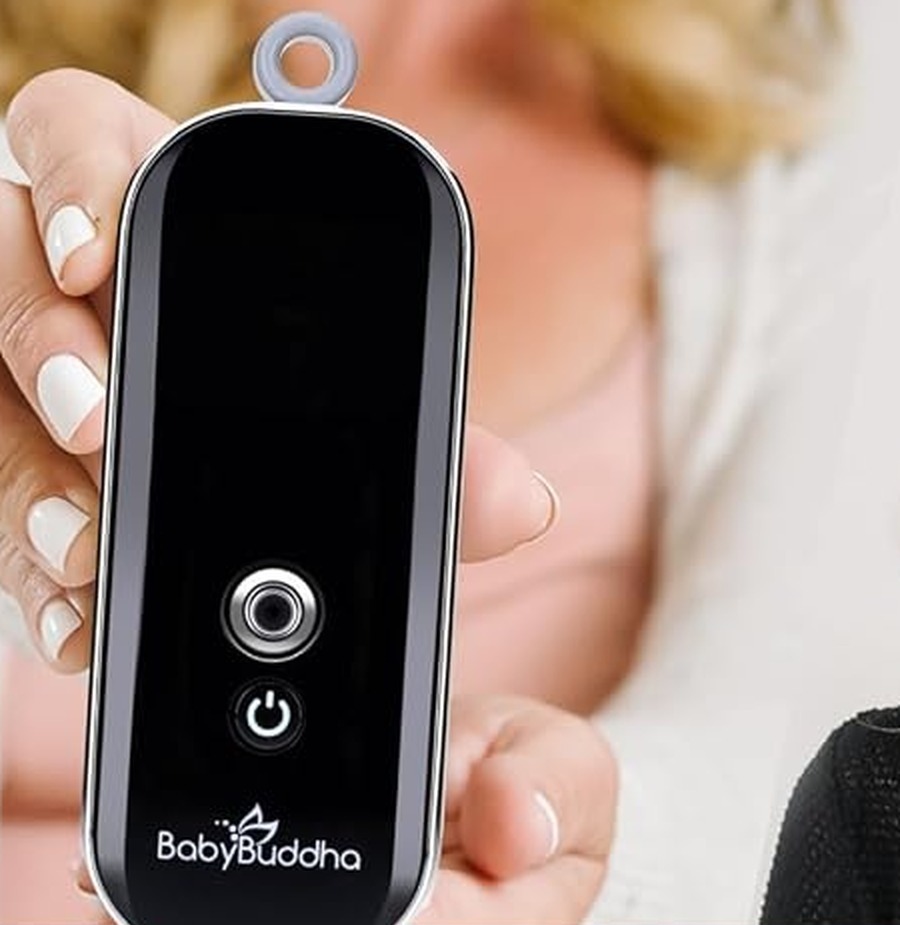
 The 2.0 motor in hand — the 6.8 oz lanyard unit, not the in-bra Wearable and not the 3.0
Feeding & Pumping · Check #225
BabyBuddha Breast Pump 2.0
A 6.8 oz lanyard primary pump with tester-verified output at low settings — held to a conditional by an unverified 320 mmHg headline, an unregulated "hospital-grade" label, and a 13–14% one-star pool reporting pain at minimum settings.
See current price ↗The pitch
hospital-grade strength in a 6.8 oz lanyard motor — 21 settings across three modes, including the new gentler Soft Stimulation mode
The catch
the 320 mmHg headline spans three conflicting figures (300/315/320), there is no controlled output test of the 2.0, and 13–14% of owners rate it one star, mostly for pain at minimum settings
FSA/HSA
eligible — IRS Publication 502; if insurance pays part, only your out-of-pocket upgrade-fee portion counts
What it is
A single-user, closed-system double-electric primary pump built around a motor smaller than the job usually allows: 6.8 oz, worn on the included lanyard or set down, USB-C rechargeable (full charge about 4 hours; it can pump while charging), with an LCD timer and a thumb trackball that walks through three modes — 6 levels of Soft Stimulation (the 2.0’s headline addition), 6 of Classic Stimulation and 9 of Expression, 21 settings in total. The standard kit brings two 24mm flanges, two 22mm massage cushions, duckbill valves, silicone diaphragms, bottles, tubing with a T-connector, a lanyard and a tote — but kit contents vary by listing and date, and newer listings ship an EasyFit kit with ten smaller inserts instead. “Hands-free” here means lanyard motor plus tubing plus a pumping bra; true in-bra pumping needs the brand’s Hands-Free Collection Cups, a $39.99 add-on. Even the warranty conflicts: Babylist and Edgepark state 2 years up to 600 hours; Aeroflow and the manual summary state 1 year.
Claims vs. reality
“Hospital-grade” certifies nothing. There is no FDA definition of “hospital-grade” for breast pumps — FDA guidance uses “multiple user” vs. “single user,” and this is a single-user Class II device. The brand’s own settings guide concedes the 2.0 is “not classified as a rental-grade hospital pump”, and its “CPSC-certified and FDA-approved” wording rests on SGS chemical testing — neither phrase works the way it reads. The suction number is unverified: brand-backed sources give three maxima for the same pump — 320, 315 and 300 mmHg — with no per-level table and no cycle-rate figures published at all. The only independent gauge test in the family, BabyGearLab on the original, measured 290 mmHg and about 0.45 oz/min, slower per minute than the Spectra S1’s verified 270 mmHg and about 0.55 oz/min. No controlled output test of the 2.0 exists; what is verified is tester output at low settings (The Bump’s 2026 panel: about 4 oz per breast on expression level 2) and that suction and cycle speed are linked in fixed patterns, where the Spectra adjusts them independently. The Soft Stimulation fix is real — two 2026 hands-on programs found it much more comfortable than the original — but both warn low settings are still too powerful for some.
Safety & recalls
No CPSC recall naming BabyBuddha was found on Oct 26, 2026. The posture is the standard one for this class, stated plainly because the brand’s page blurs it: a single-user powered pump — do not share it or buy it used as a shared device. The closed system and anti-backflow diaphragms are the hygiene mechanism, and they only work if wear parts are replaced on schedule (duckbill valves and diaphragms every 1–3 months, flanges every about 6 months). The brand’s own FDA 510(k) number was not verified in this check — a clearance number circulating in secondary material belongs to a different manufacturer and is not cited here. No medical advice is offered or implied: persistent pain while pumping at any setting is a stop-and-ask-a-lactation-professional signal, not a settings problem to push through — the manual’s own troubleshooting says the same.
Real reviews — what owners say
The Amazon pool for this listing is genuinely polarized, and the shape is the finding: 4.1/5 across about 1,668 ratings, roughly 68–69% five-star and 13–14% one-star — a one-star bloc three to four times a healthy pump listing’s. The five-star story is consistent: the strongest emptying owners have had from anything this small, faster sessions than their previous pump (the Spectra S2 is named repeatedly), a motor that disappears into a pocket, and exclusive pumpers running it as their only pump. The one-star story is the same feature with the sign flipped: suction too powerful or painful even at the lowest settings, followed by no settings lock — the trackball bumps in a pocket and changes levels mid-session. The smaller Babylist pool runs warmer, 4.6/5 across 132 ratings (74% five-star, 3% one-star), but recent reviews there include motors failing or fading within one to three months next to five-star long-haul reports. Which camp a buyer lands in is mostly decided by how their body answers strong, long-pull suction — which is why the insurance and returns route matters more here than for most pumps. Plan on about 60 minutes of battery, whatever the “up to 4–5 sessions” copy says.
Price & FSA/HSA
$214.99 at Amazon (list $254.99); $179.99 at Babylist. Check insurance before either number — for this pump the cash price is usually the wrong comparison. BabyBuddha is an upgrade-fee pump only: no fully covered version exists (one supplier quoted a $100 upgrade fee for the 2.0; fees vary by plan and supplier). The real menu is typically a fully covered pump at $0 (the Spectra S2 on most plans, check #18) vs. this pump at your upgrade fee vs. the Spectra S1 at a roughly $29–$99 upgrade fee — or $214.99 cash for a second pump while keeping the covered one. Recurring costs belong in the total: diaphragms $7.99, tubing and T-connector kit $7.99, flange kits $14.99–$21.99, insert pairs $12.99, bottles $12.99–$14.99, plus the $39.99 collection cups if “wearable” is why you are buying. FSA/HSA: eligible — breast pumps and lactation supplies are qualified expenses under IRS Publication 502, and replacement parts qualify on the same basis. If insurance pays part, only your out-of-pocket upgrade-fee portion is the FSA/HSA amount — never claim the covered amount twice.
A 6.8 oz lanyard pump whose strong suction and portability are real — tester-verified output at low settings and a roughly 69% five-star owner pool — but whose headline numbers are not: “hospital-grade” is an unregulated label, the 320 mmHg peak is unverified and contradicted by the brand’s own 300/315 figures, and a 13–14% one-star bloc finds even the lowest settings painful. Buy it through your upgrade fee, not at cash price. Worth It If…