
 The best-documented newborn carrier in this batch — public manual, stated standards, lab-verified ease
Travel & On the Go · Check #248
BabyBjörn Baby Carrier Mini, 3D Jersey (Light Beige)
The best-documented newborn carrier in this batch — public manual, ASTM F2236 stated, named on IHDI’s page, lab-verified easiest to load — bought as a first-months specialist you retire around 15–17 lbs, at $79.99, not $119.99.
See current price ↗The pitch
Newborn specialist from 7 lbs and 21 in: detachable front for sleeping transfers, facing-out from 5 months, ASTM F2236 compliance stated, and BabyGearLab’s top ease-of-loading scores
The catch
No waist belt — testers and owners retire it around 15–17 lbs despite the 24 lb rating, so a second carrier is a planned cost; the brand publishes two maximums (24 current vs 25 in the manual)
FSA/HSA
not eligible — baby carriers aren’t a qualified medical expense
What it is
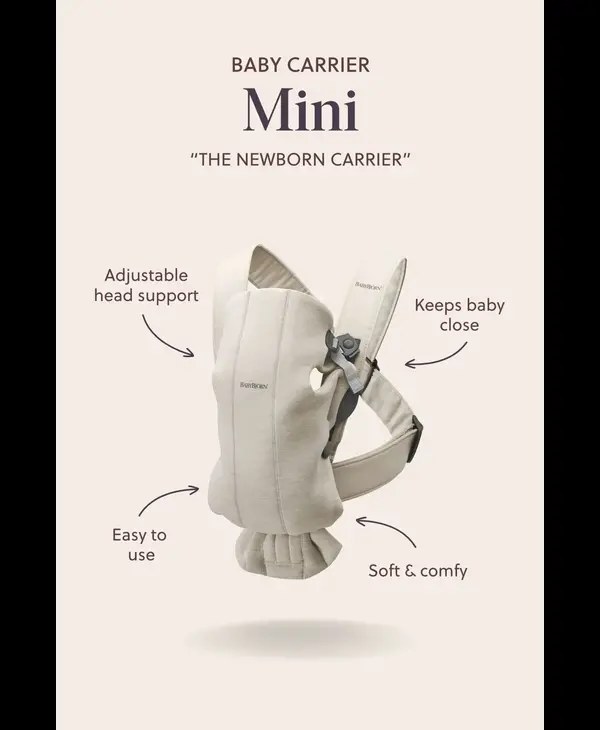
BabyBjörn’s smallest structured carrier: a two-piece front carrier — a harness the adult wears (crossed back straps, no waist belt) plus a detachable front section that unfastens completely so a sleeping baby can be lifted out still lying in it. The pinned variant is the Mini in 3D Jersey, Light Beige (ASIN B0BTFQMX7H): main fabric 80% polyester / 16% cotton / 4% elastane, harness 100% cotton, all materials OEKO-TEX Standard 100 Class 1 — consistent across the owner’s manual, brand product facts and listing spec tables. Built for short sessions in the first months: brand facts scope it 0–12 months, and every serious source treats it as a newborn specialist you graduate from. Sizing: wearer fit XS–XL; baby length is set by a double buckle inside the seat (smallest, 21 in, for a newborn), and leg straps are mandatory for babies 7–10 lbs. Accessories (bib, winter cover) are sold separately. One spec could not be pinned: the carrier’s own weight (published figures conflict from 0.5 to 1.76 lb, the higher figures reading as package weights); every hands-on source calls it light and compact, and no verdict figure depends on the exact number. This check is the Mini only — the library’s Harmony check (#208) is a different, larger carrier, and none of its facts are imported here.
Claims vs. reality
The weight window: the brand publishes two maximums, and the manual disagrees with the current page. The minimum verifies cleanly and identically everywhere: 7 lbs (3.2 kg) AND 21 in (53 cm) — both conditions, from the manual’s first page. The maximum splits: the brand’s current product facts and FAQ say 24 lbs (11 kg), with outgrowing also at 29.5 in or age 1; the owner’s manual (021056US) says 25 lbs (11 kg); the Amazon title for this ASIN says “7-25 lbs” while its own details table says 7–24 lbs. The root is arithmetic — 11 kg is 24.25 lbs, rounded down by the current brand pages and up by the manual. This check pins 24 lbs and prints the conflict rather than resolving it silently. Carry positions: facing-in plus a real facing-out — and a hard no on back carry. Brand FAQ and manual agree: facing-in from birth, and facing-out from 5 months with the head support folded down (the manual’s reasoning is developmental, matching conservative facing-out guidance). The “three carrying positions” line counts newborn facing-in, facing-in and facing-out — three settings, all front carry. Back carry is not merely absent: the manual warns “this baby carrier must not be used as a back carrier.” “Hip-healthy” / IHDI: the strongest verification in this batch — and still not a certification. IHDI’s own page lists BabyBjörn as an Industry Partner and names “BabyBjörn Baby Carrier Mini” by name — while stating it “is not a certifying body,” does “not certify or endorse products,” and that “no baby carrier can cause or prevent hip dysplasia.” Two honest footnotes: the brand discloses that BabyBjörn financially supports IHDI as a donation-making strategic partner; and the Mini’s design record is more mixed than the badge implies — BabyGearLab scored its child-comfort adjustment at 2.0/10, the lowest in its table (see reviews). “Ergonomic for you & your baby” and “easy to put on”: the ease verifies independently; the parent-ergonomics half does not. BabyGearLab gave the Mini Ease of Use 8.0, Put On 9.0 and Put Baby In 10.0 — the detachable-front design genuinely is the solo-parent, sleeping-transfer mechanism the brand describes. But there is no waist belt, so the load rides on shoulders and upper back, and both testers and owners converge on the consequence: fine for newborns and short sessions, a strain as the baby grows.
Safety & recalls
No CPSC recall naming the Baby Carrier Mini was found (cpsc.gov and web searches, Oct 28, 2026) — stated as an absence. The only BabyBjörn carrier recall in the record is the 1998/99 Baby Carrier Original (leg openings too large) — a different, discontinued product, named here only to keep it out of this check’s file. Compliance, by contrast with both Momcozy checks in this batch, is published and checkable: the Mini “complies with both the European EN 13209-2:2015 and the American ASTM F2236 safety standards” (brand facts; the manual states the same), and this ASIN’s listing carries Baby Safety Alliance certification (the body formerly known as JPMA; the registry listing itself was not independently fetched). The manual’s warnings are the full standard set and are the operative rules: suffocation hazard — “infants under 4 months can suffocate in this product if face is pressed tight against your body,” don’t strap too tight, allow head movement, keep the face free from obstructions at all times, never lie down or sleep with the baby in the carrier, with premature infants, infants with respiratory problems and under-4-months at greatest risk; fall hazard — leg straps mandatory at 7–10 lbs, bend at the knees never the waist, walking only; plus no driving/cooking/sports use and a check of buckles and seams before every use. Premature and low-birth-weight babies sit under the same standing rule as every carrier here: the 7 lb / 21 in floor is a minimum specification, not a clearance — clinician first.
Real reviews — what owners say
Pools kept separate, with one syndication warning. Amazon, this ASIN (Light Beige 3D Jersey): 4.7/5 across 6,068 ratings (“1K+ bought in past month” in the same crawl). Target, this exact variant: 4.8/5 across 1,023 ratings / 969 reviews — with the caveat that Target’s pool syndicates many reviews “originally posted on babybjorn.com,” so it overlaps the brand pool (brand site, Mini all fabrics: 4.8/5 across 904) and the two must not be added together. Independent tests: BabyGearLab files the Mini as “Other Notable” rather than a top pick — ease scores above; child comfort Fabric 4.0 / Adjustment 2.0 / General 6.0; no overall score for the Mini was published in the pages fetched and none is invented here. Mommyhood101 (Best Baby Carriers of 2026) prices the window honestly: “perfect for birth to about 6-8 months… you’d be better off with a more full-featured baby carrier for a child over about 17 pounds. The lack of a waistband… is our primary concern.” MadeForMums: 4.1/5 (“fiddly to start with,” only lasts until a year). The owner praise spine: easiest solo on/off in the batch, sleeping-baby transfers, soft non-bulky fabric, machine-washable in practice. The complaint spine converges with the testers: outgrown/heavy fast (“once we hit 15/16 pounds it got a bit heavy”), shoulder and back strain with no waistband, first-assembly fiddliness — and one specific, recent flag printed at full size: a verified-purchase Target review (Oct 25, 2026) reports the plastic clasp between the baby’s thighs leaves a red mark after each use. Net: the warmest and largest owner file of this batch, agreeing with the labs about both the delight and the expiry date.
Price & FSA/HSA
No price-tracker record for this exact ASIN was found (flagged, not filled in), and the US brand-site price was not verified in this pass, so the shelf is pinned to retailer records for this exact variant: $79.99 at Target (in stock) and from $79.99 at Babylist for the Light Beige 3D Jersey, against $119.99 at Kohl’s and Amazon “new (5) from $119.99” (other sellers, no clean Amazon-sold price in the record). The honest band is $79.99–$119.99, and $79.99 is the price to pay — a $40 spread on an identical product is a patience test, not a quality signal. Judged at $79.99 against this batch: check #246’s WeeSnug ($59.99) is $20 less for the same facing-in newborn job, but publishes no manual or ASTM statement and has no independent test — the Mini’s $20 buys exactly that documentation-and-testing file. Against the library’s bigger shelf, the Mini is a first carrier, not an only carrier: budget the graduation purchase (a waist-belt carrier — check #208’s Harmony class, or check #60’s Ergobaby Omni Breeze at $199) into its true cost, because the evidence says its comfortable life ends around 15–17 lbs whatever the 24 lb rating says. Resale softens this: BabyBjörn carriers hold value unusually well secondhand (a general brand pattern, not a Mini-specific verified figure). FSA/HSA: not eligible — baby carriers are general parenting gear, not a qualified medical expense.
The best-documented newborn carrier in this batch — public manual, ASTM F2236 stated, named on IHDI’s page, lab-verified easiest to load — bought as a first-months specialist you retire around 15–17 lbs, at $79.99, not $119.99. Worth It If…