
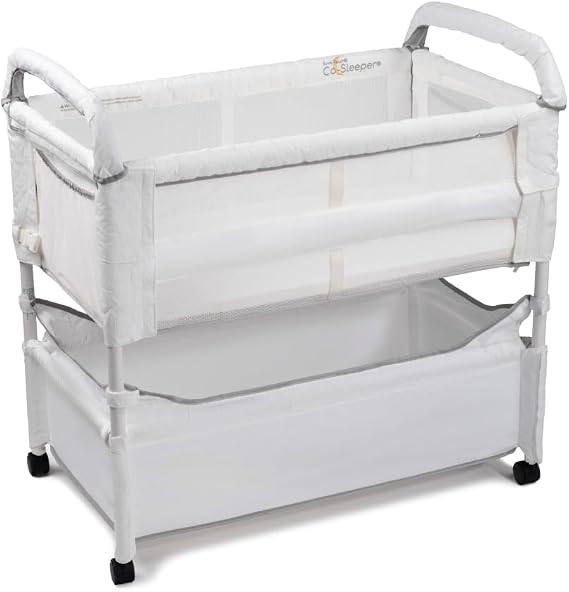
 Arm’s Reach Clear-Vue Co-Sleeper — Arm’s Reach product photo
Sleep · Check #114 — Batch 8
Arm’s Reach Clear-Vue Co-Sleeper Bassinet
Worth It If…$199.99 at Target · $219.99–$220 list; Amazon price not verified for the pinned listing · See it on Amazon ↗
BabyGearLab's Best Overall Bassinet with its best-tested sleep surface — but your bed must be 24–30″ high and the real limit is 18 lbs, not 30.
See current price ↗The pitch: See your baby at all times, right at your bedside, on wheels with storage
The catch: Bed must be 24″–30″ high, anchor strap and liner discipline every use, and a frustrating two-person setup
What it is
A bedside sleeper / freestanding bassinet on four locking castor wheels (model 7003 family) — the original strap-to-the-bed form factor. In bedside mode the included nylon strap and resistance plate anchor it to the adult bed with one side lowered; freestanding, all sides come up. Mesh on all four sides down to mattress level. In the box: the 1″ mattress pad (the federal maximum), one fitted polyester sheet, the strap & plate, and the group’s deepest under-bassinet storage basket. Legs adjust in 2″ steps for adult beds 24″–30″ high (floor to mattress top), no extension kit to buy. BabyGearLab measured 34.5″L × 20.3″W × 34.8″H at 22.1 lbs (brand copy prints 34″ × 20″ × 31″ / 25 lbs — flagged in the full check). No electronics. Not the Mini Ezee/Mini siblings, the Cambria, the Versatile, or the discontinued Original/Universal models named in the 2011 recall.
Claims vs. reality
- “Co-sleeper” vs. the AAP — it is room-sharing, and that distinction is the safety case. The AAP recommends room-sharing — baby in your room on their own separate, firm, flat surface — for at least the first 6 months, and does not recommend bed-sharing under any circumstances. Strapped to the bed, on its own pad, behind its own barrier, this is the AAP-compliant version of close sleep; the brand’s name and copy (“sleep comfortably next to each other,” “safely explore co-sleeping”) use the word the way marketing does, not the way the AAP does. The manual’s geometry is the discipline: lowered rail at or below your mattress top, bassinet pad at least 4″ below the rail, gap to the bed no more than 1/2″ — and a baby who falls asleep in the adult bed goes back.
- Height range 24″–30″ — real, built-in, and a hard floor. Four 2″ steps cover most standard beds. Below 24″ — low platform frames — the rail would sit above your mattress, breaking the manual’s rule and leaving a barrier to lift over: the fit test is pass/fail, so measure floor-to-mattress-top before ordering. Above 30″ fails the same way in mirror image.
- The window is 18 lbs / push-up / ~5 months — the “30-lb” figure is a different product. BabyGearLab’s tested spec table gives 5 months or 18 lbs, stop at push-up; the brand’s own copy states ~5 months or push-up and prints no weight limit. The 30-lb figure in the queue and some listings traces to the discontinued Original Co-Sleeper (30 lbs bedside / 50 lbs as a play yard) and is rejected for this model; a lone 23-lb record is an uncorroborated outlier. Budget ~4–5 months, about $40–$55/month — the same runway as check #101’s HALO, at a lower sticker.
- Visibility, access and mobility verify — setup is the price. BabyGearLab ranks it one of the most accessible bassinets in its group and confirms the see-through mesh from bed level (Breathability 7.0 — average, because corner panels are solid fabric). The four locking wheels roll it room to room (never with the baby inside) — the direct answer to the HALO’s fixed pedestal. But the lab’s setup took 29 minutes, 58 with a redo, because the manual omits basics like rail direction: budget an hour and two adults, before the baby arrives.
- The sleep surface is the best BabyGearLab has tested — the materials are its worst score. Sleep Surface 9.0: the 1″ pad is stable, snug and Velcro-secured, with no low spots. Eco-Health 3.0 is the lowest in the program: no flame retardants, but a polyurethane-foam pad on an MDF board and a polyester sheet (the organic sheet is sold separately). Owners notice the same split — sturdy and tilt-free, but “frumpy” and synthetic-feeling to some hands.
Safety & recalls
No CPSC recall for the Clear-Vue (7003 family) in checks run Oct 22, 2026. Two brand actions are named so they are neither confused with it nor read as reassurance: (1) the 2011 CPSC recall (~76,000 Original/Universal sleepers, 1997–2001) — if the fabric liner was not used or not securely attached, babies could fall into the loose fabric or become entrapped at the mattress edge (10 reports, no injuries). Those are different, discontinued models — and the lesson is this product’s discipline: liner installed and fully attached, re-checked after every wash; a used unit missing its liner, strap or plate is incomplete — do not buy it. (2) Health Canada’s 2019 notice included the Clear-Vue (7003-N, ~69 Canadian units) for not being tested to Canadian requirements — a certification issue with no hazards or injuries reported, not a defect finding; Canadian buyers should treat it as live. Every bedside use: strap & plate tight, gap ≤1/2″, straps checked; only the included pad and sheet; back to sleep, bare basket; stop at 18 lbs / push-up / ~5 months. The manual itself warns it is not a crib and is never for unattended sleep.
Real reviews
Pools kept separate. Target (Gray): 4.7/5 across 32 ratings / 31 reviews — small and warm: owners praise the four-leg sturdiness (“legs on all 4 sides… doesn’t tilt”), the wheels-plus-storage combination, mesh visibility and night-feed access, and one family bought it again for a second child 5.5 years later; the one detailed detractor found the materials cheap-feeling and synthetic while still using it. BabyGearLab: 77/100, #2 of 11, Best Overall Bassinet (Ease of Use 8.0, Sleep Surface 9.0, Quality 8.0, Breathability 7.0, Eco-Health 3.0). Ubuy’s mirror of the current Amazon listing shows 5.0/5 across a single rating — no weight given, and no Amazon star average was verified for either listing. No Wirecutter or Mommyhood101 test of this model exists in the reachable record. Complaint spine: the manual and setup, materials feel and frumpy finish, the arduous Velcro strip-down for washing (line-dry only), no fold for car travel, and the short ~4–5-month runway.
Price & FSA/HSA
$199.99 at Target (Gray — out of stock at check time, so it is the street anchor, not a buyable shelf that day); $219.99 at Jillian’s Drawers (Grey or White) and $220 list at BabyGearLab. Amazon’s price for the pinned listing was not verified — the Amazon page rendered only its spec table (see the full check’s pin note). Against the library: check #101’s HALO BassiNest 3.0 is $249.99 — the Clear-Vue is $30–$50 less, trades the swivel and press-down wall for a strap-on lowered side, and answers the HALO’s two loudest complaints (wheels instead of a fixed 34″ pedestal; no measured tilt) while scoring lower on breathability and eco-health. The box is complete for bedside use — mattress, sheet, strap & plate, no extension kit to add; extra/organic sheets and the upgraded pad are separate (prices not verified). FSA/HSA: not eligible — a bassinet is general baby gear (checks #10/#13/#101).
Bottom line: BabyGearLab’s Best Overall Bassinet (77/100) with the best-tested sleep surface in its program (9.0) — a wheeled, strap-to-the-bed sleeper for $30–$50 less than the HALO. But “co-sleeper” means room-sharing on a separate surface, never bed-sharing; your bed must measure 24″–30″ to the mattress top; and the real limits are 18 lbs / push-up / ~5 months — not the 30 lbs in some listings.